



Precision Machining Series – Part 1: Definition, Processes, and Material Compatibility
Precision machining is a manufacturing process that allows for the production of high quality, accurate components with desirable surface finishes and tight tolerances. The process encompasses a wide range of machining operations—including turning, milling, grinding, drilling, gear cutting, and honing—that are used to form the workpiece into the final shape and design. Heat treatment is often applied to precision machined parts and products. This practice adds several additional operations such as carburizing, quenching, tempering, nitriding, carbonitriding and freezing.
Through precision machining, manufacturers can produce a wide range of complex parts and complete assemblies. Some of the key end-markets that employ precision machined parts and products include the industrial equipment, aerospace, medical, automotive, and consumer electronics industries.
How Does Precision Machining Work?
Most precision machining workflows require some level of computer numerical control (CNC) programming. This programming allows the machines to convert specialized designs into exact shapes through multiple dimensions.
There are several processes that comprise precision machining, and they may be combined with additional operations, such as heat treatment and surface treatment or inspection, to produce finished parts and products.
An example precision machining process may proceed as follows:
- Pre-heat Treatment Machining – Soft machining operations – such as CNC turning, CNC milling, drilling, and gear cutting – typically start off the precision machining process. Before fine details can be machined into metal blanks and stock, excess material is removed, and both exterior and interior shapes are established. In CNC milling, for example, a blade creates uniform, precise cuts to create custom parts with tight tolerances.
- Heat Treatment – Heat treatments are implemented to make metal workpieces stronger, tougher, and more resistant to wear. They ultimately improve the mechanical performance of resulting parts. Tempering, a commonly implemented heat treatment, can reduce the brittle quality of metals such as 1045 and A36 mild steels and 4140 and 4240 alloy steels. Other heat treatments include carburizing and carbonitriding, quenching, nitriding, carbonitriding as well as freezing.
- Post-Heat Treatment Machining – By this stage, metal workpieces are much harder and require specialized equipment – such as diamond-tipped tools – in order to proceed with additional fine-tuning operations. Turning, grinding, gear grinding, and honing each act on post-heat-treated parts to create smooth surfaces, and can also be used to make gear teeth and bores.
- Additional Process – The additional steps in the precision machining process encompass deburring, inspection and measurement, and assembly. If, for example, any excess materials or surface deformations are left on parts from the previous steps, deburring will remove them by manual, mechanical, or chemical means).
We cover each of these processes in detail in our upcoming eBook, “A Complete Guide to Precision Machining: Components, Process Types, and Future Market Outlook.”
What Materials Are Compatible With Precision Machining?
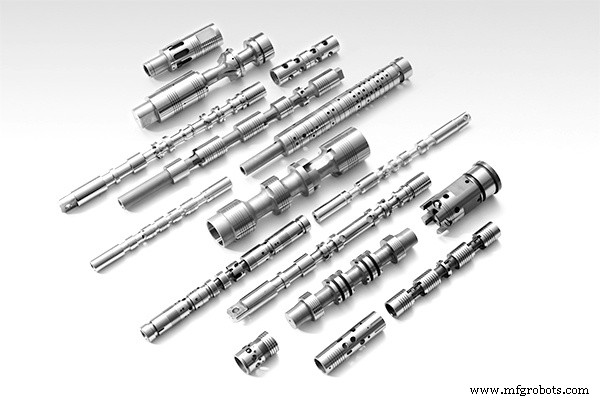 Precision machining is suitable for a wide range of materials. Standard material options include alloy steel, carbonsteel and structural steel, stainless steel, tool steel, aluminum alloy and copper alloy. Examples of the specific metal alloys that can be utilized in precision machining include:
- Aluminum alloys (2011-T3, 2024-T4, 6061-T6/T6511, 7075-T6)
- Carbon and structural steel (1010 1020, 1045, C60, Q345B, St52)
- Stainless steel (including 300- and 400-series alloys and more)
- Copper alloys (P31C, C36000, Alloy 18)
By machining these materials, manufacturers can produce products in a variety of profiles, such as bar, tube, and hexagonal profiles.
Precision Machining Services at Impro
Precision machining presents an ideal solution for organizations seeking high quality, precision components. Tooling and fixture design & manufacturing, precision machining, heat treatment, surface treatment, inspection and measurement, and assembly operations work together to create finished products from a wide range of raw materials, including aluminum, copper, carbon steel, and stainless steel.
In the next installments of this precision machining blog series, we will also talk about the kinds of equipment used to work these metals and alloys into the excellent quality components used in Aerospace, hydraulic equipment, automotive, medical and many other industrial applications.
At Impro, we are proud to be an industry-leading manufacturer of high-complexity and mission-critical machined components. We dedicate ourselves to offering customers quality products and services at reasonable costs.
To learn more about our precision machining services and capabilities, contact us today or download our upcoming eBook, “A Complete Guide to Precision Machining: Components, Process Types, and Future Market Outlook.”
Industrial Technology
- Plasma Cutting Explained: How It Works and Key Benefits
- Electrochemical Grinding Explained: How It Works & Key Benefits
- Plasma Arc Machining (PAM): How It Works and Its Industrial Applications
- Electrical Discharge Machining (EDM): How It Works and Why It Matters
- Understanding Ransomware: How It Works & Why It Matters
- Understanding LED StarBoard: Design, Function, and Heat Dissipation Benefits
- Optocoupler Basics: Function, Types, and Practical Applications
- Vacuum Tube Diodes Explained: Function, History, and Modern Applications
- Refrigerator Alarm: The Smart Solution to Keep Your Food Fresh
- Precision Machining Series – Part 2: Ideal Industries, Applications & Sample Products