



Electrochemical Machining (ECM): Principles, Equipment, Benefits, Drawbacks, and Practical Applications
Electrochemical machining (ECM) is a machining process in which electrochemical process is used to remove materials from the workpiece. In the process, workpiece is taken as anode and tool is taken as cathode. The two electrodes workpiece and tool is immersed in an electrolyte (such as NaCl). When the voltage is applied across the two electrodes, the material removal from the workpiece starts. The workpiece and tool is placed very close to each other without touching. In ECM the material removal takes place at atomic level so it produces a mirror finish surface.
- This process is used to machine only conductive materials.
Working Principle
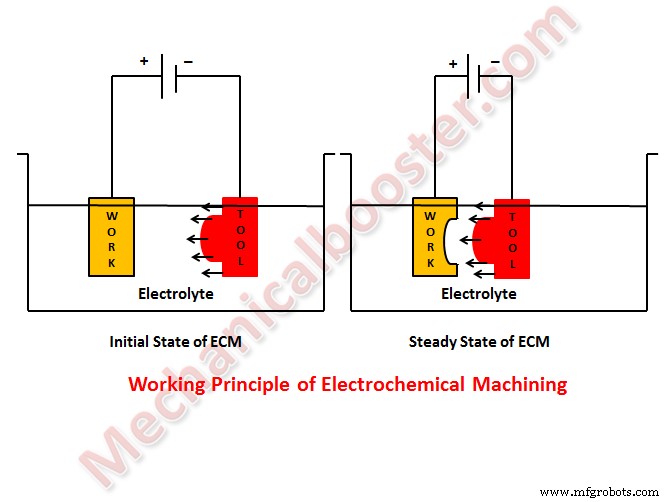
ECM working is opposite to the electrochemical or galvanic coating or deposition process.
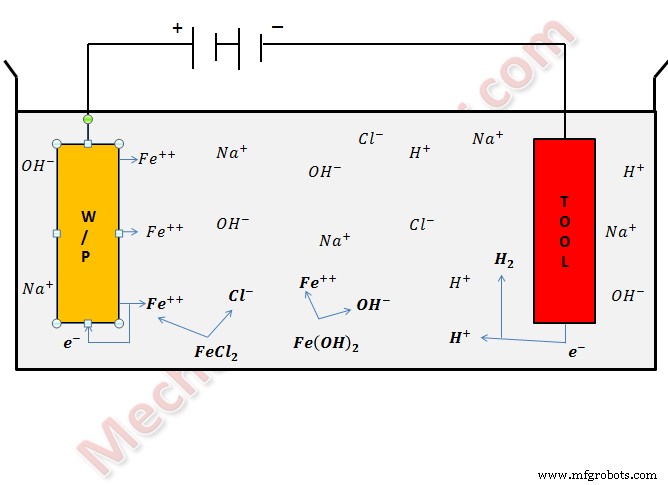
During electrochemical machining process, the reactions take place at the electrodes i.e. at the anode (workpiece) and cathode (tool) and within the electrolyte.
Let’s take an example of machining low carbon steel which is mainly composed of ferrous alloys (Fe). We generally use neutral salt solution of sodium chloride (NaCl) as the electrolyte to machine ferrous alloys. The ionic dissociation of NaCl and water takes place in the electrolyte as shown below.
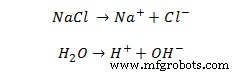
As the potential difference is applied across the electrode, the movement of ions starts in between the tool and w/p. The positive ions moves towards the tool (cathode) and negative ions move towards the workpiece.
Also Read:
- Ultrasonic Machining (USM) – Main Parts, Working Principle, Advantages and Disadvantages with Application
- Water Jet Machining – Working Principle, Advantages and Disadvantages with Application
- Laser Beam Machining – Main Parts, Principle, Working with Application
At cathode the hydrogen ions takes electrons and gets converted into hydrogen gas.
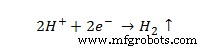
In the same way the iron atoms comes out from the anode (w/p) as Fe++ ions.
Within the Electrolyte, the sodium ions combines with Hydroxyl ions and form sodium hydroxide and ferrous ion combine with Chloride ions and forms ferrous chloride. Also iron ions combine with hydroxyl ions and form Iron hydroxide.
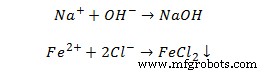
In the electrolyte, the FeCl2 and Fe(OH)2 produced and gets precipitated in the form of sludge and settle down. In this way material is removed from the workpiece as sludge.
The various reactions taking place in the Electrochemical machining process are in the figure given below.
The ECM system has the following modules or Main Equipment of ECM
- Power Supply
- Electrolyte filtration and delivery system
- Tool Feed system
- Working Tank
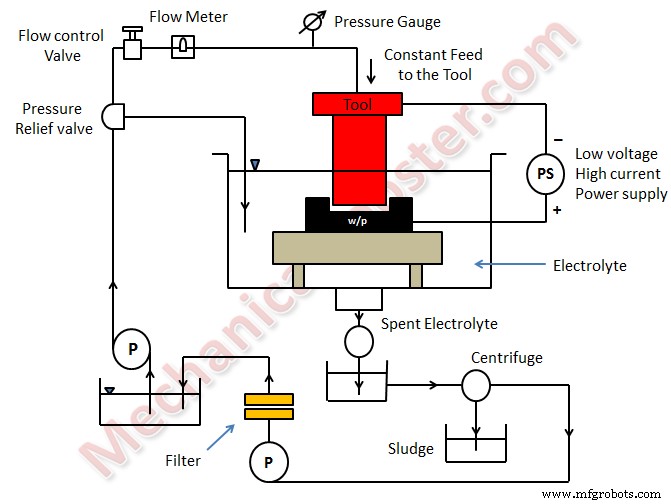
Working of Electrochemical Machining
- First, the workpiece is assembled in the fixture and the tool is brought close to the workpiece. The tool and workpiece is immersed in a suitable electrolyte.
- After that, a potential difference is applied across the w/p (anode) and tool (cathode). The removal of material starts. The material is removed in the same manner as we have discussed above in the working principle.
- Tool feed system advances the tool towards the w/p and always keeps a required gap in between them. The material from the w/p comes out as positive ions and combine with the ions present in the electrolyte and precipitates as sludge. Hydrogen gas is liberated at the cathode during the machining process.
- Since the dissociation of the material from the w/p takes place at atomic level, so it gives excellent surface finish.
- The sludge from the tank is taken out and separated from the electrolyte. The electrolyte after filtration again transported to the tank for the ECM process.
- What is Plasma Arc Machining (PAM) And How it Works?
- What is Electrical Discharge Machining (EDM) Process and How it Works?
- How Electron Beam Machining Process Works?
Application
- The ECM process is used for die sinking operation, profiling and contouring, drilling, grinding, trepanning and micro machining.
- It is used for machining steam turbine blades within closed limits.
Advantages
- Negligible tool wear.
- Complex and concave curvature parts can be produced easily by the use of convex and concave tools.
- No forces and residual stress are produced, because there is no direct contact between tool and workpiece.
- An excellent surface finish is produced.
- Less heat is generated.
Disadvantages
- The risk of corrosion for tool, w/p and equipment increases in the case of saline and acidic electrolyte.
- Electrochemical machining is capable of machining electrically conductive materials only.
- High power consumption.
- High initial investment cost.
Process Parameter
| S.no | Parameters | Values |
| 1. | Power Supply | |
| Type | Direct Current | |
| Voltage | 2 to 35 V | |
| Current | 50 to 40,000 A | |
| Current Density | 0.1 A/mm2 to 5 A/mm2 | |
| 2. | Electrolyte | |
| Material | NaCl and NaNO3 | |
| Temperature | 20 oC to 50 oC | |
| Flow rate | 20 lpm/100 A current | |
| Pressure | 0.5 to 20 bar | |
| Dilution | 100 g/l to 500 g/l | |
| 3. | Working gap | 0.1 mm to 2mm |
| 4. | Overcut | 0.2 mm to 3 mm |
| 5. | Feed rate | 0.5 mm/min to 15 mm/min |
| 6. | Electrode material | Copper, brass and bronze |
| 7. | Surface roughness (Ra) | 0.2 to 1.5 μm |
Industrial Technology
- Water Jet & Abrasive Water Jet Machining: Principles, Process, Equipment, Applications, Pros & Cons
- Electron Beam Machining: How It Works, Equipment, Applications, and Pros & Cons
- Abrasive Jet Machining Explained: Principles, Equipment, and Pros & Cons
- Ultrasonic Machining Explained: Principles, Equipment, Applications, Benefits & Drawbacks
- Electrochemical Machining: Principles, Process, Equipment, Applications, Benefits & Drawbacks
- Gas Welding: Principles, Techniques, Equipment, and Applications
- Water Jet Machining: Principles, Benefits, Drawbacks, and Applications
- Ultrasonic Machining (USM): Core Components, Principles, Pros & Cons, and Practical Applications
- Ultrasonic Machining: Fundamentals, Components, and Industrial Applications
- Electrochemical Machining (ECM): Fundamentals, Components, Advantages, Limitations, and Industrial Uses