



Swaging: How It Works, Key Applications, Benefits & Drawbacks
Today we will learn about swaging process. Swaging is a metal forming process of reducing diameter of a rod or tube by forcing it into a die with the help of reciprocating blow. This will plastically deform the metal and force it to flow into die and acquire die cavity shape. The fundamental concept is similar to forging process but it uses reciprocating die for repeated hammering, which force the metal into die. The die cavity contain the exact shape which we want to produce on rod or tube. This process is used to form screw drivers, soldering iron tip etc.
Swaging Process:
Working:
As we discussed this process work on the same principle of plastic deformation in which the work piece or more appropriate rod is forced into a predefine die cavity where it deform and convert into shape of die cavity. It is a cold working process. This process performs in two part.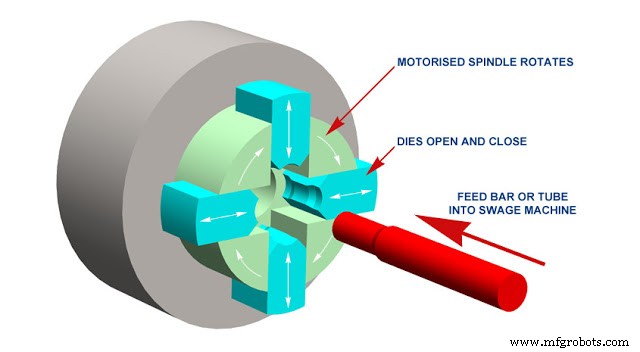 |
| Image Source |
Advantages:
- It can use for mass product.
- The process is easy and does not require any skilled operator.
- Low manufacturing cost.
- High surface finish.
- No material wastage because it does not form any chips.
- High accuracy can obtain by this process.
- Any material can be formed by this process.
Disadvantage:
- It is noisy operation.
- This process is limited according to diameter of rod and die.
Key Sheet Metal Operations in Modern Manufacturing
Understanding Metal Drawing Processes: Wire, Rod, and Tube Drawing Explained
Manufacturing process
- Ultrasonic Welding: Principles, Process, Equipment, Applications, and Pros & Cons
- Electroslag Welding Explained: Principles, Process, Applications, Pros & Cons
- Forge Welding Explained: Principles, Techniques, Uses, Pros and Cons
- Diffusion Bonding: Principles, Process, Applications, Benefits & Limitations
- Friction Welding Explained: Principles, Methods, Types, Applications, Benefits & Drawbacks
- Centrifugal Casting Explained: Principles, Types, Uses, Benefits & Drawbacks
- Casting in Manufacturing: Process, Benefits, Drawbacks, Key Terminology & Applications
- Gas Welding: Principles, Techniques, Equipment, and Applications
- Extrusion Process Explained: How It Works, Types, Applications, Pros & Cons
- Shell Moulding: Process, Applications, Benefits & Drawbacks