



Shell Moulding: Process, Applications, Benefits & Drawbacks
There are various casting processes used in manufacturing industries. All these processes have their own advantages and disadvantages which makes them suitable for particular casting. Shell moulding, which is sometimes known as shell mold casting, is one of a most suitable casting process for complex and other thin sections. This process gives high accuracy and better surface finish. One of the major advantages of this casting process which make it suitable for various casting industries is that it can easily automated. These all advantages make this process versatile and easily adoptable for any industries.
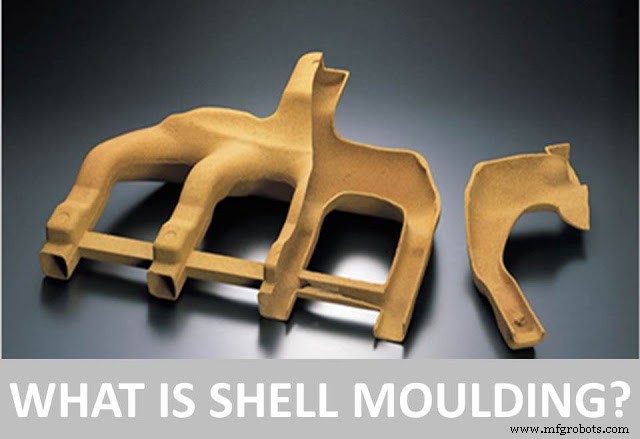
Shell mold casting process uses a mold like a shell, which is made by the mixture of sand and resin. This mold is light weighted and have high strength which makes it suitable for automatic casting. This process is suitable for both ferrous and non-ferrous casting but it is mostly used for steel.
In this article we will discuss about shell moulding process, its advantages and disadvantages along with its application.
Let’s start the discussion.
Shell Moulding Process:
Process:
Shell moulding involves various steps. These are given below
#Step 1: Making of Metal Pattern
The first and most important step involves in every casting process is pattern making. Pattern is replica of the final product. It can made by wood, plastic, metal etc. Shell moulding uses a metal pattern along with all pattern allowance. This pattern is made by either aluminium of cast iron. One of the major advantage of using metal pattern is that it gives high accurate casting and can be used for multiple casting.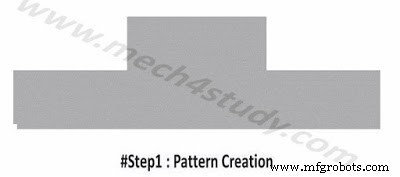
#Step 2 : Heating of Pattern
The metal pattern created by other casting process is now heated at a temperature range between 180 – 250 degree centigrade. This heating is essential which allows to solidify resin mixed silica when poured on it. After heating, a small layer of lubricant (Mosltly Silicon) sprayed over metallic pattern which allows easy removal of metallic pattern from shell.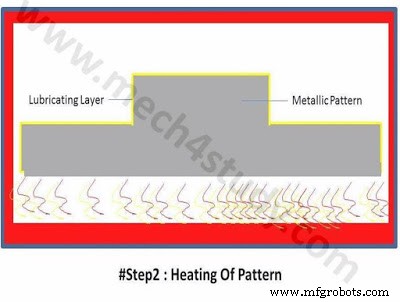
#Step 3 : Shell Mould Creation
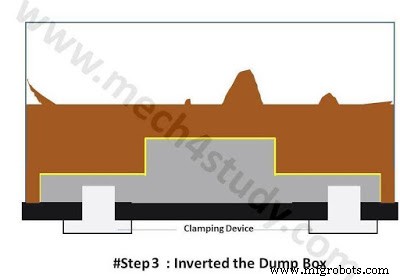
This step is major step in this casting process. This step can be further divided into following steps.- Pattern is clamped over a dump box. Now this assembly is turned face down. A mixture of sand and resin is filled into dump box. Mostly fine grade green sand is used for mixture.
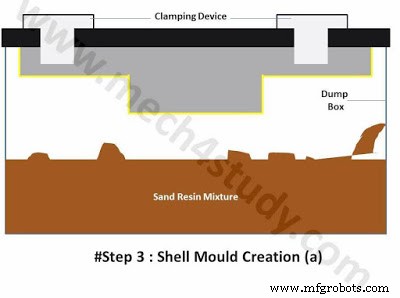
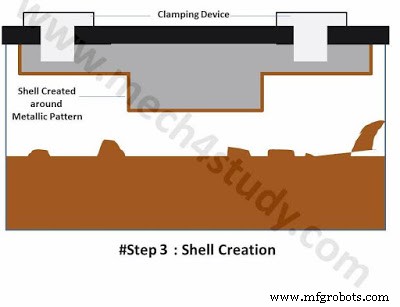
- Now this whole assemble is inverted which allow to sand resin mixture fall over heated pattern. A layer of mixture, which is in direct contact with pattern is become hard and form a shell. The thickness of shell is mostly depends on the temperature of the pattern and time duration of contact.
- Now the dump box is again inverted which allow to remove extra sand resin mixture.
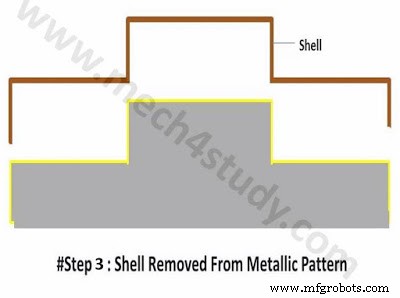
- After it, metallic pattern is removed from dump box and shell is separated from it. The other half of the mold is also created using same technic.
#Step 4 : Mold Assembly
This step assemble all shells created by the shell moulding. The all required shell assembled into a flask and supported by a baking material. All desirable part like cores, runner, riser etc. are attached to it.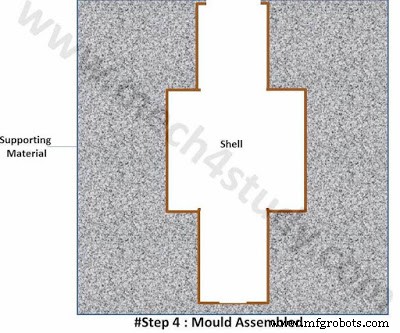
#Step 5 : Casting formation
Now the cavity is filled with a molten metal and allow to solidify. After solidification the metal cast is removed by breaking the shell. The casting formed by this process is highly accurate and well finished. Generally it does not required further machining.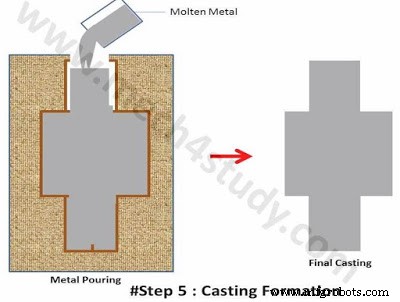
Advantages and Disadvantages:
Advantages:
- Thin and complex section can be easily cast.
- High dimension accuracy and good surface finish.
- Easily automated.
- It can be operate by an semi skilled operator.
- No further machining required.
Disadvantages:
- Special metal pattern required which makes it expensive for large casting.
- It is not suitable for small batch production.
- Shell moulds are less permeable compare to green sand mould.
- Size and weight limitation.
Application:
Most of industrial products like gearbox housing, connecting rod, small size boats, truck hoods, cylindrical head, Camshaft, valve body etc. are made by shell moulding.This is all about shell moulding casting process, advantages and disadvantages along with its application. If you have any query regarding this article ask by commenting. If you like this article, don’t forget to share it on social networks. Subscribe our website for more informative articles. Thanks for reading it.
Honing: Process, Parameters, Types, and Key Advantages for Superior Surface Finish
Heat Treatment Processes: Enhancing Metal Strength & Performance
Manufacturing process
- Non-Traditional Machining: Requirements, Types, Benefits & Drawbacks
- Ultrasonic Welding: Principles, Process, Equipment, Applications, and Pros & Cons
- Electrochemical Machining: Principles, Process, Equipment, Applications, Benefits & Drawbacks
- Solid‑State Welding: Principles, Types, Applications, Benefits & Drawbacks
- Centrifugal Casting Explained: Principles, Types, Uses, Benefits & Drawbacks
- Casting in Manufacturing: Process, Benefits, Drawbacks, Key Terminology & Applications
- Swaging: How It Works, Key Applications, Benefits & Drawbacks
- Extrusion Process Explained: How It Works, Types, Applications, Pros & Cons
- Forging Process: Types, Operations, Applications, Benefits & Drawbacks Explained
- Die Casting: Key Benefits and Drawbacks Explained