



Ultrasonic Welding of Plastics: A Professional Guide to High-Strength, Eco-Friendly Bonding
Ultrasonic welding is a precision bonding technique that fuses two identical or chemically compatible plastic parts using high‑frequency ultrasonic vibrations. Within seconds, it creates a solid‑state, gas‑tight, water‑tight joint without the need for screws, glue, or solder. The resulting parts can be handled immediately on an automation line—no curing jig required. This eco‑friendly process consumes minimal energy, delivers a cost‑effective, permanent, and clean weld, and is widely adopted across the electrical, computer, automotive, aerospace, medical, and packaging sectors.
The core of any ultrasonic welding system is the transducer stack. 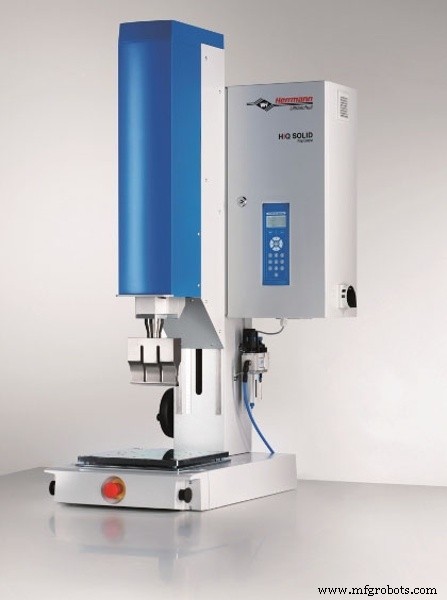 The stack consists of three key components: a sonotrode, a booster, and a weld horn. The sonotrode—housing piezoelectric ceramic disks wrapped around metal plates—provides the primary vibration source. High‑frequency electrical input from the power module drives it. Because the vibration amplitude alone often falls short of melting most thermoplastics, a booster amplifies the signal to the level required for welding. The weld horn then delivers the amplified energy to the parts, its geometry engineered to match each component’s contours and to apply the precise force needed for a successful bond.
Ultrasonic welding relies on the plastic softening—without full melting—during the process, making it ideally suited to thermoplastics. These materials, typically amorphous with some crystallinity, possess a glass‑transition temperature that allows them to soften over a wide range of temperatures. In contrast, thermoset polymers are crystalline and only melt at a sharp melting point, making them unsuitable for this technique. Thermoplastics such as ABS, acrylic, polycarbonate, and PVC—each with a largely amorphous structure—excel in ultrasonic welding. When the two joined parts share the same material, the strongest, most reliable bonds are achieved. In certain cases, chemically compatible thermoplastics with similar melting points can also be welded, such as ABS paired with acrylic.
Polymers like PE, PP, and PIA are crystalline and tend to absorb ultrasonic energy before it reaches the joint, rendering ultrasonic welding ineffective. Even commonly requested pairs such as polyethylene and polypropylene, both crystalline and chemically incompatible, are difficult to join with this method.
Industries that routinely use ultrasonic welding include the manufacturing of butane lighters, toys, pipettes, intravenous catheters, and the upper sections of athletic shoes—often chosen over stitching or gluing for its speed and precision. Household appliances rely on the process to join components like washing‑machine display panels and pump‑wheel halves. In automotive production, ultrasonic welding unites tail‑light assemblies, instrument clusters, and bumpers. Reports suggest that Apple has adopted the technique for its earbuds, leveraging the clean, streamlined finish that ultrasonic welding delivers.
Looking for additional ways to bond different plastics? Explore our free guide to gluing plastics for comprehensive solutions.

Resin
- Five Key Fusion Welding Techniques Explained
- High‑Performance Plastics: Essential Materials for Modern Semiconductor Fabrication
- Understanding Anti‑Static, Dissipative, and Conductive Plastics: Materials, Applications, and ESD Protection
- Expert Overview of Biodegradable Plastics: Facts, History, and Applications
- Metal‑Detectable Plastics: Enhancing Food Safety in the Industry
- From Ivory to Bakelite: Tracing the Evolution of Modern Plastics
- Ultrasonic Welding Explained: Seamless Bonding Without Fasteners
- Tracing the Evolution of Welding: From Ancient Origins to Modern Innovation
- Robotic Welding: Shaping the Future of Metal Fabrication
- Semi-Automatic Welding Machines: Boost Efficiency & Precision