



The Top 3 Commercial Uses of Nylon: Fasteners, Cookware, and Fabric
One of the most widely used plastics today, nylon was first patented in 1935 by Wallace Carruthers, a chemist at Dupont®.
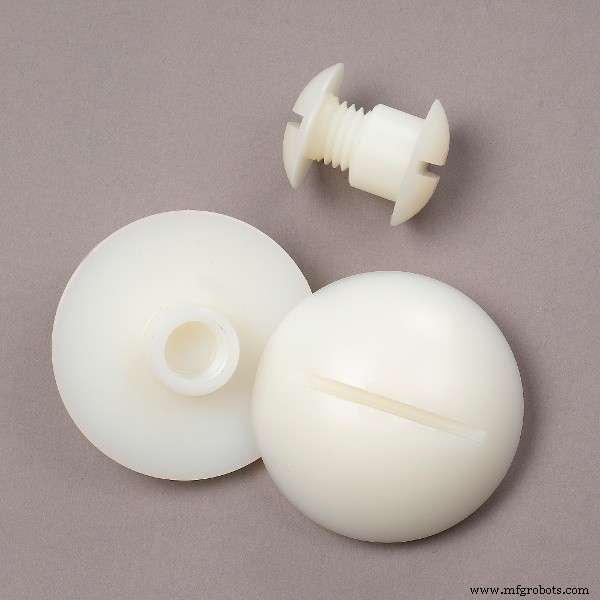 Nylon is a thermoplastic derived from petrochemicals. It is semi‑crystalline, containing both amorphous and crystalline domains. When heated, it remains rigid until it reaches its melting point of 256 °C (450 °F), at which it melts in a single, rapid transition.
Its exceptional toughness, resistance to abrasion, and elastic recovery make nylon ideal for demanding applications. It resists oils, solvents, and alcohols, but is susceptible to degradation in dilute sulfuric acid, phenols, alkalis, and iodine. Nylon is hygroscopic; water molecules absorb into its amide bonds, causing slight swelling. While it does not readily absorb surface water, prolonged UV exposure can degrade it, so UV stabilizers are commonly added. Fungi, molds, mildew, and insects have no effect on nylon.
Here are the three most prevalent commercial uses of nylon today:
3) Plastic Fasteners and Machine Parts
Nylon’s low cost and durability make it a go‑to material for machine components, especially in the electronics sector where its non‑conductivity and heat tolerance are critical. Common items include screws, bolts, washers, nuts, and circuit‑board hardware. Its low coefficient of friction enables smooth rotation or sliding in mechanisms, and its abrasion resistance makes it a favorite for appliance bearings.
2) Cookware
Thanks to its high continuous service temperature, nylon is used in a range of kitchen tools—spatulas, slotted spoons, turners, forks, tongs, brushes, and more. It can be dyed easily, allowing manufacturers to coordinate tool colors with kitchen décor. Nylon utensils are gentle on non‑stick surfaces, and brands such as OXO and Caphalon have incorporated nylon into their cookware lines.
1) Fabric
Perhaps nylon’s most celebrated attribute is its ability to be spun into strong, lightweight fibers that can be woven into a silky, drapable fabric. Introduced at the 1939 New York World’s Fair, nylon quickly replaced silk in women’s stockings and later proved indispensable as a parachute material during WWII. Today, nylon remains a staple for parachute canopies, harness straps, suspension lines, tents, sleeping bags, sails, ropes, tennis strings, fishing lines, and a vast array of apparel and accessories—including backpacks, flak jackets, wedding gowns, athletic shoes, ponchos, umbrellas, camera cases, swimsuits, socks, gloves, hats, and luggage.
That’s a quick tour of nylon’s commercial footprint. Did we miss any notable applications? What’s your favorite commercial use for nylon?
Looking for more information on nylon? Download our complimentary guide!

Resin
- 10 Key Applications of Indium in Modern Industry
- Iridium: Key Uses, Properties, and Industrial Applications
- Top 10 Industrial Applications of Niobium: From Steel to Superconductors
- Can Apple AirTags Track Commercial Assets? A Practical Evaluation
- Top 5 Plastic Bearings for Metal Surfaces: Phenolics, Nylon, PTFE, Acetal, UHMWPE
- Top 3 Manufacturing Applications of Carbon Fiber 3D Printing
- Grilamid TR HT 200 – First Transparent Nylon to Endure 400 Steam‑Sterilization Cycles
- Top 6 Essential Machines for the Manufacturing Sector
- 5 Expert Tips for Securing Financing on Used Equipment
- Copper’s 4 Key Industrial Applications: From Wiring to Piping