



The Complete Guide to Cooking Oil: Production, Quality, and Sustainability
Background
Cooking oil is an edible vegetable oil derived from a variety of plant sources, including olives, peanuts, and safflowers. Liquid at room temperature, it is a staple in both home kitchens and commercial food production, used for frying, sautéing, and as a base for salad dressings.
Human civilization has extracted vegetable oils for millennia, harnessing the sun, fire, or ovens to coax oil from plant matter. By 2000 B.C., the Chinese and Japanese were producing soy oil, while southern Europeans were already producing olive oil by 3000 B.C. In North America and Mexico, peanuts and sunflower seeds were roasted, beaten into a paste, and boiled to skim off the oil. African methods involved grinding palm kernels and coconut meat, then boiling the pulp to capture the rising oil. Advances in extraction technology introduced corn oil in the 1960s and opened the door to other novel oils such as cotton seed, watermelon seed, and grapeseed.
Early mechanization efforts appeared in China, Egypt, Greece, and Rome. Techniques ranged from stone mortars and pestles to early millstones, employing lever or wedge presses. Greek and Roman refinements introduced edge runners and winches to drive lever presses, a process that persisted through the Middle Ages.
Further innovations followed: the Dutch stamper press (1600s–1800s), John Smeaton’s roll mill (1750), Joseph Bramah’s hydraulic press, and V. D. Anderson’s 1876 screw expeller, which continuously applied pressure to a closed cage, draining oil through side slots.
Solvent extraction emerged in 1856 when Deiss patented a method following Jesse Fisher’s 1843 experiments. Early processes used benzene; German engineers Bollman and Hildebrandt later developed continuous spray systems. Today, solvent extraction—typically with hexane—is the industry standard for maximizing yield.
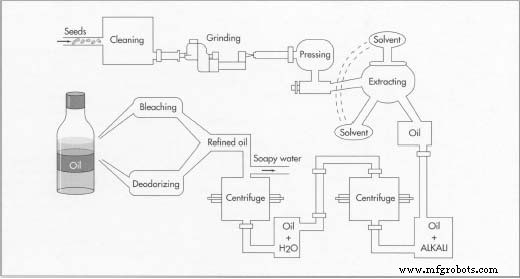 Cooking oil manufacturing involves cleaning seeds, grinding them, pressing, and extracting oil with a volatile hydrocarbon such as hexane. The crude oil is then refined: it is washed with alkaline solutions, centrifuged, filtered, and distilled before packaging.
Early pressing methods recovered roughly 10% of the oil, whereas modern solvent extraction can recover up to 95–98% of the available oil.
Raw Materials
The average bottle of cooking oil contains pure vegetable oil, free from additives, preservatives, or artificial flavorings. Oils are sourced from plant seeds—such as sunflower, palm kernel, safflower, cotton, sesame, and grapeseed—or nuts, including peanut, soybean, almond, and walnut. Some oils come from fruit flesh: coconut oil from the coconut’s white meat, palm oil from palm fruit pulp, and olive oil from fresh olives. Corn oil is unique in that it is derived from the kernel’s germ (embryo).
The Manufacturing Process
Cold‑pressed oils like olive, peanut, and certain coconut and sunflower varieties undergo minimal processing, preserving light flavor and delicate aroma. Other oils cannot be cold‑pressed because the process would leave undesirable trace elements, resulting in off‑odors, bitterness, or dark color. Those oils undergo a series of steps to produce a clear, neutral product.
Cleaning and Grinding
- Incoming seeds pass through magnets to remove metallic contaminants, then are dehulled, deskinned, or otherwise stripped of extraneous material. For cotton, lint is removed; for corn, the kernel is milled to separate the germ.
- The cleaned seeds are ground into coarse meal using grooved rollers or hammer mills. Heating the meal increases surface area, enhancing oil release but also extracting impurities that must be removed later.
Pressing
- Heated meal is fed continuously into a screw press. Pressure rises from about 68,950 kPa to 206,850 kPa as the meal traverses a slotted barrel, forcing oil out through the slots for recovery.
Solvent Extraction of Remaining Oil
- For soybeans and high‑oil seeds, a second extraction follows the screw press. The oil cake is treated with hexane, which dissolves residual oil. The mixture is then distilled to recover the oil, while the solvent is recycled. Industry‑standard equipment includes the Blaw‑Knox Rotocell and Bollman/Hansa‑Mühle units.
Removing Solvent Residues
- Approximately 90% of the solvent evaporates naturally. The remaining solvent is removed in a stripping column where steam drives off hexane, which is then condensed and reused.
Refining the Oil
- Refining removes color, odor, and bitterness. The oil is heated to 107–188 °F (40–85 °C) and mixed with an alkaline agent (sodium hydroxide or sodium carbonate). Soap forms from unwanted fatty acids and is removed by centrifugation. Subsequent washes eliminate residual soap and dry the oil.
- Degumming follows: water heated to 188–206 °F (85–95 °C), steam, or acid water precipitates phosphatides, which are then centrifuged out.
- Bleaching removes pigments using fuller’s earth, activated carbon, or clays. Oils intended for refrigeration undergo winterization—rapid chilling and filtration—to remove waxes and prevent cloudiness at low temperatures.
- Deodorization employs steam under vacuum at 440–485 °F (225–250 °C) to distill volatile taste and odor components. A trace amount (0.01 %) of citric acid is added to inactivate trace metals that could accelerate oxidation.
Packaging
- Finished oil is measured and filled into clean containers: plastic bottles for domestic retail, glass bottles for specialty or imported oils, and cans for certain imports like olive oil.
By‑Products and Waste
Oilseed cake, the residue after extraction, is a valuable by‑product. Most are used as animal feed or low‑grade fertilizer; some are processed into more specialized products. Cotton lint becomes yarn and cellulose for mattresses, rayon, and lacquer. Coconut yields desiccated meat (copra) for confectionery, coconut milk, and coir fiber for mats and rope. Corn oil production produces corn meal, hominy, starch, and syrup.
Lecithin, obtained during soybean degumming, is a versatile ingredient in animal feed, chocolate, cosmetics, soap, paint, and plastics. Recent research explores converting oilseed cake into high‑protein, palatable food for protein‑deficient regions, after removing toxins such as gossypol (cotton) or aflatoxin (peanut).
Quality Control
Seeds are inspected and graded post‑harvest by licensed inspectors under the U.S. Grain Standards Act. Fat content is measured, and the best seeds are stored briefly—ideally under low temperature and humidity—to prevent mold, nutrient loss, and rancidity. Seeds should have a moisture content of ~10% or be dried to that level to inhibit mold growth.
Processed oil is evaluated for consistency in color, taste, and viscosity. Color is measured with a Lovibond Tintometer or visual comparison to standard glasses. Experienced tasters assess flavor, and viscosity is measured with a viscometer, timing the emptying of a calibrated bulb.
Smoke point, flash point, and fire point tests determine safe cooking temperatures; a smoke point between 402–503 °F (204–260 °C) is desirable. Cloud point testing involves chilling 120 ml of salad oil at 35 °F (0 °C) for 5.5 hours; a clear oil indicates proper winterization.
Before filling, bottles are cleaned and inspected electronically for foreign matter. Nitrogen gas is injected to displace air, preventing oxidation and rancidity.
Manufacturing process
- Kerosene: Production, Uses, and Future of a Key Petroleum Product
- The Science and Industry of Frozen Vegetables: From Harvest to Table
- Olive Oil: From Ancient Traditions to Modern Production
- Scratch & Sniff: The Science and Craft of Micro-Encapsulated Scent Printing
- Gasoline: Production, Refining, and the Road Ahead
- Lubricating Oil: Types, Uses, and Performance
- Grease vs. Oil: Selecting the Optimal Lubricant for Linear Bearings
- Road Oil Explained: Benefits, Uses, and Safe Application
- Engine Oil Pump Explained: How It Powers Engine Lubrication
- High-Mileage Engine Oil: When and Why to Switch