



Olive Oil: From Ancient Traditions to Modern Production
Background
Olive trees and their fruit have been symbols of prosperity and peace since antiquity. Archaeological excavations on Crete reveal that olive cultivation dates back to 3500 B.C., and by 3000 B.C. Semitic peoples were already harvesting olives for ritual anointing and illumination. Ancient laws—including a Hebrew injunction against destroying olive trees—illustrate the tree’s cultural significance.
During the Roman Empire, olives became a cornerstone of the agricultural economy. Romans pressed the oil for use in lubricating wagon axles, while Greek traders exchanged it for grain, shipping it in intricately decorated clay amphorae that would become celebrated works of art.
The olive tree is frequently cited in both the Koran and the Bible. Noah’s dove returns with an olive branch, and Greek mythology links Athena to the tree, crediting Acropos, the founder of Athens, with teaching the Greeks how to extract olive oil.
Botanically, the olive tree is an evergreen with a gnarled trunk and silvery undersides of leaves. Its deep root system can penetrate sand, limestone, and poorly aerated soils, making it ideally suited to regions that experience wet winters and hot, dry summers. Although it may take up to eight years before a tree yields its first crop, a single olive tree can live for several centuries.
Early producers pressed olives by crushing them between massive cone‑shaped stones that rotated on a granite base. Modern factories now use hydraulic presses that apply hundreds of tons of pressure to separate the oil from the paste. Spain and Italy remain the world’s largest commercial producers, with Greece close behind. California, Australia, and South Africa are rapidly emerging as significant players. In California, missionaries planted olive trees in the 1800s, producing high‑grade oil before the market demand faltered and vineyards replaced the groves.
In the late twentieth century, the growing focus on nutrition and the Mediterranean diet sparked a renaissance in olive oil trade. The oil is marketed as a healthy monounsaturated fat, superior to corn and vegetable oils. It is also promoted for its skin‑care benefits, such as dandruff relief and homemade lip balm formulations. In the 1990s, the United States and Canada consumed approximately 147,600 tons of olive oil annually, a volume that often exceeded supply and drove prices upward.
Raw Materials
The core ingredient of olive oil is the oil extracted from ripe olives. In late spring, small flowers bloom on olive trees; wind pollination produces fruit that reaches peak oil content roughly six months later. Harvesting occurs from November to March, as olives transition from green to reddish‑violet to black. Farmers often harvest multiple times from the same trees to gather fruit at a uniform ripeness.
Traditional harvesting involved knocking fruit from the trees with long‑handled poles—a practice that has changed little over centuries. Modern harvesters use pole‑like rakes, and many producers now employ plastic covers to cushion falling fruit, enabling faster, cleaner collection.
To produce one quart (0.95 L) of extra‑virgin olive oil, roughly 2,000 olives are required. The only additive in extra‑virgin oil is warm water, used to flush the bitter oleuropein. Extra‑virgin oil contains no more than 1 % oleic acid. Pure olive oil, derived from a second pressing, is typically blended with extra‑virgin oil. Commercial or non‑edible grades undergo refining, which may leave trace amounts of soda or bleaching agents.
The Manufacturing Process
Collecting and Grading the Olives
- After harvesting, olives are hand‑sorted to remove damaged fruit. They are classified by plumpness, ripeness, and quality before being transported to the press. The olives rest for a short period—ranging from a few hours to several days—to warm up and release oil without fermenting.
Washing and Milling the Olives
- Olives are rinsed in cold water and then fed through a conveyor belt with rollers or continuous hammers, known as the olive crusher. This process breaks the cells and removes stones. Depending on skin resilience and maturity, the fruit may be milled a second time.
Creating an Olive Paste Through Malaxation
- In antiquity, olives were ground with a mortar and pestle. Today, milled olives are transferred to vats where slowly rotating blades homogenize the paste. This malaxation stage blends oil droplets and prepares the mixture for pressing.
Cold‑Pressing the Olive Paste to Extract the Oil
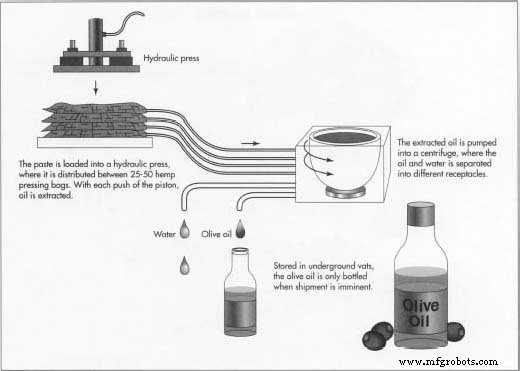
- Hydraulic presses receive the paste, which is spread over hemp or synthetic‑fiber pressing bags. Each bag or disk holds 9–13 lb (4–6 kg) of paste. Between 25 and 50 bags are stacked, with plate guides every five to six bags to balance the load and distribute pressure evenly. A piston compresses the stack, allowing oil to seep through the bags into attached tubes while solids remain inside.
- The term “cold‑pressing” indicates that the paste is not heated during extraction, preserving oil purity. The resulting reddish mixture of oil and vegetable water is labeled “extra‑virgin.” Subsequent presses yield lower grades.
Separating the Oil from Vegetable Water
- Initially, oil and water were allowed to separate in vats, then skimmed off—an approach that often led to fermentation and altered flavor. Modern operations employ centrifuges, which spin a drum and auger at high speed, separating oil and water by density. The oil and water flow into separate receptacles almost instantaneously.
Storing and Packaging the Oil
- Oil is stored in underground vats until shipping. It is then canned or bottled on an assembly line. Dark‑tinted containers preserve the deep‑green hue; clear glass may fade to yellowish‑green but does not affect flavor.
- Distributors frequently rebottle oil, and packaging has become increasingly elaborate. Unusual bottle shapes, netting, rope caps, and artist‑designed labels are common, reflecting the product’s premium status.
Quality Control
The U.S. Food and Drug Administration (FDA) regulates olive oil and defines five grades: virgin (first pressing), pure (blend of refined and virgin), refined (commercial, lampante base with acid, color, and odor removed), lampante (high‑acid, historical use as lamp oil), and sulfide (solvent‑extracted and extensively refined). The FDA’s 1995 report found only 4 % of 73 domestically produced oils tested were pure, though the North American Olive Oil Association disputes this, claiming that out of 300 oils tested annually, only a handful are impure. Consumers should remain vigilant when purchasing labeled olive oil.
The Future
Labor shortages in hand‑harvesting are driving the industry toward mechanization. Large producers are adopting centrifugation not only for pressing but also for separating oil from water. Although this method consumes more energy and water, it occupies less floor space and shortens setup time. Moreover, centrifugation eliminates the need for washing pressing bags.
Manufacturing process
- Kerosene: Production, Uses, and Future of a Key Petroleum Product
- Olives: From Tree to Table—History, Production, and Health Benefits
- Scratch & Sniff: The Science and Craft of Micro-Encapsulated Scent Printing
- Gasoline: Production, Refining, and the Road Ahead
- The Complete Guide to Cooking Oil: Production, Quality, and Sustainability
- Lubricating Oil: Types, Uses, and Performance
- Grease vs. Oil: Selecting the Optimal Lubricant for Linear Bearings
- Road Oil Explained: Benefits, Uses, and Safe Application
- Understanding Oil Derricks: Key Features & Functions
- Engine Oil Pump Explained: How It Powers Engine Lubrication