



Scratch & Sniff: The Science and Craft of Micro-Encapsulated Scent Printing
Background
Scratch & Sniff™ is a specialty printing technique that embeds micro‑encapsulated scented oil into paper. The fragrance is trapped in microscopic beads—usually 20–30 µm in diameter—that remain sealed until a user deliberately scratches the surface, releasing the aroma. This localized delivery keeps ambient spaces free of overpowering scents while allowing interactive olfactory experiences.
In children’s books, a child can "scratch and sniff" a cookie illustration to inhale the fresh‑baked scent. Advertisers use the technology to capture the smell of a new car, fresh‑cut lumber, or a specific detergent, turning a visual ad into a multisensory encounter. In perfume marketing, a narrow strip of paper coated with micro‑encapsulated perfume is clipped from the ad; tearing it ruptures the capsules and liberates the fragrance.
History
Micro‑encapsulation originated in the early 1960s with efforts to produce carbon‑less copy paper. 3M chemist Gale Matson patented a process using polyoxymethylene urea (PMU) that could separate ink from water, eliminating the need for carbon sheets. A contemporaneous gelatin‑based method was developed at National Cash Register. Marketing teams at 3M recognized the potential beyond copy paper, leading to the first commercial Scratch & Sniff product in 1965. The pull‑apart perfume strip, a key variation, debuted in 1981 and remains the standard for perfume sampling.
Raw Materials
Key ingredients include water, scented oil, a water‑soluble polymer (often PMU or gelatin), a chemical catalyst to polymerize the shell, and a water‑soluble adhesive that bonds the slurry to paper during printing.
The Manufacturing Process
Reacting
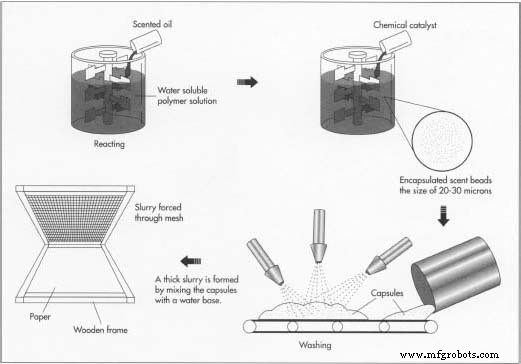
- 1. In a large reactor, scented oil is dispersed in a water‑soluble polymer solution. High‑shear agitation—via a rotary blade—breaks the oil into droplets 20–30 µm in size, a process that can take up to 12 hours.
Adding the Catalyst
- 2. Once droplets reach the target size, agitation stops and a catalyst is introduced. The polymer’s molecular weight rises, making it insoluble. It precipitates around each oil droplet, forming a robust shell that seals the fragrance.
Washing
- 3. Capsules are transferred to a conveyor and washed—once for scratch‑and‑sniff, twice for perfume strips—to remove residual polymer and stabilizers.
Making the Slurry
- 4. Washed capsules are mixed with a water base to create a thick slurry. For scratch‑and‑sniff, an adhesive is added to ensure proper adhesion to the substrate.
Printing
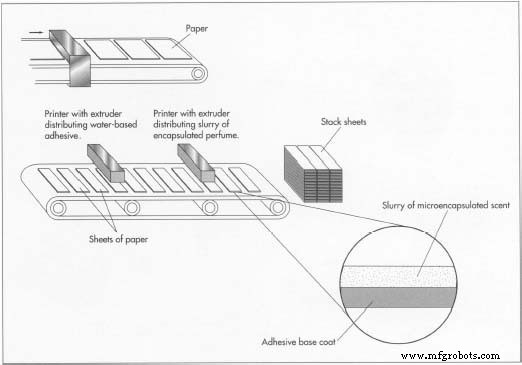
- 5. Four primary printing methods are employed: silk‑screening, web offset with a pattern gluer, flexographic printing for stickers, and extrusion for perfume strips. Extrusion, the most complex, requires precision presses and computer controls to deposit micro‑encapsulated perfume onto paper.
Quality Control
Micro‑capsules undergo rigorous laboratory testing. Samples are frozen, steamed, and examined under high‑magnification to assess integrity, longevity, and release behavior. Finished prints are verified for scent identity and intensity; adjustments to strip width or adhesive content correct any deviation.
The Future
Growth is concentrated in perfume strip manufacturing, driven by advances in computer‑controlled extrusion presses. The 1990s saw innovations such as pressure‑sensitive labels and strips that open to reveal perfume pearls for direct skin application. Future progress will hinge on tighter collaboration between perfumers, printers, and encapsulation chemists to produce commercially viable, high‑performance scented products.
Manufacturing process
- Kerosene: Production, Uses, and Future of a Key Petroleum Product
- Olive Oil: From Ancient Traditions to Modern Production
- Gasoline: Production, Refining, and the Road Ahead
- The Complete Guide to Cooking Oil: Production, Quality, and Sustainability
- Lubricating Oil: Types, Uses, and Performance
- Understanding and Tackling Sludge & Varnish in Industrial Machinery
- Revolutionizing Oil & Gas: How 3D Printing Drives Efficiency and Sustainability
- Oil & Gas Embraces Digital Transformation: Strategies, Success Stories, and Future Outlook
- Projected Timeline for U.S. and Global Oil Market Recovery
- Wet vs Dry Oil Sump Systems: A Comprehensive Guide