



Understanding and Tackling Sludge & Varnish in Industrial Machinery
Sludge and varnish—those stubborn deposits that cling to engine parts and hydraulic valves—can silently erode machine performance and shorten equipment life. They’re often invisible until they appear as tar‑like films or black crusts, and once present, they’re notoriously difficult to eliminate.
Many operators have experienced the frustration of an oil change or flush that seems to clear the problem only to find the deposits re‑emerging, now deeply ingrained in the machine’s interior. Understanding why this happens—and how to stop it—requires a systematic approach grounded in real-world experience.
At Noria Corporation, we’ve observed a marked increase in sludge and varnish (S&V) incidents across a wide range of industrial equipment. The rise coincides with a heightened demand for reliability and the growing use of advanced lubricants. Our research shows that while low‑solvency base stocks such as hydrocracked and polyalphaolefin synthetics offer superior thermal and oxidative stability, they can also trap degradation products—oxides, salts, and carbon fines—leading to sludge formation.
Other contributing factors include extended oil drain intervals, improper top‑treatments with additive concentrates, and the recycling of used oils. Additionally, tighter leakage controls—while reducing waste—can shorten the effective life of the oil by limiting the replenishment of fresh additives.
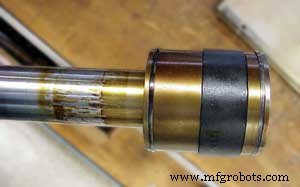
Sludge and varnish can appear in many forms. The image above shows a gold‑adherent film on a valve.
Modern maintenance practices—cooler, cleaner, drier operating environments and routine oil analysis—have generally reduced the incidence of S&V. Yet, when they do occur, the root cause is often elusive. Our laboratory investigations have identified more than 25 distinct degradation pathways that can lead to sludge and varnish, including aeration, bulk thermal degradation, soot coagulation, oxidation, hydrolysis, and additive incompatibilities.
Because the evidence for S&V is rarely found in the oil itself, it must be examined directly using specialized tests. Used‑oil analysis remains a valuable diagnostic tool, helping to pinpoint likely causes and eliminate unlikely ones.
Below is a non‑exhaustive list of the conditions that can give rise to S&V:
- Aeration of the fluid
- Sparking from static electricity
- Bulk thermal degradation
- Antifreeze contamination
- Soot coagulation
- Bulk oil oxidation
- Hydrolysis
- Prolonged cold storage
- Grease contaminated oil
- Caustic detergent contamination
- Nitration coking on hot surfaces
- Radiological contamination
- Poor engine combustion efficiency and blowby
- Highly aromatic fuels
- Sulfation (fuel, H2S, etc.)
- Lead corrosion reactions
- Reactive compressor gases
- Additive incompatibilities
- Base oil incompatibilities
Each cause demands a specific corrective action. Without a clear root‑cause analysis, remediation becomes a costly trial‑and‑error exercise. Therefore, we recommend maintaining a detailed log of operating conditions, observations, and maintenance events to build a comprehensive case file.
Common deposition sites include:
- Black crust on mechanical seals
- Gold film on spool valves in electrohydraulic systems
- Charcoal‑like deposits on babbitt sleeve bearings
- Gooey brown residue in diesel engine oil filters
- Scabby black deposits on thrust‑bearing pads
- Tar‑like clumps in dryer bearing drain lines
- Grayish gummy deposits on natural‑gas engine discharge ports
- Carbon residue on servo strainers
- Hard black enamel on piston crowns and ring lands
- Curd‑like gunk on engine valve covers
- Slime on compressor oil filters
These deposits impair fluid dynamics, increase wear, and can lead to mechanical failures such as clogged orifices, damaged seals, or premature bearing failure. For example, varnish on a servo control valve spool can tighten the interference fit, while soot on a bearing surface can accelerate wear.
Organizations dealing with S&V typically share three core objectives:
- Identify the root cause accurately.
- Implement quick, effective fixes to restore lubricant and machine operation.
- Prevent recurrence by addressing the underlying cause.
Our dedicated research program—comprising laboratory tests, field studies, and collaborations with leading academics—has built a deep knowledge base on S&V. We continuously refine our diagnostic tools and preventive strategies to help clients protect their assets.
If you’ve encountered sludge or varnish in your equipment, or have new insights on its formation or mitigation, we invite you to share your experience. Your feedback fuels ongoing improvements in S&V management.
Equipment Maintenance and Repair
- Voltage Multipliers Explained: Doubler, Tripler, Quadrupler, and the Cockcroft–Walton Design
- Scratch & Sniff: The Science and Craft of Micro-Encapsulated Scent Printing
- Lean Machines for World-Class Manufacturing and Maintenance: A Practical Guide to Equipment Excellence
- How Maintenance Drives a Sustainable Circular Economy
- Beyond Trial and Error: A Proven Guide to Effective Maintenance Troubleshooting
- How ERP Drives Inventory Reduction & Operational Efficiency
- SIMULIA: Advanced Tire Engineering & Design Solutions
- Transformer Oil Filtration: Key Functions, Benefits, and Best Practices
- The IRF740 MOSFET: Comprehensive Overview & Practical Applications
- Avoid These Common Hydraulic Maintenance Errors to Save Time and Money