



The Craft of Scissors: From Ancient Spring Blades to Modern Precision Tools
The Craft of Scissors: From Ancient Spring Blades to Modern Precision Tools
Scissors—simple yet indispensable—have evolved over millennia. From early bronze spring scissors to today’s precision‑engineered tools, they combine metallurgy, mechanical design, and meticulous quality control to deliver reliable cutting performance for countless applications.
Background
Scissors consist of a pair of metal blades hinged together so that closing the handles brings the blades into contact, cutting any material placed between them. The term shears refers to larger versions with blades over 6 in (15 cm). While children’s scissors feature dull blades for safety, professional instruments—haircutting, fabric work, metal cutting, or gardening—require sharper, stronger blades.
Specialized variants include sewing scissors (one sharp, one blunt point), nail scissors (curved blades), pinking shears (notched blades for decorative edges), and thinning shears (to reduce hair volume).
Historical milestones:
- ~3,000–4,000 years ago: Middle Eastern bronze spring scissors—two blades linked by a curved strip that flexes when squeezed.
- Roman, Chinese, Japanese, Korean: pivoted scissors with a central hinge—design still used in modern tools.
- 16th‑17th century Europe: spring scissors remained common; pivoted scissors saw limited production.
- 1761: Robert Hinchliffe of Sheffield introduced cast‑steel pivoted scissors, leveraging Benjamin Huntsman’s new cast‑steel technique for uniform, impurity‑free steel.
- 19th century: decorative, hand‑forged scissors with intricate handles; 20th century saw mechanized drop‑hammer production.
Raw Materials
Most scissors are made from steel, though specialized tools may use alternative alloys:
- Carbon steel (≈1 % carbon): blades and handles form one continuous piece; durable and sharp, often nickel‑ or chrome‑plated to resist rust.
- Stainless steel (≈1 % carbon, ≥10 % chromium): blades paired with plastic handles (ABS or similar) for lightness and rust‑resistance.
- Special applications: spark‑free blades for cutting cordite; magnet‑neutral blades for magnetic tape.
The Manufacturing Process
Making the Blanks
- Blanks are the unsharpened, pre‑assembled halves of scissors—either blade+handle or blade only. A welded or molded handle may be attached later.
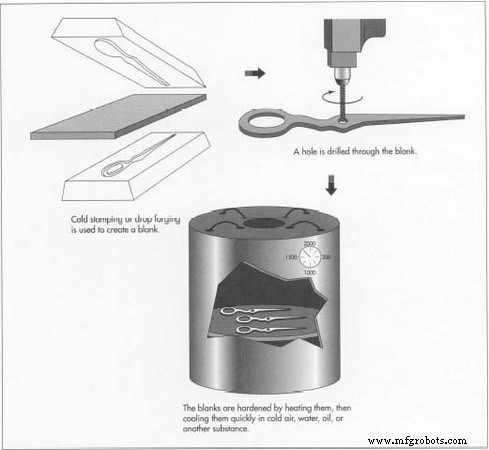
- Low‑cost scissors often use cold stamping—a die cuts the blank from unheated steel.
- Higher quality blanks come from molding (molten steel poured into a die) or drop forging—a heated hammer strikes the steel, enhancing strength.
Processing the Blanks
- Trim excess metal and drill the pivot hole.
- Heat‑hardening: blanks are heated to a specified temperature, then quenched in air, water, oil, or other media.
- Tempering: reheated and slowly cooled to achieve uniform hardness across both blades.
- Peening: gentle hammering on an anvil straightens any warping from heat cycles.
Grinding and Polishing
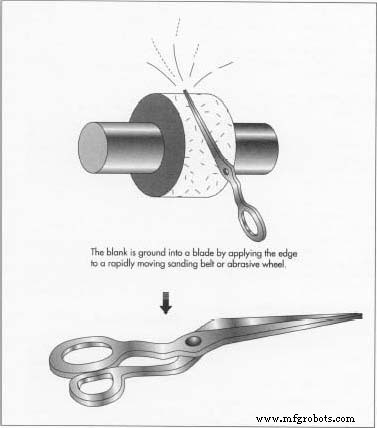
- The blade edge is ground on a rotating belt or abrasive wheel. Small abrasive particles wear steel to a razor‑sharp edge.
- Water or cutting fluids cool the blade, preventing heat‑induced warping.
- Polishing follows with finer abrasives for a smooth, durable finish.
Making the Handles
- Metal handles may be forged or cast and then welded to the blade. Plastic handles are injection‑molded from molten ABS or similar, then attached with a strong adhesive.
Assembling the Scissors
- Polished blades are aligned and joined by a rivet (fixed) or screw (adjustable).
- Adjustment ensures even blade contact; the device is then plated or coated for corrosion protection.
- Final inspection checks alignment, sharpness, and finish before packaging.
Quality Control
Key QC focus: precise blade alignment. The pivot point and cutting point must line up within ±0.0001 in (≈0.025 mm). Visual inspection checks for:
- Even blade contact without gaps or overlap.
- Absence of “wing” defects where one blade overlaps the other.
- Consistent pressure required to close the blades.
Functional tests use tough synthetic fabrics to verify cutting sharpness and strength. End users are advised to maintain scissors by regular oiling, sharpening, and proper storage.
The Future
Innovations continue to refine this classic tool. Rolling‑blade designs reduce friction, while zirconium‑oxide ceramics produce rust‑proof, self‑sharpening blades—extending life and reducing maintenance.
Conclusion
From ancient spring blades to modern precision tools, scissors exemplify how thoughtful material science, engineering, and quality control converge to create a timeless instrument of everyday life.
Manufacturing process
- Steel Wool: History, Production, and Safety Insights
- Steel Pipe: Types, History, and Modern Manufacturing
- The Evolution of Bathtubs: From Ancient Baths to Modern Manufacturing
- Zinc: Properties, Applications, and Production Process
- Stainless Steel: Properties, Manufacturing, and Future Applications
- What Is A2 Steel? A Versatile, Cost‑Effective Tool‑Steel Grade for Industrial and Woodworking Applications
- The Role of Nitrogen in Steel Performance
- Advanced Ladle Metallurgy: Precision Refining for High-Quality Steel
- Optimizing Steel Quality: The Critical Role of Deoxidation
- Steel vs. Stainless Steel: Choosing the Right Metal for Your Project