



The Evolution of Bathtubs: From Ancient Baths to Modern Manufacturing
Background
While bathing has been part of human culture since prehistoric times, early baths served mainly religious, social, or recreational purposes rather than hygiene. The Greeks pioneered indoor bathrooms with water supply and drainage as early as 1700 B.C. The Romans elevated bathing to a central social ritual in the 3rd B.C., constructing vast public complexes with rooms for changing, exercise, and immersion.
After the fall of the Roman Empire, bathing declined across Europe, surviving mainly in monastic settings and in Muslim societies, where elaborate hammams featured dressing rooms, cold and warm baths, and a domed steam chamber. Public baths reemerged in Europe during the 11th and 12th centuries.
In domestic settings, wooden tubs in bedrooms were common, but some castles and palaces, such as Henry VII’s Westminster Palace, installed running hot and cold water.
By the 18th century, “watering places” like Bath, England, became fashionable retreats. It was not until 19th‑century hygiene research that bathing gained widespread health recognition. Private homes began installing permanent tubs mid‑century, though plumbing remained rudimentary until after World War I, when integrated water supply made the modern bathtub a household staple.
Today, bathtubs form a core segment of the plumbing fixtures market, which reached approximately $5.7 billion in the U.S. in 1994. About three million units—including whirlpool baths and hot tubs—are shipped annually. Materials are categorized into vitreous, metal, and plastic. In recent years, plastic has displaced other media, accounting for 62 % of tubs, 92 % of whirlpool baths, and 28 % of lavatories. Enamel‑cast iron or steel remains the standard base material, with production governed by ANSI standards.
The Manufacturing Process: Enamel‑Coated Bathtubs
Raw Materials
The base metal for enameled bathtubs is typically gray cast iron, titanium steel, zero‑carbon steel, or partially decarburized steel—all engineered for optimal enameling. The enamel itself is a glass frit composed of clay, feldspar, barium carbonate, boric acid, limestone, fluorspar, sand, and other oxides.
Preparing the Metal
- Castings or sheet metal are cleaned by shot‑blasting or high‑pressure air, often following annealing at 1 350–1 500 °F (730–820 °C) to relieve stresses.
- Sheet metal undergoes a multi‑step cleaning: shot‑blasting, degreasing with organic solvents and hot alkaline solutions, acid pickling (HCl or H₂SO₄), optional nickel dip (nickel sulfate/boric acid), neutralization with soda ash and borax, and rapid drying to prevent rust.
Preparing the Enamel
- Raw materials are precisely weighed, melted in rotary or continuous furnaces, then quenched in cold water to form frit fragments.
- The frit is dried, ground into powder using a ball mill, and, if wet enamel is desired, mixed with clay and water to create a slip.
The Enameling Process
- Dry enamel is dusted onto the heated metal surface (above the enamel’s melting point). The powder melts, forming a continuous coating that is fired in a furnace for a porcelain‑like finish.
- Wet enamel is applied by dipping or automatic spraying. After draining, the coating is dried and fired in metal‑heated furnaces. Two coats—a ground coat and a cover coat—are typical, with the cover coat requiring a longer firing cycle.
The Manufacturing Process: Plastic Bathtubs
Raw Materials
Plastic bathtubs are manufactured from polymers such as ABS (acrylonitrile‑butadiene‑styrene), acrylic resins, or glass‑fiber reinforced polyester. Glass‑polyester dominates the tub‑shower market. Additives for fire resistance and marble chips for a cultured‑marble aesthetic are common.
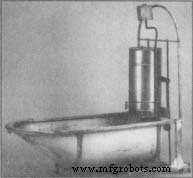 This 1920s bathtub folded for storage and included its own hot water heater. (From the collections of Henry Ford Museum & Greenfield Village.)
In the 19th‑century U.S., most city dwellers relied on pails and sponges. By the 1920s, central water systems enabled mass production of sanitary enameled fixtures, making bathtubs a domestic staple.
Forming Processes
- Injection molding: Melted plastic is pressurized into a cooled mold, then solidified. A reciprocating screw machine repeatedly melts, injects, and cools the plastic for high‑volume production.
- Compression molding: Used for plastic and fiber‑reinforced tubs. Resin, fibers, pigments, and fillers are combined into a sheet, then pressed under high pressure in steel dies to cure.
- Hand lay‑up and spray lay‑up: For fiberglass tubs. Hand lay‑up involves manual placement of reinforced layers; spray lay‑up uses a stream of chopped fibers and resin, allowing automation and faster cycle times.
The Future
New residential construction remains the primary driver of bathtub demand. Over the past decade, the share of new single‑family homes with two and a half or more baths has doubled to roughly 44%, signaling continued growth as the economy recovers.
Design trends reflect regulatory and safety considerations. The Americans with Disabilities Act has spurred patented accessible tubs, while plastic’s molding versatility has led to integrated bathtub‑shower units. Slip‑resistant coatings and leak‑proof features—such as moisture barriers and fully integrated walls—are becoming standard.
Manufacturing process
- Steel Wool: History, Production, and Safety Insights
- Steel Pipe: Types, History, and Modern Manufacturing
- The Craft of Scissors: From Ancient Spring Blades to Modern Precision Tools
- Zinc: Properties, Applications, and Production Process
- Stainless Steel: Properties, Manufacturing, and Future Applications
- What Is A2 Steel? A Versatile, Cost‑Effective Tool‑Steel Grade for Industrial and Woodworking Applications
- The Role of Nitrogen in Steel Performance
- Advanced Ladle Metallurgy: Precision Refining for High-Quality Steel
- Optimizing Steel Quality: The Critical Role of Deoxidation
- Steel vs. Stainless Steel: Choosing the Right Metal for Your Project