



The Craftsmanship Behind the Classic Baseball Bat
Background
When the game of baseball was first played, players used sticks to hit the ball. By the time the sport was formally organized, each player either whittled his own bat or purchased one from a local woodturner. The 1863 league specifications were broad: any wood was allowed, and the bat had to be round, no thicker than 2.5 inches (6.5 cm) at its widest point, but there was no limit on length. Early bats weighed between 48 and 50 ounces (1 1361–1 1417 g) and had an average handle circumference of 4.5 inches (11.4 cm). The substantial weight kept home runs rare. By the 1960s, players such as Hank Aaron began using shorter, lighter bats that allowed them to send balls into center‐field seats. Aaron’s bat measured 35 inches (89 cm) long and weighed 33 ounces (979 g).
Today’s rules cap bat length at 42 inches (107 cm) and diameter at 2.75 inches (7 cm). No weight limit applies, but the bat must be made of solid wood—no metal, cork, or other reinforcement is permitted. Over the years, several major‐league stars have tried to gain an edge with reinforced bats. A colorful episode involved Albert Belle’s bat, which was confiscated during a 1994 game at Comiskey Park. The bat disappeared from the umpires’ locker room and was returned anonymously the next day, only to be found with a corked center. Belle received a temporary suspension, and the mystery remains unsolved.
Hillerich & Sons, a Kentucky wood‐turning shop, pioneered dedicated bat manufacturing. According to company lore, in 1884 John "Bud" Hillerich witnessed a Louisville Eclipse player, Pete "Old‐Gladiator" Browning, break his bat. Bud custom‐made a new bat from a white ash piece. The next day, Browning delivered three hits in three at‐bats. The success led Bud to convince his father to add bat production to the family business, and the first model was christened the "Louisville Slugger." The company later became Hillerich & Bradsby in 1911 when sporting‐goods magnate Frank Bradsby joined.
Players have long been particular about their bats. Frank Frisch, a five‐time World Series champion, hung his bats like sausages in a barn during the off‐season. Boston Red Sox legend Ted Williams soaked his bats in alcohol to keep them cool during hitting streaks and sought wood with narrow growth rings. Babe Ruth preferred pin‐knotted barrels. These anecdotes illustrate the personal rituals that underscore the sport’s craftsmanship.
 Traditional 40‐to 50‐year‐old ash trees are prized for their strength, flexibility, and light weight.
Raw Materials
Ash trees from Pennsylvania and upstate New York supply most baseball bats. The ideal trees grow in sheltered clusters, forcing them to grow straight toward the sun. After 40 to 50 years, a trunk reaches 14–16 inches (36–41 cm) in diameter, yielding roughly 60 bats per tree. Foresters mark suitable logs with spray paint; log cutters fell them with chainsaws, leaving top branches in the forest. The trunks are cut to 10–16-foot (3–5 m) lengths, inspected for knots and grain, and then sliced into 40-inch (101 cm) splits. Only about half of the harvested wood meets bat‐grade standards.
The Manufacturing Process
Turning the splits into billets
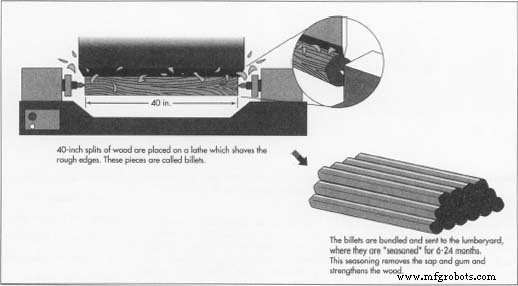
- 1 A mill worker places each split onto an automatic lathe, shaving off rough edges while rotating the wood. The resulting billets are inspected for straight grain, bundled into six-sided packs, and painted with a protective preservative to prevent fraying. The bundles are then trucked to the bat manufacturer’s lumberyard.
Seasoning the billets
- 2 Billets arriving as "green" wood still contain sap and gum. They are stacked in the yard and left to air-dry for six months to two years, a process called seasoning that strengthens the wood.
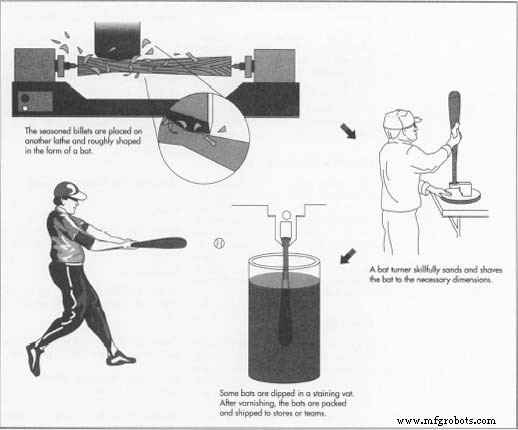 Bat turners are highly skilled artisans who shape the final product. When an order arrives, a turner selects a billet from storage and crafts a replica of the requested model.
Shaping and sanding the billets
- 3 After drying, billets are weighed and inspected. Each is placed on an automatic lathe to form a rough bat shape with a narrowed neck. The bat is sanded, inspected again, and sorted by weight.
Matching the bat to the model
- 4 The manufacturer keeps a catalog of every model, usually labeled by the player who ordered it. For example, an order might read: six Johnny Bench models, ten Hank Aaron models, four Mickey Mantle models. The turner selects a billet matching the requested weight and length, places it on the lathe, and uses a model bat as a guide. Calipers and a scale measure the bat every 1‒2 inches (2.54–5 cm) until it matches the prototype exactly.
Branding, staining, and varnishing the bats
- 5 The bat receives the company trademark and the player’s signature, positioned a quarter-turn from the sweet spot. If requested, the bat is dipped in a staining vat. All bats are then varnished, packed into cartons, and shipped to the player or team.
Quality Control
Structural integrity is verified through repeated impact testing. Some factories use compressed-air cannons to fire baseballs at precise points on the bat; high-speed cameras capture the impact while accelerometers record velocity. Other plants employ robotic arms that strike the bat off oversized golf tees. Inspectors analyze bending frequency and ball flight to ensure consistency.
The Future
Despite assurances that ash supplies remain adequate, composite and aluminum bats continue to develop. A typical composite bat features a plastic foam core surrounded by resin-impregnated synthetic fibers. Recent innovations include "lanxide," a ceramic-enforced material. Proponents argue that non-wood bats resist breakage and dramatically increase batting average. However, amateur and college players are permitted to use composite and aluminum bats, whereas Major League Baseball mandates all-wood bats. The sport’s deep tradition makes a wholesale shift to non-wood materials unlikely, as it would alter historic records.
Manufacturing process
- What is VMC Machining? An Expert Overview of Vertical Machining Centers
- Expert Guide to Aluminum Laser Marking: Precision, Durability, and Industry Applications
- MIG vs. TIG Welding: Selecting the Right Arc Welding Technique for Your Project
- Comprehensive Guide to Laser Marking: Types, Benefits, and Applications
- Key Considerations for High‑Volume Swiss Machining
- The Baseball Cap: From Design to Production – A Deep Dive
- The Craftsmanship Behind the Classic Baseball Bat
- The Craftsmanship and Standards Behind Every Official MLB Baseball
- The Evolution and Craftsmanship of Baseball Gloves: From 19th‑Century Beginnings to Modern Innovations
- Beyond Baseball Caps: Protecting Workers with Proper Head Safety