



The Evolution and Craftsmanship of Baseball Gloves: From 19th‑Century Beginnings to Modern Innovations
Background
In the years following the Civil War, baseball spread across the United States with the speed of a cavalry charge. Yet the idea of wearing a glove was still seen as unmanly. The first recorded players to don leather protection were Charles G. Waite (or Waitt), a first‑baseman for a Boston professional team in 1875, and Doug Allison, a Cincinnati Red Stockings catcher in 1869. Waite, conscious of his reputation, chose flesh‑colored gloves to keep them inconspicuous.
By 1880 a padded catcher’s mitt had appeared, and by the turn of the twentieth century most players wore some form of glove. Those early models were primitive by today’s standards, yet they demanded high craftsmanship and were heavily padded to protect the catching hand. It wasn’t until the late 1930s that the glove’s design evolved into a true aid for both catching and playing.
Modern gloves allow a player to perform one‑handed catches with the precision of a surgeon, and a catcher’s mitt can extract a ball from the air as if using tweezers. The once‑essential two‑handed catch has become a useful but rarely necessary skill.
Today’s gloves differ in heel thickness, web design, and palm depth. Outfielders favor large, deep‑palm gloves for fly balls, while infielders prefer smaller gloves for quick grip and throw. Most outfielders break their gloves vertically; infielders typically break them horizontally.
Improving design, efficiency, and protection is an ongoing process. A baseball glove reflects over a century of history and more than thirty patents—an enduring creative endeavor.
Raw Materials
Except for small plastic reinforcements at the base of the small finger and thumb, and a nylon thread, a glove is made entirely of leather, usually from cattle. Texas‑based Nocona Glove Company also incorporates kangaroo hide from Australia; this softer hide shortens the breaking‑in period.
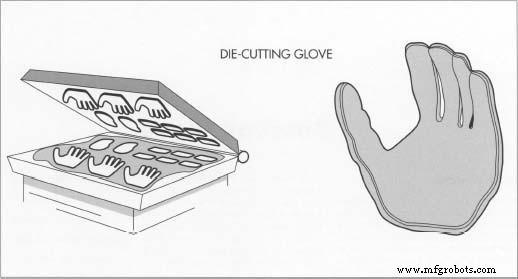
The first step in manufacture is die‑cutting cowhide into four pieces—shell, lining, pad, and web—using a machine that mimics a cookie cutter.
Cowhides are processed by a tannery; the finest, blemish‑free hides are sent to glove factories. Tanning chemically treats the hides, preventing drying and flaking. Rawlings, for example, relies on a single tannery to supply all its leather. Each cowhide yields three or four gloves. Rawlings also cuts and tans its own leather for lacing, which requires different durability and flexibility. While synthetic materials have been tested, none yet match leather’s resilience, stretch, and feel.
The Manufacturing Process
When cowhides arrive at the factory, they are already cured (salting or drying) and tanned, preparing them for glove production. They are then graded for color and strength in a laboratory.
The manufacturing process is relatively straightforward: cut the parts, then stitch them together with rawhide leather.
Die‑cutting the glove parts
- 1. The hide is die‑cut into shell, lining, pad, and web.
- 2. Before cutting, the manufacturer’s logo—usually foil tape—is burned into the leather with a brass stamping die.
Shell and lining
- 3. The shell is sewn inside‑out, then turned right‑side‑out and its lining inserted. Before reversal, the shell is mulled (steamed) to maintain flexibility and prevent cracking.
- 4. The turned shell is placed on a hot hand—a hand‑shaped metal form—ensuring correct sizing and properly opened finger stalls.
Inserting the pad and plastic reinforcements
- 5. A pad is inserted into the heel. Superior gloves use two‑part pads that allow the glove to flex correctly. Catcher’s mitts, which need thicker palms, use five leather layers.
- 6. Plastic reinforcements are added at the thumb and little finger to protect the player’s fingers from accidental bending.
Web
- 7. Before lacing, the web is assembled from several leather pieces—usually two to six—depending on the desired web type.
Lacing and stitching
- 8. Lacing—typically a single rawhide piece up to 80–90 inches long—begins at the thumb or little finger and holds the glove together. Non‑leather stitches (e.g., nylon) are used for parts like the web.
- 9. The strap across the back of the hand was once lined with shearling; today it is made from synthetic material.
- 10. Catcher’s mitts and first‑base gloves are hand‑assembled from palm, pad, back, and web, then laced with rawhide.
- 11. The final lay‑off operation places the glove back on the hot hand to correct any shaping issues and ensure finger stalls remain open.
Quality Control
Quality control begins when hides arrive at the factory, where they are graded for color and strength. Rawlings, for instance, uses only about 30% of a hide to produce three or four gloves.
Because glove making requires personal attention at every step, each craftsman acts as a quality controller. If a defect appears, the worker removes the glove from production.
Some purists prefer older methods and products. The Gloveman in Fremont, California, led by Lee Chilton, restores vintage gloves for current use and offers its own line of catcher’s mitts. Chilton insists that the best gloves can be found second‑hand and restored.
Professional Gloves
Professional gloves are often the same models—sans autographs—that anyone can purchase. Players receive free gloves (and a fee) in exchange for signing endorsements. Most professionals keep the same model they used in college, high school, or even little league.
According to Bob Clevenhagen, Master Glove Designer at Rawlings, “ball players are conservatives who stick with what works.”
The Future
Glove design continues to refine rather than revolutionize. Past innovations included lacing the fingers, redesigning the pocket and heel, and creating the one‑handed catcher’s mitt. In the 1950s, Rawlings introduced a six‑fingered glove at Stan Musial’s request to serve both first base and infield positions.
Manufacturers retire models—like the Rawlings Playmaker of the 1950s—as styles change. Current trends focus on visibility: catcher’s mitts now feature fluorescent edging to improve targeting, and in August 1992, Neumann Tackified Glove Company announced black gloves with a white palm to aid passing between players.
Manufacturing process
- The Evolution and Craftsmanship of Modern Boxing Gloves
- The Baseball Cap: From Design to Production – A Deep Dive
- The Craftsmanship Behind the Classic Baseball Bat
- The Craftsmanship and Standards Behind Every Official MLB Baseball
- DIY Low‑Cost Glove Controller & Propeller Car – Build Your Own Arduino Hand Controller
- Smart Gesture-to-Text Hand Glove for Sign Language
- CNC Machinist Safety: Best Practices for a Secure Workshop
- MIT Engineers Develop High-Precision Touch-Sensing Glove for Medical Diagnostics
- Advancements in Grasp‑Assisting Gloves for NASA Space Missions
- Featherlite Thin Work Gloves – Ultimate Hand Protection for Automotive Assembly