



The Craftsmanship and Standards Behind Every Official MLB Baseball
Background
Modern baseball, as we know it, traces its lineage back to the English game of rounders. In 1845, New York pioneer Alexander Cartwright formalized the first set of rules that replaced the soft ball used in rounders with a smaller, harder version, setting the stage for the sport’s rapid evolution in the United States.
While the ball’s exterior appears simple, it is in fact a meticulously engineered object that has sparked debate over the decades. Critics have alleged that baseballs have been secretly “juiced” to increase home‑run totals during periods of declining attendance. Major League Baseball (MLB) and ball manufacturers consistently deny such claims, and no credible evidence of covert alterations has ever emerged.
An official MLB baseball consists of a cushioned cork core—referred to as the “pill”—enclosed in two layers of rubber, wrapped in four concentric strands of wool and poly/cotton yarn, and finally covered by stitched cowhide. Roughly 600,000 baseballs are produced for all MLB teams each season. In a typical game, a ball stays in play for only five to seven pitches. Every ball must weigh between 5 and 5.25 ounces (141.75–148.83 grams) and measure 9 to 9.25 inches (22.86–23.49 cm) in circumference to meet league standards.
Early in the sport’s history, balls were handmade or custom‑ordered by cobblers, tanners, and small manufacturers. The first uniform specifications for weight and size were adopted in 1872, and production consistency improved under the new National League’s demands.
In the early 1900s, the ball’s core transitioned from a rubber shell to a cork‑centered design in 1910, and two decades later to a cushioned cork core that remains in use today. The only major change since then was the switch from horsehide to cowhide covers in 1974, prompted by a shortage of horsehair.
Raw Materials
The baseball’s construction is composed of three layers: a cushioned cork core, wool and poly/cotton windings, and a cowhide cover.
The core—a sphere 13/16 of an inch (2.06 cm) in diameter—is made of a cork and rubber composite and encased in two rubber shells: a black inner layer and a red outer layer. The entire core measures 4‑1/8 inches (10.47 cm) in circumference.
Four layers of yarn wrap around the core. The first is a four‑ply gray woolen yarn, the second a three‑ply white woolen yarn, the third a three‑ply gray woolen yarn, and the fourth a white poly/cotton finishing yarn. The wool’s natural “memory” allows it to compress under pressure and rebound to its original shape, preserving the ball’s roundness throughout play. The poly/cotton blend protects the wool and strengthens the outer cover.
The cover is made of Number One Grade, alum‑tanned, full‑grained cowhide sourced mainly from Midwest Holstein cattle, chosen for their superior grain and smoothness. Official MLB balls feature a white cover stitched with 88 inches (223.52 cm) of waxed red thread. Prior to use, each hide is tested for thickness, grain strength, tensile strength, and other critical parameters.
The Manufacturing Process
Manufacturing a baseball is a multi‑step process that layers rubber, fabric, and hide around a small cork sphere under precise conditions to ensure consistent size, shape, and quality.
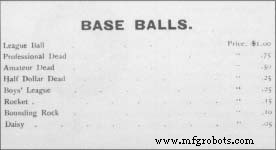 An advertisement for baseballs from the 1891 catalog of Horace, Partridge & Co.
Mark Twain famously described baseball as “the symbol of the 19th‑century drive and struggle.” The sport gained rapid popularity after the Civil War, evolving from leisurely play among gentlemen to a fast‑paced, physical competition that eclipsed its English counterparts such as cricket and rounders.
In the 19th century, the ball’s liveliness varied: the first ball was overly lively, sometimes producing scores above 100 runs; the second was too dead, leading to 24‑inning, scoreless games that highlighted the need for balance. By 1888–89, A. G. Spalding introduced a series of baseballs in both boys’ and regulation sizes, priced between four cents and one dollar.
William S. Pretzer
Molding the Rubber Pill
- Two hemispherical black rubber shells, each about 5/3 of an inch (0.39 cm) thick, are molded over a rubberized cork core measuring 13/16 of an inch (2.06 cm) in diameter. Small openings in the shells are sealed with red rubber gaskets.
- A thin layer of red rubber, roughly 3/32 of an inch (0.24 cm) thick, is applied over the black shell. The complete core weighs approximately 24.80 g (0.88 oz) and measures 4‑1/8 inches (10.48 cm) in circumference. A cement coat secures the wool yarn during the first winding.
Winding the Fabric
- Controlled‑temperature wool yarn is wound around the core by computerized machines that maintain high tension, eliminating “soft spots” and ensuring a uniform surface. The yarn is wound in three layers: 121 yd (110.6 m) of four‑ply gray, 45 yd (41.13 m) of three‑ply white, and 53 yd (48.44 m) of three‑ply gray. After each layer, the ball is weighed and measured to confirm compliance.
- A 150 yd (137.1 m) poly/cotton finishing yarn protects the wool and keeps it in place. The ball is trimmed of excess fabric, then dipped in an adhesive solution before the hide is applied.
Sewing the Hide
- The cowhide cover is cut into two figure‑8 pieces, each covering half the wound ball. The hides are dampened for pliability, then coated with adhesive.
- The two pieces are stapled to the ball and hand‑stitched together using 88 inches (223.52 cm) of waxed red thread. The process involves 108 stitches, with the first and last hidden. It takes roughly 13–14 minutes to complete.
- After stitching, staples are removed, and the ball is rolled for 15 seconds to level any raised stitches. Final measurements, weight checks, and visual inspections are performed. Approved balls receive the manufacturer’s trademark and league designation stamp.
Quality Control
Every shipment of baseballs undergoes statistical sampling for the Coefficient of Restitution (COR), the industry standard for measuring a ball’s resiliency. Using MLB‑approved procedures, a ball is launched from an air cannon at 85 ft/s (25.90 m/s) toward a wooden wall eight feet (2.43 m) away. The rebound speed must equal 54.6 % of the launch speed, ±3.2 %.
Additionally, a ball must retain its round shape after 200 strikes with a 65‑lb (29.51 kg) force and deform less than 0.08 in (0.20 cm) when compressed between two anvils.
The Future
The dimensions and raw materials of MLB baseballs are expected to remain stable. 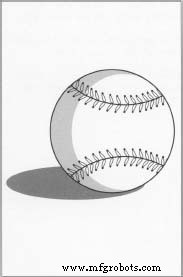 A finished MLB ball, stitched with 88 inches of waxed red thread, weighs 5–5.25 oz and measures 9–9.25 in in circumference.
Automation attempts for sewing cowhide covers have yet to succeed; current machines struggle with start‑stop control and tension variation—critical for secure stitching without tearing. Consequently, the hand‑sewn tradition is likely to persist.
Controversy over “juiced” balls will likely endure as long as baseball is played and fans seek explanations for variations in home‑run output.
Manufacturing process
- Gyroscopes: From Classic Toy to Modern Navigation Masterpiece
- The Baseball Cap: From Design to Production – A Deep Dive
- Mercury: Uses, Production, and Environmental Impact
- The Craftsmanship Behind the Classic Baseball Bat
- The Evolution and Craftsmanship of Baseball Gloves: From 19th‑Century Beginnings to Modern Innovations
- Micro Craft: Decades of Excellence in Aerospace Testing Solutions
- Optimizing Blast Furnace Design for Superior Performance and Longevity
- AMPCO® 22 Forgings – Duplex Alloy with Exceptional Hardness, Compression & Wear Resistance
- UGIMA® 4542 – Premium Machinable Precipitation‑Hardened Stainless Steel
- POM (Polyoxymethylene) CNC Machining: Superior Properties & Applications