



The Evolution and Craftsmanship of Modern Boxing Gloves
Background
Boxing has entertained humanity for millennia, dating back 6,000 years to ancient Ethiopia. Over time, societal concerns about brutality led to protective gear, with the boxing glove emerging as the sport’s most enduring invention.
History
Olympic boxing debuted in 688 B.C., where athletes wrapped their hands in leather strips—initially for protection, later hardened into weapons. The Romans called these strips cestus, sometimes studded with iron or brass, and occasionally fitted with a spike known as a myrmex that could be lethal.
The modern glove is credited to English champion Jack Broughton. While fighting bare knuckles, Broughton developed padded “mufflers” for gym use, allowing gentlemen to train safely. Although his 1743 rules omit gloves, the 1867 Marquis of Queensberry rules explicitly required “fair‑sized, new, high‑quality” gloves. These regulations paved the way for the padded mitts that are standard in today’s competitions.
American heavyweight John L. Sullivan, champion from 1882‑1892, was among the first to wear gloves in public bouts, even though his title fights were governed by the older Prize Ring rules. He famously used gloves in his final fight against James “Gentleman Jim” Corbett, the first champion under the Queensberry rules.
Raw Materials
The exterior shell is traditionally top‑grain tanned cowhide or goatskin for durability and flexibility. While vinyl alternatives exist, sanctioning bodies for both amateur and professional bouts mandate leather. Lining often consists of nylon taffeta, stitched with nylon thread. Padding is typically high‑density polyurethane foam, sometimes blended with latex or PVC sheets. Historically, cotton batting—and occasionally horsehair—has also been used.
Design
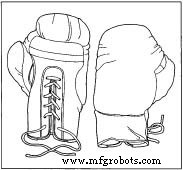
Effective padding compresses to absorb impact energy; too much compression reduces protection. Different weight classes therefore use gloves of varying pad thickness. The ideal material balances energy absorption with “memory”—the ability to return to shape after impact, preventing a “flat” glove after repeated blows.
Regulatory bodies influence design: USA Boxing requires thumbless or thumb‑attached gloves to prevent eye jabs, while Olympic gloves feature a white‑dyed knuckle area for scoring. These rules ensure both safety and fair play.
The Manufacturing Process
Patterns and Cutting
All gloves are handcrafted: cutting, stitching, stuffing, and finishing are performed by skilled artisans. The process starts with pattern placement on raw leather, optimizing material usage. Key components include the palm (with a central slit for closure), a single‑piece knuckle, a split thumb, a wide cuff strip, and a thin edge‑trim piece. The knuckle is cut larger than final size to allow for padding.
- 1. Leather from the tannery is laid on cutting tables, patterns are traced and cut with large scissors. Corresponding lining pieces are cut simultaneously.
Assembly and Stitching
- 2. The leather shell is sewn inside out, often with industrial machines; high‑end gloves are fully hand‑stitched with double stitching for durability.
- 3. The oversized knuckle is attached to the palm over a buckle, creating the glove’s signature clenched‑fist shape.
- 4. Lining pieces are added, and the palm is stuffed. Depending on design, the thumb is assembled separately or as part of the knuckle.
Stuffing the Glove
- 5. The assembly is turned right‑side out. Padding sheets are layered, cut to the glove’s profile, and stuffed into the knuckle pocket.
- 6. Manufacturers often pre‑cut padding patterns for quick assembly.
- 7. Layered padding is inserted to achieve the specified weight and density.

Finishing the Glove
- 8. The cuff is stitched to its lining, stuffed, and left open for closure.
- 9. The cuff assembly is sewn to the glove’s open end, sealing the padding.
- 10. For lace closure, a template is applied, holes punched with an awl, and reinforced with stitching.
- 11. For hook‑and‑loop closure, the loop side is sewn to the cuff’s outer face, and the hook side to the opposite edge.
- 12. A thin leather trim seals the edge; brand and sanctioning labels are sewn onto the cuff. Gloves are then packaged for shipment.
Quality Control
Each country’s boxing commission enforces equipment standards. In the U.S., bodies like USA Boxing and Golden Gloves set glove specifications. Wayne State University’s Sports Biomechanics Department conducts rigorous testing: a glove is mounted on a maple block mimicking a fist, struck by a hydraulic ram, and impact data are recorded by a sensor‑equipped dummy. The severity index ensures gloves meet safety thresholds.
The Future
While the basic form of the glove has remained stable, material science has driven incremental improvements. Modern padding offers greater resilience, yet some experts warn that enhanced protection may inadvertently enable more forceful punches. Innovations such as thumb‑free designs have seen limited adoption, reflecting boxing’s resistance to change. Nonetheless, the evolution of glove technology continues to balance tradition with athlete safety.
Iconic Boxer: Muhammad Ali
Born Cassius Marcellus Clay on January 17, 1942, in Louisville, Kentucky, Ali dominated amateur boxing, winning six Kentucky Golden Gloves titles across weight classes and securing Olympic gold in 1960. He became the first African‑American heavyweight champion in 1964, converting to Islam and renaming himself Muhammad Ali. His career spanned controversies, including draft refusal in 1967, which led to a temporary ban and legal battles that ultimately affirmed his constitutional rights. Ali’s professional record—59 wins, 3 losses—cemented his legacy, and he was posthumously inducted into the International Boxing Hall of Fame in 1990.
Manufacturing process
- Amber: From Ancient Resin to Scientific Treasure – History, Properties, and Modern Uses
- The Guillotine: History, Design, and Legacy
- Silicon: Properties, Production, and Market Outlook
- The Ukulele: From Portuguese Roots to Modern Craftsmanship
- The Complete Guide to the U.S. Chicken Industry: History, Production, and Quality Control
- Compost: The Ultimate Soil Enrichment Solution
- Gelatin: From Ancient Protein to Modern Applications – Production, Uses, and Safety
- The Evolution and Manufacturing of Modern Pin‑Tumbler Locks
- Vodka: From Ancient Distillation to Modern Production
- Milk: Production, Processing, and Nutrition in the United States