



Decorative Plastic Laminate: From Formica to Modern Manufacturing
Background
Decorative plastic laminate is a durable, flat‑sheet material prized for its resistance to stains, scratches, and heat. Widely recognized under the Formica brand, it is produced by the world’s largest manufacturer, the Formica Corporation, as well as Premark and DuPont.
History
Invented in the early 1900s by engineers Herbert A. Faber and Daniel J. O’Conor, plastic laminate began as an insulating material for industrial and electrical applications. They first applied Bakelite‑impregnated paper at Westinghouse in Pittsburgh, eventually patenting a flat laminate sheet in 1913. The name “Formica” was coined to signify “for mica,” reflecting its replacement of mineral mica as an insulator.
After establishing the Formica Insulating Company in 1913, the duo shifted focus to flat sheets, quickly finding a decorative niche. By 1927, lithographic printing allowed realistic wood‑grain and marble patterns, expanding its use from radios to kitchen and dining furniture. Manufacturing advancements in the 1940s further enhanced durability, making laminate a staple in both domestic and industrial interiors.
Raw Materials
Modern laminate consists of three layers:
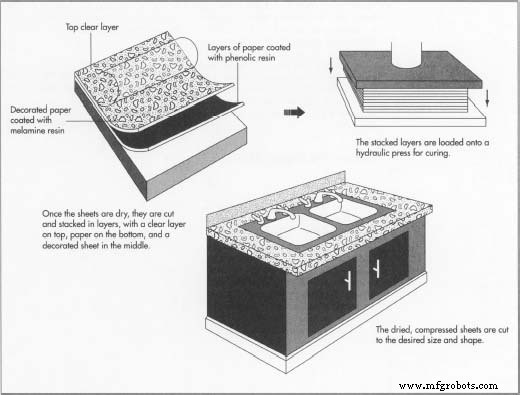
- Bottom: kraft paper saturated with phenolic resin (a polymer of phenol and formaldehyde).
- Middle: decorative paper printed with the desired pattern, also impregnated with melamine resin.
- Top: clear melamine‑coated sheet providing a glossy, protective finish.
Typical laminates combine 7–18 paper layers, depending on the required thickness and application. The paper ribbons are usually 3–5 feet wide.
The Manufacturing Process
1. Paper Impregnation
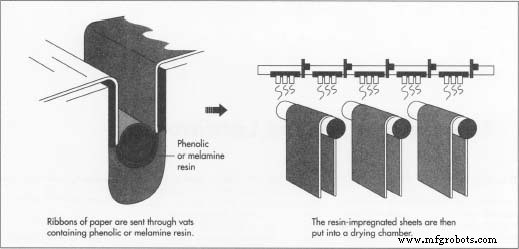
- Paper ribbons are soaked in a phenolic resin bath for the kraft layers and in a melamine resin bath for the top and decorative layers.
- The process can be customized to produce a wide range of thicknesses and patterns.
2. Drying
- Resin‑soaked sheets are stacked with the decorative layer and clear top on the outside, then dried in a controlled chamber.
3. Thermosetting
- Stacks are pressed in a flat‑bed hydraulic press at 1,400 psi while heated to high temperatures.
- During this stage, phenol/melamine and formaldehyde molecules form cross‑linked chains, releasing water and creating a single, rigid sheet that is heat‑stable and insoluble.
4. Finishing
- The cured laminate is cut to specification and may be bonded to substrates such as plywood, particleboard, or metal.
Byproducts & Environmental Impact
Traditional manufacturing emits phenolic and melamine vapors, and some pigments used in decorative papers are metal‑based and hazardous. Major manufacturers now mitigate these risks by:
- Switching to water‑based phenolic resins, reducing toxic emissions.
- Updating melamine formulations to virtually eliminate alcohol by‑products.
- Installing packed‑column scrubbers to capture particulate matter.
- Burning paper and laminate waste in boilers to minimize landfill use.
- Gradually eliminating metal‑based pigments to further reduce environmental impact.
While decorative laminate itself is not recyclable, some companies repurpose used sheets into new sample sets for distribution.
Manufacturing process
- Premium Plastic Dolls: From Playtime to Collectible Art
- Cushioning Laminates: Production, Materials, and Future Trends
- From Paper to Polypropylene: The Modern Manufacturing of Drinking Straws
- Acrylic Plastic: Properties, Production, and Future Trends
- Premium Plastic Food Wrap: Preserve Freshness & Seal Odors
- The History, Production, and Recycling of PET Soda Bottles
- Multi-Material Plastic Hardware Solutions for Industrial & Medical Applications
- Choosing Between Plastic and Metal: Expert Insights for Optimal Material Selection
- DIY Robot Gripper: Build an Arduino-Driven Plastic Hand
- Plastic vs. Wood Pallets: Selecting the Optimal Choice for Your Supply Chain