



Dental Floss: From Production to Cutting‑Edge Innovations
Background
Dental floss is a slender filament designed to dislodge debris lodged between teeth and along the gum line. In 1994, Americans collectively used more than 2.5 million miles of floss—an amount equivalent to circling the globe over 100 times.
Flossing removes plaque, a sticky, bacteria‑laden film that forms on tooth surfaces and below the gum line. When plaque is not removed, it calcifies into tartar. Accumulated tartar can trigger gingivitis, an inflammatory gum condition marked by redness, swelling, and bleeding. If untreated, gingival pockets form, inviting infection that ultimately erodes the bone supporting the teeth and can lead to tooth loss. For this reason, dental professionals recommend daily flossing for adults and children over ten years old. Regular flossing interrupts bacterial colonization, preventing plaque buildup and the cascade of gum and bone disease.
Floss comes in string or ribbon forms and can be lightly waxed, fully waxed, or un‑waxed. Flavors such as cinnamon, mint, bubble‑gum, and plain are available. Ribbon floss is best suited for wide gaps, making it the preferred choice for children’s widely spaced teeth, whereas string floss excels in tight contacts. Waxed or lightly waxed floss is recommended for crowded or misaligned teeth because the coating reduces friction and protects the gum line.
Raw Materials
Dental floss is typically made from one of two polymers: nylon or Teflon (polytetrafluoroethylene, PTFE). Nylon is a long‑chain polyamide—essentially a fiber‑forming synthetic polymer—while PTFE is a fluoropolymer known for its low friction and chemical resistance. Additional ingredients include wax coatings, flavoring agents, and proprietary additives that vary by manufacturer.
The Manufacturing Process
Filament extrusion and twisting (for nylon)
- 1. Nylon is polymerized from nylon salt and extruded into a ribbon. The ribbon is then cut into chips, flakes, or pellets, remelted, and pumped through spinnerets to form filaments. Upon cooling, the filaments solidify and gather into yarn. The ends of the filaments are joined to create a single floss strand. Proper twisting—typically 2.5 to 3.5 turns per inch—adds strength and reduces fraying.
- Floss is quantified in decitex (weight of 10 000 m of unwaxed nylon in grams) or denier (weight of 9 000 m of uncoated floss in grams). Higher values correspond to thicker strands.
Making floss with Teflon
- 2. PTFE is melted into a paste and stretched into a thin strand. The polymer is then expanded and cut to create various denier grades. PTFE is a monofilament, eliminating the need for twisting and offering superior resistance to shredding.
Filament coating
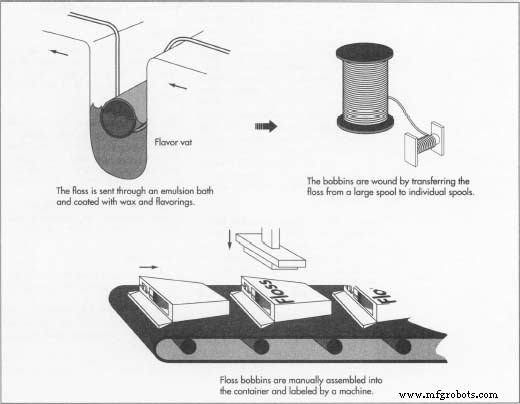
- 3. Coatings are applied by immersing the floss in emulsion baths containing waxes, flavors, and other additives, ensuring a uniform finish.
Bobbin winding
- 4. Floss bobbins are wound in either cylindrical or roll‑type spools. Cylindrical bobbins, dispensed through tubes or rectangular packages, can accommodate more yarn. Roll bobbins, the traditional format, are dispensed from flat containers and wound from the outer layer.
Case molding
- 5. The standard case for nylon floss is an angled, two‑piece polypropylene design with an insert that holds the spool. Many manufacturers now use a one‑piece “clam‑shell” construction featuring a window to gauge usage and grooves for easier gripping.
Assembly
- 6. Bobbins are manually assembled into the container. The core is cut off, the floss is threaded around a metal cutting clip, and the cover is closed. The package is then ready for labeling, or if pre‑decorated, for packing and shipping.
Decoration
- 7. Three primary decoration methods exist: pad printing, labeling, and thermal transfer. Pad printing is most common in the U.S.; labeling is preferred for European exports; thermal transfer offers higher image quality and a broader color range.
Packaging
- 8. Blister packaging—plastic molds affixed to cardboard backing—allows products to hang on display pegs, prominently displays the brand, and eliminates paper packaging, improving environmental friendliness. A growing trend is to co‑pack floss with toothbrushes, toothpaste, or mouthwash.
The Future
Innovation is reshaping floss technology. Oral‑B Laboratories introduced Oral‑B ULTRA FLOSS, featuring a patented network of interlocking fibers that resists shredding and fraying. Its woven, spongy texture stretches thin between tight spaces and springs back to trap plaque. ULTRA FLOSS is gentle on sensitive gums, easier to handle, and pre‑measured into 18‑inch (46 cm) segments, the length recommended by the American Dental Association.
John O. Butler Company launched Butler‑Weave, a floss that behaves like dental tape. This smooth, shred‑resistant material spreads when pulled between teeth, increasing surface contact for effective plaque removal. Its thin, flat profile glides effortlessly between tight contacts.
Manufacturing process
- Professional Teeth Whitening: History, Ingredients, and Future Trends
- Dental Crowns: Materials, Design, and Modern Fabrication Techniques
- The Dental Drill: History, Design, and Future of Modern Dentistry
- Dentures: Types, History, and Modern Manufacturing for Optimal Oral Health
- From Flint to Factory: The Evolution, Manufacturing, and Future of Handheld Saws
- The Evolution and Science of Toothbrushes: From Ancient Roots to Modern Innovation
- 3D Systems NextDent 5100: High‑Speed, Accurate Dental 3D Printing Solution
- Why DATRON Dental Tools Are the Best Choice: 5 Key Advantages
- Revolutionizing Dental Care: Advanced 3D Printing Applications
- Choosing the Right Blade for Cutting: Types, Teeth, and Materials