



Diamonds: History, Mining, and Modern Applications
Background
Diamonds are the hardest naturally occurring material, composed of a crystalline lattice of carbon atoms. They form within kimberlite, an igneous rock created by deep‑mantle volcanic eruptions that have shaped Earth’s crust for millions of years. Kimberlite is found in vertical shafts beneath former volcanic zones, often adjacent to mountain ranges. Within these pipes, diamonds appear as intermittent pockets among other minerals such as mica, garnet, and zircon. Kimberlite itself may display a blue‑grey “blue ground” tone or a yellowish “yellow ground” hue when exposed to air.
History
Archaeological evidence places the first discovery of diamonds in the riverbeds of the Indian subcontinent around 6,000 years ago. From there, traders carried the gems as far east as China and as far west as Rome during the classical and early medieval periods. The Chinese were the first to exploit the diamond’s exceptional hardness, using it to cut other stones. Pliny the Elder documented the gemstone in the first century CE. The word “diamond” derives from the Greek adamas, meaning “invincible” or “unconquerable.”
Because of their rarity, early diamonds were wrapped in myth. Some cultures believed that wearing a diamond could grant victory in battle or ward off poison, while others cautioned that placing a diamond in the mouth could cause dental loss. Fine powdered diamond was feared as a potent poison, given its ability to create microscopic perforations in tissues. Throughout history, diamonds have commanded extraordinary prices, serving as a portable store of wealth during times of conflict and instability.
The industrial mining of diamonds began in India around 800‑600 BC. The first known deposits outside India were discovered in Borneo in AD 600. By the Middle Ages, the gem was eclipsed by rubies and emeralds in European courts because gem‑cutting techniques were not yet advanced enough to showcase its brilliance. The breakthrough came in the 17th century when Venetian lapidary Vincenzo Peruzzi introduced the brilliant cut, revealing the stone’s full potential.
 Diamond mining expanded in the 18th century to Brazil, Australia, Russia, and the United States. Brazilian stones were initially shipped to India and sold as “Indian diamonds” to meet market perceptions of value. In the 20th century, a novelty mine opened near Murfreesboro, Arkansas, offering public diamond‑panning for a modest fee. Siberian diamonds, though abundant, remain largely untapped due to extreme cold and logistical challenges.
In 1866, the world’s largest diamond deposit was uncovered in South Africa, sparking a rush that birthed shantytowns of prospectors. The region’s mines were consolidated under the DeBeers conglomerate, which now controls roughly 80% of global diamond production. DeBeers’ Central Selling Organization and Diamond Trading Company release pre‑selected lots to a select group of wholesalers every six weeks, making South African diamonds the most sought after on the market.
Industrial Applications
In the early 20th century, Henry Ford championed the industrial use of diamonds as cost‑effective abrasives. The Detroit area quickly became a hub for diamond tool manufacturers. Since then, aerospace, oil and gas, optics, and even music equipment industries have relied on diamond‑cut tools for their unmatched hardness, precision, and longevity. Industrial‑grade diamonds, while lower in gem quality, retain the same physical properties that make them indispensable for cutting, grinding, and drilling.
Typical applications include:
- Mirror and optical lens fabrication
- Oil and gas drilling bits
- Textile cutting machines
- Medical instruments for bone and tissue surgery
- Concrete and pavement grinding tools
- Precision cutting tools for stereo record players
Physical Characteristics
Diamonds are pure carbon arranged in a tetrahedral lattice. On the Mohs scale, they score a perfect 10, the highest possible hardness. Gemstones are measured in carats, with one carat equaling 0.2 g. The carat can be further subdivided into 100 points for finer gradation. A well‑cut diamond reflects light back to the observer, creating its renowned brilliance—a property that stems from its high refractive index. Diamonds also conduct electricity, a feature that underpins certain high‑tech applications.
Structurally, a diamond resembles an octahedron, with two interlocking four‑sided pyramids of carbon chains. Occasionally, small triangular pockets called trigons appear within the crystal. Color variations range from colorless (the most common) to tinted hues—yellow, blue, pink, green, amber, and, in South Africa, orange. Iconic colored gems include the Dresden Green and the Hope Diamond, the latter now housed at the Smithsonian Institution.
Extraction and Refining
Diamonds are mined from kimberlite pipes beneath the surface or from alluvial deposits in riverbeds. Alluvial mining begins by removing over‑burden sand and gravel. Large mechanical scrapers and bulldozers separate the gravel, which is then screened to isolate diamond fragments. In some cases, bedrock beneath the gravel must be excavated using a vacuum device known as a Vacuveyer.
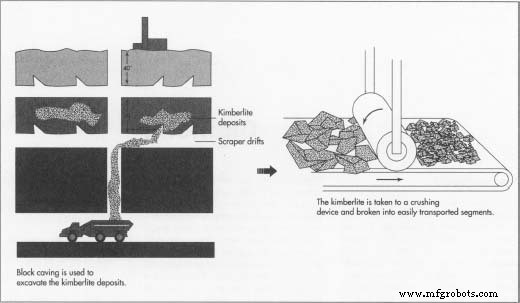
Subsurface mining of kimberlite requires moving vast quantities of rock—often 15 to 30 million tonnes of waste for every tonne of diamond recovered. The process starts with block caving: a massive vertical shaft (typically 1,750 ft or 533 m) is excavated, and horizontal tunnels (scraper drifts) are carved at regular intervals. Conical openings allow broken kimberlite to fall into the drifts, where trucks transport the material to crushers.
Mining
- Block caving offers the highest yield and cost efficiency. After drilling vertical shafts, horizontal tunnels are created, and conical openings allow kimberlite to break and fall into the drifts for collection.
Crushing
- Initial crushing reduces kimberlite to manageable fragments. The material then passes through a grizzly screen; oversized pieces are re‑crushed until they pass.
Separating
- Gravity‑based washing pans or modern media separators (cone tanks, lifting‑wheel separators, hydrocyclones) isolate diamond‑laden concentrate from tailings. The process relies on the density differential between diamonds and surrounding minerals.
Greasing
- In South Africa, a greasing belt coated with petroleum jelly prevents freshly excavated diamonds from becoming wet. Water washes away non‑diamond particles, and the diamond‑rich concentrate is later boiled to remove grease. Contemporary methods may employ X‑ray imaging to identify diamonds directly.
Cutting
- After separation, diamonds are precision‑cut using diamond saws lubricated with a diamond‑dust/olive‑oil mixture. The lapidary marks a groove, inserts a cleaving iron, and strikes to split along natural cleavage planes. Subsequent grinding and polishing produce gemstones for jewelry.
The Future
Diamonds are a finite resource. India’s historic production of over 12 million carats has dwindled to roughly 100 carats annually, illustrating the limits of natural supply. Synthetic diamonds, first created in 1953, now match natural stones in hardness and durability. While they will never replace natural diamonds in the jewelry market, they are increasingly favored for industrial and high‑technology applications, ensuring that the gemstone’s legacy endures in modern engineering.
Manufacturing process
- Diamond's Exceptional Role in Modern Medicine: From Surgical Instruments to Nanomedicine
- Industrial Diamond: How Tungsten Powers Modern Technology
- Diamond Turning: Precision Machining for Advanced Optics and Beyond
- Designing and 3D‑Printing Custom Clean Station Baskets
- Benefits and Applications of Diamond Plate (Tread/Floor Plate) – Slip‑Resistant, Corrosion‑Resistant, and Versatile
- Java 9: Simplify Anonymous Inner Classes with the Diamond Operator
- Diamond Aircraft Launches the All‑Carbon Fiber DA50 RG – Redefining Luxury in Single‑Engine Jets
- Nano Diamond Batteries: Eco‑Friendly, High‑Performance Energy for All Devices
- 6 Proven Benefits of Diamond Plate Anti‑Fatigue Mats
- Mastering Diamond Machining: Proven Tips & Advanced Techniques