



Diamond Turning: Precision Machining for Advanced Optics and Beyond
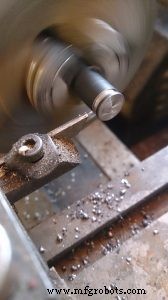
In the manufacturing world, turning is a cornerstone machining process that removes material from a workpiece using a stationary cutting tool on a lathe. The workpiece is mounted and spun while the tool slices away precise sections of material. Diamond turning elevates this classic method by employing a diamond‑tipped cutting tool, enabling unprecedented accuracy and surface quality.
How Diamond Turning Works
The basic principles mirror traditional turning: a lathe holds the part while a stationary cutter engages it. The difference lies in the cutting edge. A diamond tip—whether natural or synthetic—is affixed to the tool. Diamond’s unparalleled hardness allows it to cut with minimal wear, producing extremely smooth finishes that are essential for high‑performance components.
Most diamond‑turning operations use a single‑point diamond tool, known as Single‑Point Diamond Turning (SPDT). This configuration delivers sub‑micron surface roughness and exact dimensional control. In specialty applications, multi‑point diamond tools with contoured heads are employed to create complex geometries in a single pass.
Key Advantages
Diamond turning is indispensable when precision is paramount. CNC control allows manufacturers to program intricate profiles with nanometer‑level repeatability, translating to consistent part quality. The process excels in fabricating infrared (IR) optics, where a mirror‑like finish is required to avoid scattering and absorption losses. Beyond optics, the technique is used for aerospace components, medical devices, and any application demanding a flawless surface and tight tolerances.
Other Diamond‑Based Machining Techniques
Diamonds also power milling, honing, and grinding operations. While the cost of diamond tooling is higher, the performance gains—extreme hardness, thermal stability, and longevity—often justify the investment for high‑value manufacturing streams.
Industrial equipment
- Turning vs. Milling: Key Differences in Metalworking
- Understanding Machine Turning: A Key Precision Machining Process
- Understanding CNC Turning: Precision Material Removal for Manufacturing
- CNC Turning Explained: Process, Applications, and Benefits
- CNC Turning Explained: The Complete Process Overview
- CNC Turning Explained: Precision Machining for High‑Quality Parts
- CNC Turning vs. Milling: Key Differences & Applications
- Understanding CNC Turning Centers: The Ultimate Guide to Modern Lathe Technology
- What Is Hard Turning? A Deep Dive into Precision Machining.
- Hard Turning: The Key to Precise Machining of High-Hardness Materials