



Drywall: History, Materials, and Modern Manufacturing
Background
Drywall—thin panels of gypsum board—has replaced the old plaster‑on‑lath method, delivering a faster, more economical construction solution worldwide. The board consists of a gypsum core sandwiched between two layers of specially engineered paper.
Beyond ease of installation, drywall provides a reliable fire barrier. Gypsum holds water in crystalline form—over 2 quarts (2 L) of moisture per 10 sq ft (1 m²) of board. When exposed to heat, the bound water vaporizes at 212 °F (100 °C), keeping the panel’s temperature steady until the water is released. Even after all moisture has escaped, the gypsum core remains non‑combustible, continuing to protect the underlying timber framing.
Gypsum plaster has been used for millennia; wall‑coverings inside the Great Pyramids of Egypt still show excellent preservation. Modern drywall panels now dominate residential, commercial, and institutional construction around the globe.
Raw Materials
The core ingredient is the mineral gypsum (dihydrous calcium sulfate), a light‑density rock found in abundant deposits worldwide. Each molecule contains two water molecules (H₂O) and one calcium sulfate (CaSO₄) unit—21 % by weight and nearly 50 % by volume.
Because the water is locked in a crystalline lattice, gypsum is dry at room temperature. It only becomes liquid at 212 °F (100 °C), when the crystal lattice breaks down and the water turns to vapor.
Gypsum, called gypsos by ancient Greeks, is prized for its versatility. In pure form it is white, but natural impurities can produce gray, brown, pink, or black hues. The ancient Assyrians called it alabaster and fashioned sculptures from it. Today, pulverized gypsum is a key ingredient in toothpaste, paint, cosmetics, pharmaceuticals, automotive glass polishing beds, soil conditioners, and even cinematic “snow” generators.
When gypsum is crushed and heated to remove 75 % of its water, it becomes plaster of Paris. Adding water yields a fine white powder that can be molded into any shape; once dried it regains a rock‑like strength. Besides drywall, plaster of Paris is used for sculptures, pottery, dishware, bathroom fixtures, and medical casts.
Millions of tons of gypsum are mined annually in North America, with drywall being the principal end‑use. Up to 20 % of the gypsum used can come from recycling plant or construction‑site waste. Gypsum captured as a by‑product of flue‑gas desulfurization at power plants offers a cost‑effective, environmentally sound raw material for high‑quality board.
Two paper types form the face and back of most drywall. Both are recycled newspaper. The ivory‑manila face paper, when properly primed, accepts most paints and finishes. The gray back paper can be laminated with aluminum foil to create vapor‑resistant drywall for bathrooms. Specialized grades use moisture‑resistant paper or highly absorbent paper for plaster veneer applications.
The Manufacturing Process
Drywall fabrication involves sandwiching a gypsum core between two paper layers, drying the product, and cutting it to standard panel sizes.
Blending of additives
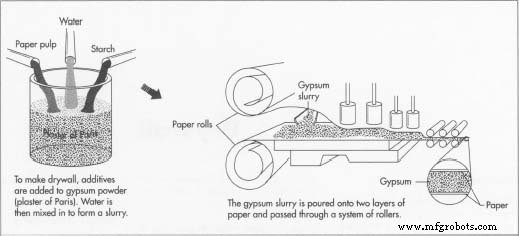
- Depending on the board type, small amounts (≤ 0.5 %) of additives are mixed with plaster of Paris. Starch improves paper adhesion; paper pulp enhances tensile strength. Fire‑resistant boards may include unexpanded vermiculite or clay.
- The plaster mixture is blended with water to a consistent slurry. Asphalt or wax emulsions adjust moisture resistance. A foaming agent introduces air, resulting in panels that are > 50 % air—reducing weight and easing installation. Glass fibers are added for fire‑rated boards.
Making the sandwich
- The slurry is poured onto a unrolling paper layer, then covered by a second paper layer. Rollers compress the core to the target thickness: 0.37 in (9.5 mm), 0.5 in (12.7 mm), or 0.62 in (15.7 mm).
Finishing the edges
- Automated lines span 300–800 ft (93–247 m). As the board moves along the conveyor, edges are shaped into square, tongue‑and‑groove, tapered, beveled, or rounded profiles depending on the application.
- Face paper is tightly wrapped around each edge and sealed to the back paper.
Cutting the panels
- Once the core has set, a precision knife slices the continuous strip into standard panel dimensions—typically 48 in (1219 mm) or 54 in (1572 mm) wide, cut into 8 ft (2400 mm) or 12 ft (3600 mm) lengths.
The drying process
- Panels travel through a long drying oven—e.g., a 470‑ft (143 m) gas‑fired oven—at 500 °F (260 °C). Temperature is gradually reduced over 35–40 min, while humidity and heat are tightly controlled.
The finished product
- After drying, panels undergo visual inspection, then are bundled into “lifts” of 30–40 boards. Each board is labeled with a UPC barcode for inventory, billing, and retail scanning.
Product Evolution
Since the early 20th‑century introduction of gypsum board, manufacturers have continually refined the product. In the late 1950s, standard board weighed 2 lb/ft² (9.8 kg/m²); today it averages 1.6 lb/ft² (8 kg/m²), easing handling, installation, and shipping.
Fire‑resistant and moisture‑resistant variants emerged in the late 1950s and early 1960s. In 1988, controlled‑density (CD) ceiling board was introduced: a dense outer layer on a standard core, yielding a 0.5‑in (12.7 mm) board that resists sagging better than a 0.62‑in (15.7 mm) conventional board.
Research now focuses on valorizing drywall waste. In 1990, U.S. landfills received ~1.7 million tons (1.5 billion kg) of gypsum board debris. Studies show pulverizing this waste for soil amendment yields benefits comparable to commercial gypsum fertilizers.
Manufacturing process
- How Lawn Sprinklers Work: Design, History, and Modern Manufacturing
- Dishwasher Technology: History, Design, and Future Innovations
- The Evolution of Pump‑Action Water Guns: From Invention to Global Market Leader
- The Evolution, Materials, and Manufacturing of Modern Toilets
- Fire Hydrants: Design, Manufacturing, and Their Role in Urban Fire Safety
- Water: History, Types, and Modern Treatment Processes
- The Science Behind Shampoo: Ingredients, Manufacturing, and Future Trends
- Kayak Design & Manufacturing: From Ancient Eskimo Roots to Recycled‑Plastic Innovation
- Life Vests: History, Design, and the Future of Personal Flotation Devices
- Salt: Production, Uses, and Health Impact