



Dishwasher Technology: History, Design, and Future Innovations
Background
Cooking sparks creativity, yet the cleanup can feel burdensome. Dishwashers were conceived to transform the tedious task of hand‑washing into a swift, efficient, and hygienic process. Modern units tackle everything from delicate crystal to heavy cookware, offering multiple wash, sanitize, and dry cycles. They come in under‑counter or freestanding models, fitting any kitchen layout and budget while keeping hands free for more important tasks.
History
Early civilizations relied on limited dishware and manually carried water to streams or troughs for cleaning. Women would transport water in buckets from communal sources or private pumps until indoor plumbing made kitchen water a domestic utility. The first dishwashers were patented around 1850; they were large steam‑powered units that soaked dishes in heated water. These early machines used cradles that rocked through water, paddles that stirred, or rotating racks that circulated dishes. In 1875, C. E. Hope‑Vere introduced a machine that directed water sprays at racked dishes—a concept later adopted by inventors such as A. W. Bodell (1906) and the Blick machine, which used a propeller to spray jets over racks. This fundamental water‑jet principle remains the core of today’s dishwashers.
Public models appeared around 1915, but widespread household adoption didn’t occur until the early 1930s. Competing with the revolutionary refrigerator, dishwashers struggled with inefficiency and the inadequacy of soaps designed for hand‑washing. By the 1950s, specialized dishwasher detergents that rinsed clean without excessive suds were developed, sparking renewed interest. The 1970s saw a shift as more women entered the workforce; built‑in dishwashers became a kitchen asset, offering convenience and time savings.
Raw Materials
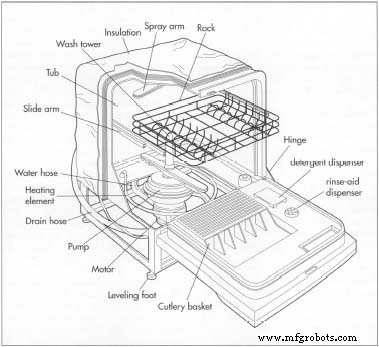
The core structure of a dishwasher is built from steel and high‑performance plastics. The frame and door panel are forged from coiled stainless steel that is pre‑finished in a range of standard colors. The inner tub is a single injection‑molded component made from calcium‑reinforced polypropylene—known for its strength, chemical inertness, and resistance to heat and water. Racks are crafted from steel wire, then coated with a fine powder of PVC or nylon to prevent scratches. Other parts—basket for cutlery, detergent containers, spray arms—are also injection‑molded.
Electrical components, motors, and pumps are sourced from specialized subcontractors, all engineered to precise specifications.
Design
Dishwasher engineers focus on two paramount features: cleaning efficacy and noise reduction. The wash tower and spray arms, water‑pump power, and rack positioning are all meticulously engineered. Since the late 1990s, sanitization—using high‑temperature cycles to kill bacteria—has become a key selling point. Manufacturers pursue quiet operation through innovative motor configurations and insulation techniques. For instance, Maytag uses a single powerful motor wrapped in heavy insulation, while Amana opts for dual motors that distribute power and reduce acoustic output.
Stand‑alone models receive extra attention to aesthetics: a wooden top turns the unit into a functional work surface, while the cabinet exterior is crafted to blend seamlessly with kitchen décor.
The Manufacturing Process
- Tub Formation: Injection molding of the polypropylene tub begins with two steel tools—cavity and core relief molds—that shape the outer and inner surfaces. Hot pellets of polypropylene are melted and injected under high pressure, filling every crevice. The mold opens to release a still‑hot tub, which is then cooled to a safe handling temperature.
- Cooling & Storage: The cooled tub is transferred to a cooling area. Other injection‑molded parts are similarly produced and stored in dedicated bins for later assembly.
- Steel Component Fabrication: Stainless steel coils are cut, stamped, and shaped into cabinets and doors. Flat steel bars form the frame, while wire is processed into racks. Racks undergo de‑burring, welding, and a PVC powder coating that is baked and cured to secure the protective layer.
- Assembly Line: Workers assemble frames, attach motors, and secure the tub. Each step is monitored by trained staff capable of rejecting faulty parts.
- Interior Installation: The filter system, wash tower, spray arms, and rack rollers are installed. Racks and cutlery baskets are positioned to allow easy loading and unloading.
- Door & Exterior Finish: Detergent dispensers, rinse‑agent cups, and control panels are mounted on the door. Electrical connections are wired, and “bagged insulation”—fibers wrapped in foil—is added to reduce noise and protect kitchen surfaces.
- Final Touches: For freestanding units, a wrap‑around cabinet and wooden top are affixed. Completed machines are carted to the packing area.
- Packaging: Styrofoam bumpers protect the edges, and cartons are sealed with instruction sheets before being stored for shipment.
Quality Control
Quality assurance is embedded at every stage: workers are trained to spot defects, supervisors oversee the assembly line, and quality engineers conduct final inspections and functional tests. Amana’s “failure mode effects and analysis” (FMEA) process captures problems detected during production or via warranty claims, driving continuous improvement across all models.
Byproducts/Waste
Dishwasher manufacturers adopt comprehensive recycling programs that capture metals, plastics, and paper, effectively eliminating waste.
The Future
Despite 99.8% of American households owning refrigerators, only 56.5% have dishwashers, indicating a sizable market for growth. Future innovations focus on advanced sanitization, quieter operation, higher energy efficiency, and convenience features that eliminate pre‑rinsing. By emphasizing these benefits, manufacturers aim to convert hand‑washing advocates into dishwasher users.
Manufacturing process
- How Lawn Sprinklers Work: Design, History, and Modern Manufacturing
- The Evolution of Pump‑Action Water Guns: From Invention to Global Market Leader
- The Evolution, Materials, and Manufacturing of Modern Toilets
- Fire Hydrants: Design, Manufacturing, and Their Role in Urban Fire Safety
- Water: History, Types, and Modern Treatment Processes
- The Science Behind Shampoo: Ingredients, Manufacturing, and Future Trends
- Drywall: History, Materials, and Modern Manufacturing
- Kayak Design & Manufacturing: From Ancient Eskimo Roots to Recycled‑Plastic Innovation
- Life Vests: History, Design, and the Future of Personal Flotation Devices
- Salt: Production, Uses, and Health Impact