



Hot Dogs: History, Production, Nutrition, and Future Trends
Hot dogs are a processed meat product made by finely grinding meat and blending it with curing agents, flavorings, and colorants. The mixture is stuffed into casings, cooked, and vacuum‑sealed for distribution. Though the basic technology dates back thousands of years, the modern hot dog remains a staple of summer cookouts and ball‑park food, with the United States alone consuming over 16 billion per year.
Background
The typical raw hot dog is a pink, cylindrical sausage weighing about 1.6 oz (45 g). It contains 0.175–0.245 oz (5–7 g) of protein, 0.455 oz (13 g) of fat, 450 mg of sodium, and 150 kcal. As a meat product, it supplies iron, zinc, niacin, riboflavin, and B‑vitamins, and pork‑based varieties provide thiamine. Because it is pre‑cooked, it is less prone to spoilage and considered one of the safest meat products.
Hot dogs go by many names—frankfurters, franks, red hots, wieners. A notable variety is the kosher hot dog, which follows 3,000‑year‑old Jewish dietary laws and is made without pork. Rabbis oversee the entire production to ensure compliance.
History
The roots of sausage‑making trace back to 1500 B.C. in Babylonia, with early references appearing in Homer’s Odyssey (9th B.C.). These first products were ground meat stuffed in animal intestines and cooked over open fires.
Scholars debate the exact origin of the modern hot dog. Some attribute it to Frankfurt, Germany, in 1484; others point to Vienna, Austria, or to the 17th‑century dachshund sausage created by Johann Georghehner of Coburg.
In 1852, a Frankfurt butchers’ guild produced a spiced, smoked sausage they named the frankfurter. Charles Feltman and Antoine Feuchtwanger brought the product to New York’s Coney Island in 1871, selling it from a pushcart. Feuchtwanger later introduced the first hot‑dog bun in 1904, solving the problem of holding sausages with white gloves.
Baseball parks adopted the sausage in 1893, starting with the St. Louis Browns. The term “hot dog” was coined in 1901 by cartoonist Tad Dorgan, who sketched a dachshund with mustard on a bun and captioned it Get your hot dogs.
Raw Materials
The core ingredient is ground meat—typically pork, but also beef, chicken, or turkey. USDA regulations require that the meat match supermarket‑grade quality. When variety meats or by‑products are used, the label must state “with variety meats” or “with meat by‑products.”
During processing, the meat is blended with a curing solution that includes salt, water, sodium nitrite, and optional antioxidants such as sodium ascorbate. The solution enhances flavor, color, and shelf life.
Additional components include sugars (sugar, corn syrup) for sweetness, flavorants (herbs, spices, or synthetic esters), and, in some cases, extenders like non‑fat milk or soy protein to increase yield and nutrition.
All ingredients must be listed on the package, ensuring transparency for consumers.
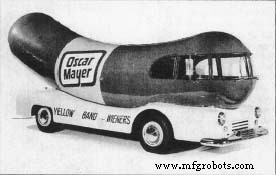 Constructed in 1936, the original Oscar Mayer Wienermobile—a 13‑ft hot‑dog on wheels—was built by Carl Mayer to showcase the brand.
The Wienermobile became a cultural icon, with successive models produced in 1950‑54, 1958, 1969, 1988, and 1995. Today it resides in the Henry Ford Museum and continues to delight fans.
In addition to meat, sugars and corn syrup are key. After inspection, the meat is chopped into fine pieces, blended with curing agents, flavorings, and ice, then pumped into an automatic stuffer.
The batter is then encased in cellulose casings. Flavorants—natural herbs or artificial esters—are added to deliver the characteristic taste. Monosodium glutamate may also be used to enhance umami.
Hot dogs may include extenders such as milk, soy protein, or cereals, which increase quantity and improve nutritional value.
The Manufacturing Process
Meat Processing
- After inspection, meat is minced in a stainless‑steel mixer with high‑speed choppers to produce a smooth emulsion. Curing agents, flavorings, and ice are blended until the batter is homogenous.
Linking
- The batter is pumped into an automatic stuffer/linker, where it is inserted into cellulose casings and twisted into a continuous strand of uniform sausages. Some producers retain natural casings for a traditional product.
Cooking
- The linked sausages are transported to a smokehouse and cooked under controlled conditions, typically about an hour. Smokers may use different wood or liquid smoke to impart unique flavors.
Final Processing
- After cooking, the sausages are cooled in water to equalize temperature and then passed through an automatic peeler that removes the cellulose casing. The resulting hot dogs are then packaged.
- In packaging, the hot dogs are lined on plastic film, vacuum‑sealed, stamped with a freshness date, boxed, palletized, and shipped in refrigerated trucks. From receipt to shipping, the process takes only a few hours.
Quality Control
Quality control is critical. Raw materials are tested for pH, moisture, odor, taste, and appearance. Equipment is sterilized before use. Throughout production, the emulsion’s composition is monitored to ensure consistency. Final products undergo the same tests to guarantee safety and flavor.
The Future
While the core technology has remained steady, innovation continues. Newer hot dogs use lean poultry or plant‑based proteins, lower sodium, and even cheese‑filled varieties. Production equipment is evolving to be faster, more automated, and energy‑efficient, boosting annual output and reducing waste.
Manufacturing process
- Dog Biscuits: History, Ingredients, and Manufacturing Process
- Hot Air Balloons: From Montgolfier to Modern Flight
- Invisible Dog Trainer: Automate Couch‑Off Training with Raspberry Pi
- Hot Drape Forming: Enhancing Composite Production Efficiency
- Efficient Energy Savings with Dry Quenching of Hot Coke
- Hot Strip Rolling & Common Defect Prevention
- Redsmelt: Advanced Two‑Step Iron Production
- Hot Meal Vending Machines: The Future of Quick, Fresh Dining
- Hot Water Pump Basics: How They Work & Why They Matter
- Haas is Hot: New Europe Flyer Unveiled