



Imitation Crab Meat: Production, Ingredients, and Future Trends
Background
Imitation crab meat—commonly called surimi—has become a staple in American kitchens, with annual sales exceeding $250 million. The product was first developed in the mid‑1970s and is now produced on a global scale.
Surimi is made from fish myofibrillar proteins that form a resilient gel when processed. This gel can be shaped into strips that closely mimic the texture of real crab meat.
While the United States introduced surimi‑based products in the 1980s, Japan has been producing kamaboko for more than 800 years. The earliest documented recipe appears in a 1528 Japanese cookbook, and commercial production began in the 19th century. Large‑scale manufacturing only took off in the 20th century, when advances in fishing technology and preservation techniques were pioneered in Japan between 1945 and 1960.
Scientists solved a key challenge: freezing destroyed surimi’s gel quality. By adding cryoprotectants such as sucrose and sorbitol, they preserved the protein structure during freezing—an innovation that fueled the surimi industry’s rapid growth in the mid‑1960s.
The first U.S. commercial production started in 1983 with Yamasa Enterprises, and by 1986 the market was worth $250 million. Today, U.S. manufacturers dominate the market and export imitation crab meat back to Japan.
Raw Materials
Imitation crab meat’s distinctive color, flavor, and texture result from a blend of ingredients. The base is surimi, most commonly produced from Alaska pollock, walleye pollock, or New Zealand hoki—fish that are abundant, inexpensive, and mild‑flavored. Other species such as blue whiting, croaker, lizardfish, and pike‑conger have been trialed but face processing challenges.
During surimi preparation, cryoprotectants (sugar and sorbitol) are added before freezing to safeguard the gel‑forming proteins and extend shelf life.
Starch (~6 % of the recipe) stabilizes the gel matrix and improves texture, especially after freezing. Egg white enhances gel strength and gives the product a glossy, white appearance, while vegetable oil adjusts mouthfeel and visual appeal.
Flavor is imparted through a combination of natural extracts—amino acids, proteins, and organic acids from crab—and synthetic compounds that replicate crab taste more precisely. Common additives include nucleotides, monosodium glutamate, vegetable proteins, and mirin.
Color is achieved with water‑insoluble dyes such as carmine, caramel, paprika, and annatto. These pigments are blended into the surimi paste before shaping, allowing a range of reds, oranges, and pinks.
The Manufacturing Process
Sorting, Cleaning, and Filleting
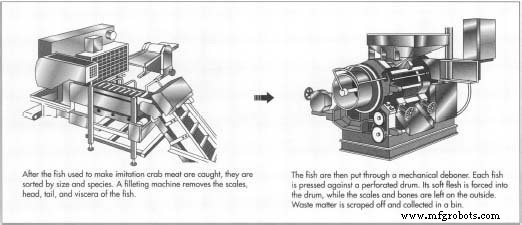
- Fish are hand‑sorted by species and mechanically sorted by size to maximize fillet yield. Scales are removed, and the fillet machine extracts heads, tails, and viscera. A subsequent water wash removes excess moisture. This can occur onboard or in a shore‑based plant.
Preparing Surimi
- Fillets are minced or deboned using a rubber‑belt and perforated‑drum machine that separates flesh from skin, scales, and bones.
- Leaching removes water‑soluble fats, salts, and proteins. The mince is then partially dewatered before refining.
- Refining separates the white, tender muscle from browner, tougher portions, ensuring a uniform product.
- After dewatering, cryoprotectants are added. The surimi is packed into 10‑kg blocks, flash‑frozen below ‑20 °C, and stored until use.
Forming the Crab Meat
- The frozen surimi is thawed to ~‑4 °C, sliced into coarse flakes, and blended with starch, salt, egg white, natural crab extract, and flavorants to produce a thick paste.
- The paste is extruded into continuous sheets (≈25 cm × 1.2 mm) that are cooked to set the structure, then cut into 1.5 mm strands.
- Strands are bundled, colored, steamed, and trimmed to final dimensions, producing a product that visually and texturally resembles real crab.
Packaging
- Product is vacuum‑packed in thermoformed trays of polyethylene, nylon, or polyester, then pasteurized in a steam cooker to inhibit bacterial growth and extend shelf life.
Quality Control
Quality checks occur at every stage—from raw material inspection (pH, moisture, odor, appearance) to surimi testing (protein, lipid, moisture, color, texture). Microbial assays ensure the finished product remains free from contamination.
Byproducts and Waste Management
Surimi production generates wastewater rich in fats and suspended solids. Environmental regulations mandate treatment—through filtration, centrifugation, or chemical methods—before discharge.
The Future
Emerging trends focus on diversifying the fish base to include low‑value, abundant species, improving surimi quality for higher‑fat fish, and streamlining production for greater yields. Sustainability initiatives aim to reduce waste, while new recipes seek to enhance the nutritional profile of imitation crab meat.
Manufacturing process
- Beef Jerky: Production, History, and Future Trends
- Imitation Crab Meat: Production, Ingredients, and Future Trends
- Why Structural FRP Is the Ultimate Choice for Meat Processing Facilities
- Silver Fern Farms Navigates Pandemic, Securing Global Meat Exports
- Why Meat Packaging & Labeling Matter: A Key to Consumer Trust and Product Success
- Industrial Robot Arms Revolutionizing the Meat Industry
- ABB Robotics: Safeguarding Meat Processing with Advanced Automation
- Reducing Food Contamination in Meat Processing with Fanuc Robots
- Motoman Robotics: Cutting-Edge Automation for Meat Processing
- Rotary Screw Technology Proven to Cut Energy Costs in Meat Processing