



Coffee: From Bean to Brew – History, Production, and Sustainability
Background
Coffee is a globally cherished beverage created by grinding roasted beans and extracting them with hot water. The resulting liquid is rich, aromatic, and traditionally served hot to fully appreciate its depth of flavor. Today, over one‑third of the world’s population drinks coffee in some form, making it the most popular processed beverage. Each culture has developed unique preparation styles: Indonesians sip hot coffee from glasses, Middle Eastern and some African drinkers use delicate brass cups, Italians celebrate the espresso—a dense, two‑shot brew served in tiny cups—while the French enjoy café au lait, a milk‑or‑cream‑infused coffee savored from bowls at breakfast.
The driving force behind coffee’s worldwide appeal is its caffeine content. A six‑ounce (170‑gram) cup contains roughly 100 mg of caffeine, far surpassing comparable amounts in tea (50 mg), cola (25 mg), or cocoa (15 mg). Caffeine, a naturally occurring alkaloid, stimulates the cerebral cortex, enhancing concentration and, when consumed in moderation, can improve athletic performance by delaying muscle fatigue and improving coordination. However, excessive intake may cause diuresis, gastric irritation, headaches, irregular heartbeat, and tremors. While some studies have linked high caffeine consumption to heart disease, benign breast cysts, pancreatic cancer, and birth defects, findings remain inconclusive. Health authorities generally advise limiting coffee to fewer than four cups per day or opting for decaffeinated varieties.
Originating in the highlands of central Ethiopia, coffee was first harvested by Ethiopian Arabs around A.D. 1000. By the fifteenth century, traders introduced wild coffee trees to southern Arabia, where Arab cultivators refined the process of roasting and grinding beans to create a hot beverage. The drink quickly spread along trade routes, reaching Venetians by 1600. In Europe, coffee houses proliferated despite occasional bans by church and state, with the first London coffee house opening in 1652. By the late seventeenth century, cafés had also appeared in New York, Boston, and Philadelphia.
In the United States, coffee achieved instant popularity, though early American preferences differed markedly from today’s standards. An 1844 cookbook recommends a higher coffee‑to‑water ratio (one tablespoon per sixteen ounces), prolonged boiling, and additives such as fish skin, isinglass, or eggshells to neutralize acidity—a method that produced a strong, acidic brew with little aroma. American innovators began experimenting with instant coffee in the mid‑1800s, eventually launching the first commercially successful instant blend in 1950 after testing with World War II troops. Today, 85 % of Americans start their day with coffee, averaging three cups daily.
Raw Materials
Coffee originates from the seed of the coffee tree, a member of the evergreen Rubiaceae family. The bean contains over 100 compounds—including aromatic oils, proteins, starches, and bitter phenols—that together define coffee’s unique flavor profile. The tree can reach 30 ft (9 m) in the wild but is typically pruned to 5–12 ft (1.5–3.6 m) for cultivation. It takes roughly five years from planting until the tree blooms and produces cherries. Each cherry holds two green beans; careful harvesting selects only ripe red cherries to ensure optimal taste.
Optimal growth occurs in temperate climates without frost or extreme heat, in fertile, well‑drained soils—especially volcanic substrates. High‑altitude plantations (3,000–6,000 ft or 914–1,829 m) yield beans with lower moisture and enhanced flavor. Brazil supplies about half of the world’s coffee, with Latin America contributing a quarter and Africa approximately one‑sixth.
There are about 25 coffee species, but the primary ones are Coffea robusta and Coffea arabica. Robusta beans are cheaper, thrive under less ideal conditions, and produce dark brown or black roasts with a stronger, more bitter flavor. Arabica beans, preferred for premium coffees, offer a reddish hue and a more delicate, less acidic profile. Arabica dominates the premium market, often sold whole for customers to grind fresh. Robusta is common in large plantations where uneven ripening can occur.
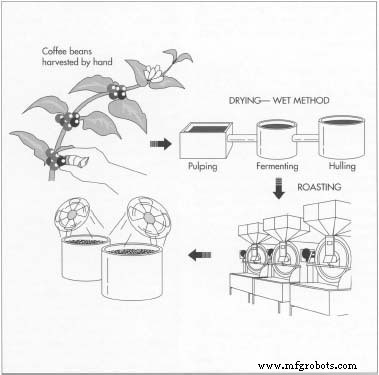 Coffee bean harvesting remains a manual process. Each bean grows in clusters of two, called cherries. After harvesting, the cherries are dried and husked. In the wet method, pulping machines remove most of the husk, followed by fermentation (18–36 h) to dissolve the remaining pulp. Beans are then washed, air‑dried, and hulled in mechanical stirrers that polish them to a glossy finish. Post‑cleaning, the beans are roasted in large ovens, where they emit their signature aroma.
The Manufacturing Process
Drying and Husking the Cherries
- 1. Cherries are manually harvested and then dried using either the traditional dry method—sun‑drying with daily raking until moisture content drops to 12 %—or the wet method, where pulping precedes fermentation and hulling.
- 2. In the wet method, pulped cherries undergo fermentation to break down residual pulp, then are washed and hulled by mechanical hulling machines that remove the parchment layer, leaving a smooth, polished bean.
Cleaning and Grading the Beans
- 3. Beans move along conveyor belts where workers remove debris. They are graded by size, origin, altitude, drying method, and flavor profile—factors that determine the bean’s final taste classification.
- 4. After grading, beans are packed for roasting companies. Robusta beans harvested in humid climates require rapid shipment to prevent insect and fungal damage.
- 5. At the roasting facility, beans are again cleaned and sorted to remove any remaining leaves or bark before roasting.
Decaffeinating
- 6. For decaf, beans undergo either solvent extraction—typically methylene chloride—to leach caffeine, followed by thorough washing, or a water‑based method that steams beans to surface‑release caffeine, which is then removed.
Roasting
- 7. Roasting occurs in commercial roasters, where beans are exposed to hot air or rotating cylinders. Temperatures reach 431–449 °F (220–230 °C), producing steam, CO₂, and other volatiles that reduce bean weight by 14–23 % and expand volume by 30–100 %. This process develops the characteristic aroma and flavor.
- 8. After roasting, beans are cooled in vats with cold air circulation and, for premium batches, sorted electronically to remove under‑ or over‑roasted beans.
- 9. For pre‑ground coffee, beans are milled immediately after cooling, with grind size tailored to specific brewing methods.
Instant Coffee
- 10. Instant coffee is produced by brewing ground coffee in large percolators, clarifying the extract, and spray‑drying it into powder through a warm air stream.
Packaging
- 11. Whole beans are typically sealed in foil‑lined bags to preserve aroma. Pre‑ground coffee is hermetically sealed in impermeable plastic, aluminum foil, or cans. Instant coffee is vacuum‑packed in tin cans or glass jars to prevent moisture absorption.
Environmental Concerns
Methylene chloride, used in solvent decaffeination, has attracted regulatory scrutiny. Although the FDA limits residue to 10 ppm, many advocate for the water method, which eliminates solvent use entirely. Decaf production is increasingly shifting toward water‑based techniques to enhance safety and sustainability.
Manufacturing process
- Custom Shop-Built Electric Coffee Grinder – Engineering a Precise Grind
- Automatic Drip Coffee Maker: History, Design, and Future Trends
- Flavored Coffee Beans: From Bean to Brew
- Instant Coffee: From History to Modern Manufacturing
- DIY Automatic Coffee Machine: Arduino, Bluetooth, and Android App
- Top 5 Coffee Roaster Manufacturers in 2023: Leading Brands & Innovation
- Understanding Coffee Plantations: Cultivation, Economics, and Impact
- Revolutionizing Airports: Automated Coffee Bars Transform Travel Experience
- Discover the Future: How a Robot Coffee Barista Enhances Home Brewing
- Automated Barista: Revolutionizing Coffee Service with AI and Robotics