



From Ancient Cocoa to Modern Confection: The Comprehensive Story of Chocolate
Background
Chocolate, in its countless variations—from candy bars and cakes to fruit coatings—is arguably America’s most beloved treat. With a per‑capita consumption of roughly 14 pounds (6 kg) annually, it is a staple in everyday indulgence.
The origins of cocoa trace back to the river valleys of South America. By the 7th century A.D., Mayan peoples had introduced cocoa to northern Mexico, and other Central American cultures such as the Aztecs and Toltecs cultivated the tree. The words “chocolate” and “cocoa” both derive from the Aztec language. When Spanish explorers like Cortez and Pizarro arrived in the 15th century, they noted that cocoa beans served as currency and that the elite drank a frothy beverage called cacahuatl, made from roasted beans, red pepper, vanilla, and water.
Initially, the Spanish found the bitter flavor of unsweetened cacahuatl unpalatable. They added sugar, cinnamon, cloves, anise, almonds, hazelnuts, vanilla, orange‑flower water, and musk, heating the mixture into a paste. Spread on plantain leaves, it hardened into slabs that were later ground into what we now recognize as chocolate. The drink chocalatl, the direct ancestor of modern hot chocolate, was created by dissolving these tablets in hot water and a thin corn broth, then frothing the mixture to evenly distribute the cocoa butter (which makes up over 50 % of a bean’s weight).
By the mid‑17th century, missionaries reported that only lower‑class Mexicans still consumed cacahuatl in its original form. The Catholic Church initially resisted the beverage, deeming it “heathen,” but the glowing endorsement from conquistadors—Cortez called it “the divine drink that builds up resistance and fights fatigue”—pushed hot chocolate to popularity in Spain. The first chocolate factories emerged in the late 16th century, grinding beans into paste for later mixing with water. A dramatic drop in sugar prices between 1640 and 1680 further propelled chocolate’s spread across Europe, alongside coffee’s rising popularity.
England soon joined the trend, hosting “chocolate houses” that mirrored London’s coffee houses of the 1600s. In the 17th century, Sir Hans Sloane, an English naturalist who had lived in Jamaica, observed local practices of mixing chocolate with milk. He advocated dissolving chocolate tablets in milk rather than water, leading to the birth of milk chocolate.
Early European chocolate in solid form was rare, as many feared internal obstructions. Over time, cookbooks began to include chocolate candy recipes. However, 18th‑century hard chocolate—made only of chocolate paste and sugar bound with plant gums—was coarse, crumbly, and far from the refined confections we enjoy today.
Innovation arrived in 1828 when Dutch confectioner Conrad van Houten invented a screw press that removed most cocoa butter from beans. This allowed the separation of cocoa into powder and butter, improving flavor and texture. A decade later, an English company produced the first commercially available hard chocolate. Swiss chocolatier Daniel Peter further refined the process in 1876, using the dried milk developed by Nestlé to create solid milk chocolate. By 1913, Jules Sechaud introduced chocolate shells filled with other confections. Chocolate, though still pricey, had become a popular treat worldwide.
American chocolate producers like Hershey Foods and Mars, Inc. made chocolate more affordable. Hershey, founded by Milton Hershey, leveraged mass‑production techniques and fresh milk to produce widely available, individually wrapped bars that cost a nickel for decades. Mars, Inc. expanded beyond chocolate, yet remains a powerhouse, having launched iconic bars such as the Milky Way, Snickers, and Three Musketeers—many of which incorporated cost‑effective nougat centers. Mars’ success was partly inspired by soldiers in the Spanish Civil War, who preserved chocolate with a sugary coating that the company later adopted.
Raw Materials
While sugar, flavorings, and potassium carbonate (used for dutched cocoa) are added, cocoa beans remain the core ingredient. Cocoa trees are evergreen, thriving near the equator at altitudes between 100 ft (30 cm) and 1,000 ft (305 cm). Native to Central and South America, they are now cultivated in Malaysia, Brazil, Ecuador, and West Africa. West Africa supplies nearly three‑quarters of the world’s 75,000‑ton annual crop, with Brazil leading in the Western Hemisphere.
The trees are vulnerable to sun, fungi, and pests. Plantation owners mitigate damage by intercropping with rubber or banana trees, which provide shade and alternate income streams.
The fruit, a pod 6–10 inches (15–25 cm) long and 3–4 inches (7–10 cm) in diameter, bears 20–40 beans in a sticky pulp. Each tree produces about 30–40 pods, each yielding 20–40 beans. Pods ripen continuously year‑round, with peak harvest from May to December.
Harvesting is labor‑intensive: only mature pods are cut with machetes or pole‑mounted knives. The pods are opened on the ground; the beans, still covered in pulp, are then left to ferment under the sun for several days. Fermentation reaches about 125 °F (51 °C), killing embryos and breaking down cell walls. After fermentation, the beans are dried, graded, bagged in 130–200 lb (59–91 kg) sacks, and shipped to auction for chocolate manufacturers.
The Manufacturing Process
Roasting, Hulling, and Crushing the Beans
- 1. Upon arrival at the processing plant, beans are roasted on screens and then in revolving cylinders with heated air. Over 30 minutes to 2 hours, moisture drops from ~7 % to ~1 %, triggering a complex browning reaction that develops chocolate’s rich flavor.
- 2. Roasting also causes shells to detach from the nibs. A winnowing machine—called a cracker and fanner—blows air across the beans, separating hulls without crushing them. Hulls are sold as mulch, fertilizer, or boiler fuel.
- 3. The roasted nibs undergo broyage—crushing in a granite‑block grinder—producing a thick syrup known as chocolate liquor (a mixture of nib particles suspended in oil).
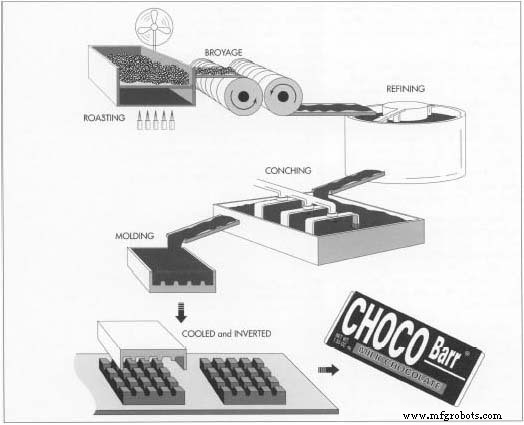
- Chocolate manufacture begins with roasting, then hulling, followed by broyage to produce chocolate liquor. Refining further grinds the mass, making it smoother.
- During conching, the liquor is ground and agitated in large open vats for 3 hours to 3 days, allowing sugar and vanilla to blend seamlessly.
- Finally, the mass is poured into molds, cooled, cut, and wrapped.
- 4. Refining further grinds the liquor between revolving metal drums, progressively reducing particle size to ~0.001 in (0.0025 cm).
Making Cocoa Powder
- 5. For cocoa powder, chocolate liquor undergoes the dutched process—treated with an alkaline solution (usually potassium carbonate) to raise the pH from 5.5 to 7 or 8. This darkens the cocoa, mellows its flavor, and prevents clumping. The resulting product is called dutch cocoa.
- 6. Defatting follows: compressing the liquor between rollers removes about half of the cocoa butter, producing a solid press cake. The cake is then broken, chopped, or crushed and sifted into cocoa powder. When blended with sugar or other sweeteners, it becomes the modern hot‑chocolate mix.
Making Chocolate Candy
- 7. To produce chocolate candy, the press cake is remixed with a portion of the removed cocoa butter. The amount of butter varies by chocolate type, ensuring proper texture and mouthfeel.
- 8. The mixture then undergoes conching, continuously turning and grinding in a large vat. This step can last 3 hours to 3 days; temperature and speed critically influence quality.
- 9. Timing and rate of ingredient addition during conching determine the final chocolate type: sweet chocolate contains liquor, butter, sugar, and vanilla; milk chocolate adds powdered or liquid milk.
- 10. After conching, chocolate is poured into molds, cooled, cut, and wrapped.
Quality Control
Ingredient proportions and processing steps are closely guarded, yet standards set by the 1944 Federal Food, Drug, and Cosmetic Law—and subsequent regulations—ensure minimum content. Milk chocolate must contain at least 12 % milk solids and 10 % chocolate liquor; sweet chocolate must have a minimum of 15 % liquor. Major producers like Hershey and Mars enforce stringent cleanliness and ingredient freshness. Even minor imperfections can lead to batch rejection.
The Future
Despite concerns over fat and calories, chocolate remains the top confection in the U.S., with per‑capita consumption declining from over 20 lb (9 kg) to about 14 lb (6 kg) per year. Some researchers suggest that chocolate’s phenylethylamine content may offer mood‑boosting effects, though these claims remain speculative. Regardless of health debates, chocolate’s enduring appeal positions it as a perennial favorite.
Manufacturing process
- What is VMC Machining? An Expert Overview of Vertical Machining Centers
- Expert Guide to Aluminum Laser Marking: Precision, Durability, and Industry Applications
- MIG vs. TIG Welding: Selecting the Right Arc Welding Technique for Your Project
- Comprehensive Guide to Laser Marking: Types, Benefits, and Applications
- Key Considerations for High‑Volume Swiss Machining
- CNC Prototyping Guide: Precision, Speed, and Cost‑Effective Production
- M&M® Candy: From Invention to Modern Production
- From Ancient Cocoa to Modern Confection: The Comprehensive Story of Chocolate
- Thermoset vs Thermoplastic: Key Differences & Performance Guide
- The Secret Ingredient: How Compressed Air Drives Chocolate Production