



The History, Production, and Future of Markers: From Ancient Inks to Modern Innovations
Background
Markers—commonly known as felt‑tip pens—serve a wide range of roles across creative, educational, commercial, and civic contexts. Children use them for vibrant drawings, teachers employ bright red markers to grade work, retailers and performers rely on their high‑contrast colors to capture attention, and protestors use them to convey messages that demand visibility. Additionally, markers provide a reliable method for permanently labeling items, from clothing tags to shipping boxes, ensuring clear identification.
History
The modern felt‑tip pen was invented in 1953 by Sidney Rosenthal of Richmond Hill, New York. By attaching a felt tip to a small, sturdy bottle of permanent ink, he discovered that the ink produced saturated, long‑lasting marks on absorbent surfaces, a breakthrough that set the stage for the marker industry.
Although Rosenthal’s invention is the most celebrated, the concept of inked marking predates it by millennia. From cave paintings made with natural dyes to aerosol graffiti, humans have long used pigments to leave a lasting impression. Early inks were often derived from plant or animal extracts; today, synthetic compounds complement these natural sources.
Ink usage dates back to 3,200 B.C., when the Egyptians mixed fine soot with vegetable gum to create a versatile writing and painting medium. Both Egyptians and Greeks later employed iron oxide—commonly known as rust—to produce red ink. By 2,000 B.C., the Chinese were producing red ink from mercury sulfate and black ink from iron sulfide combined with sumac tree sap. In Europe, the 17th century saw the emergence of inks based on tannic acid and iron salts, forming the blue and black inks still in use.
Writing implements have evolved alongside inks. Early pens were hollow reeds or quills made from goose or swan feathers. The 19th century introduced steel nibs, and the 1800s brought fountain pens that eliminated the need for constant ink refills. Paints, too, found new uses in the late 1800s when Edwin Binney and Harold Smith used red‑oxide pigments to color the first classic American red barns.
Binney & Smith’s innovation continued with the production of carbon black pigments for Goodrich’s automobile tires and the creation of chalk and the first Crayola crayons in 1903. By the late 1950s, while Binney & Smith expanded its crayon line, Rosenthal’s Speedry Chemical Products began marketing his felt‑tip pen to the art‑supplies market, soon expanding to posters, signage, and everyday use.
Competition intensified in 1958 when Carter’s, Inc. introduced a slimmer marker with an aluminum ink tube. Speedry sued for patent infringement but ultimately lost. The market shifted toward water‑soluble inks suitable for standard‑weight paper and capillary‑flow technology that improved ink delivery to the tip. In 1966, Rosenthal renamed his company Magic Marker Corporation, but increasing competition led to financial struggles and bankruptcy in 1980.
In 1989, Binney & Smith—then a subsidiary of Hallmark—acquired the Magic Marker name, recognizing its strong consumer recognition. Today, Binney & Smith produces a wide range of Crayola markers and Magic Markers, leveraging the brand’s legacy while innovating new products.
Raw Materials
The marker body, cap, and plugs are molded from high‑grade plastic resin, while the reservoir is constructed from polyester. The felt tip itself is created from a blend of powdered felt fibers and water. Markers also require a carefully formulated ink: pigments, synthetic additives, and solvents. Historically, toluene and xylene were common solvents, but due to their toxicity, manufacturers now favor safer alternatives such as cyclic alkylene carbonates. Water also functions as a solvent, and wetting agents may be added to improve flow.
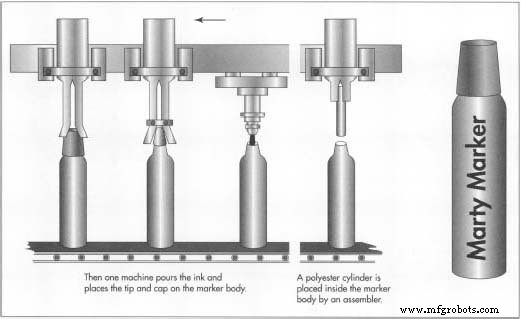
The Manufacturing Process
Making the Ink
- 1. The ink blend is prepared with a water content of 1–10 % by weight, allowing complete dissolution or dispersion of pigments. The remainder is typically a solvent such as an alkyl or alkylene carbonate.
- 2. Conventional additives—nonylphenyl‑polyglycol ether, alkyl‑poly‑glycol ether, fatty‑acid‑polyglycol ester, or fatty‑alcohol ethoxylates—along with preservatives (e.g., ortho‑phenyl‑phenol, ortho‑hydroxydiphenyl, or 6‑acetoxy‑2,4‑dimethyl‑m‑dioxane)—are incorporated to enhance performance.
Making the Marker
- 3. The marker body is formed by injection‑molding plastic resin into a precision mold, then cooled to set. Caps and plugs are manufactured in the same process.
- 4. The nib is fabricated by mixing felt powder with water, molding, and baking to achieve a pointed or flat tip.
- 5. In a single assembly line, a polyester cylinder is inserted into the barrel to serve as the ink reservoir, the ink is filled, and the nib and cap are affixed.
- 6. Finished markers are sorted by color and packaged for retail distribution.
Byproducts / Waste
Individual markers can be disposed of with regular household waste. However, manufacturers must handle excess ink carefully. While typical ink is non‑hazardous, federal regulations prohibit discharging colored ink into sewer systems. Ink must be combined with an absorbent material and treated as solid waste. If any ink component is hazardous, it must be disposed of under applicable federal and state regulations.
The Future
Marker technology continues to evolve. Modern lines include indelible and washable formulas, color‑changing pigments, translucent fluorescent highlights, scented options, and even 3‑D drawing capabilities. Companies are actively developing eco‑friendly inks that use vegetable oils or water instead of petroleum‑based solvents, aligning with growing environmental concerns. These innovations keep markers relevant across education, art, and professional industries.
Manufacturing process
- Titanium: Key Properties, Applications, and Industrial Uses
- Electronic Ink: How It Works, History, and Future Applications
- Castanets: History, Craftsmanship, and Performance
- The History, Production, and Future of Glue: From Ancient Adhesives to Modern Innovations
- Thread: Types, History, Production, and Quality Control
- Acetylene: Production, Uses, and Handling – A Comprehensive Overview
- Comprehensive Overview of Asbestos: From Ancient Uses to Modern Health Risks
- The History, Design, and Manufacturing of Dice: From Ancient Tools to Modern Gaming
- Plywood: History, Production, and the Path Ahead
- Tin: From Bronze Age to Modern Industry – Uses, Production, and Future