



Inside the Milk Carton: Production, Materials, and Sustainability
Milk cartons are water‑tight paper containers that protect milk during retail distribution. Though ubiquitous in grocery aisles, the carton is a highly engineered product crafted to exacting standards.
Background
For most of history, milk could not be sold in stores because it spoils quickly once removed from the cow. In the 19th century, European farms used large metal churns to transport milk to towns, where it was ladled into household containers. The first glass milk bottle appeared in 1884, allowing consumers to keep pasteurized milk sealed until use. Pasteurization—rapid heating above boiling followed by cooling—extended shelf life and made glass bottles popular worldwide through World II. The first paper milk carton entered the market in 1933, initially coated with wax to provide water resistance. By 1940, polyethylene replaced wax, offering superior durability. Today, over 70 % of U.S. milk is sold in paper cartons, a trend that began in 1968.
Raw Materials
Milk cartons are constructed from paperboard coated with a thin layer of polyethylene. The paperboard originates from a blend of softwood and hardwood pulp—typically 60 % hardwood and 40 % softwood. Softwood, often pine, supplies long fibers that give the board strength, while hardwood—such as oak—provides shorter fibers that create a smooth print surface. Oxygenated chlorine bleaches the pulp, and manufacturers add proprietary chemicals to enhance strength and ink adhesion.
The Manufacturing Process
Making the Paperboard
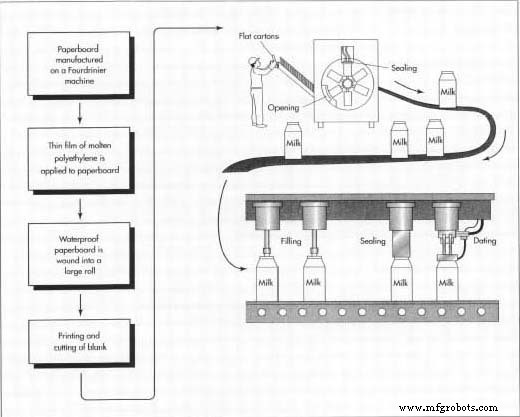
- Wood chips are heated and treated with chemicals to separate fibers. The pulp is then bleached with oxygenated chlorine and refined on a Fourdrinier machine, producing a damp fiber mat. After passing through rollers and steam‑heated cylinders, the paperboard is dried to the required thickness and width.
Applying the Waterproof Coating
- In an extruder, molten polyethylene is applied to both sides of the dried board, forming multiple layers that control moisture and oxygen transmission. The coated sheet is then chilled, rolled into a wide roll, and slit to the width needed for printing.
Printing and Cutting the Blank
- Flexographic printing plates transfer the milk‑brand artwork—often 1 to 7 colors—in a single pass. The same machine scores the board along future fold lines and dies out a blank. A typical blank contains the full printed design and all scored edges, ready for folding.
Sealing the Blanks
- Blanks are fed into a sealing machine that folds the sides, creating a watertight seam. The heat causes the polyethylene to bond without glue, producing a strong, leak‑proof side seam. Thousands of blanks pass through per minute.
Forming and Bottom‑Sealing
- Dairy facilities use a forming machine that pulls the sealed blank onto a rotating mandrel. Mechanical arms open the carton along scored lines and overlap the bottom flaps. As the mandrel completes a cycle, a hot plate seals the bottom seam, and the finished carton is removed onto a conveyor.
Filling and Top‑Sealing
- Milk is piped from storage tanks to a filling chamber that precisely measures the volume. The milk is dispensed into the open carton, which then travels to a top‑sealing machine. The gable‑top seal is formed, heated, and bonded, completing the container.
Stamping the Date
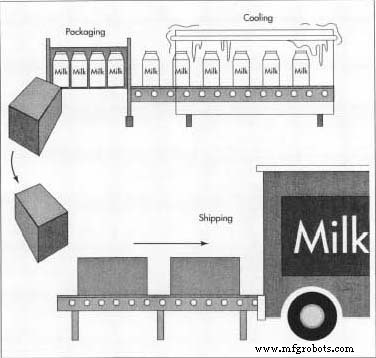
- At the next station, a stamping machine impresses the “sell‑by” date onto the carton’s top edge. In a large plant, the entire sequence—from blank to date‑sealed product—takes only seconds. The finished cartons are then packed for shipment.
Quality Control
Every stage of production undergoes rigorous inspections. Pulp color, density, and fiber composition are monitored by automated sensors. Paperboard thickness, width, and contamination levels must meet FDA standards for food contact materials. Dairy plants enforce strict hygiene protocols during forming, filling, and sealing to guarantee safety and compliance.
Byproducts / Waste
The production process generates minimal waste. Most used cartons end up in landfills, but recycling programs exist in many regions. Recyclers collect cartons, shred and sanitize them, then supply the pulp to mills that separate the polyethylene. The reclaimed paper can be made into high‑grade printing paper, while the plastic is repurposed for other products.
The Future
Milk carton design remains largely unchanged, but subtle innovations—such as integrated plastic pour spouts—continue to improve consumer convenience. As U.S. milk consumption declines, dairies are focusing on compelling graphics and exploring new markets for the gable‑top form. Research into alternative coatings could enable paper cartons to carry other liquids like wine or motor oil, expanding their utility.
Manufacturing process
- Amber: From Ancient Resin to Scientific Treasure – History, Properties, and Modern Uses
- The Guillotine: History, Design, and Legacy
- Evaporated vs. Condensed Milk: Production, History, and Quality Standards
- Silicon: Properties, Production, and Market Outlook
- The Ukulele: From Portuguese Roots to Modern Craftsmanship
- The Complete Guide to the U.S. Chicken Industry: History, Production, and Quality Control
- Compost: The Ultimate Soil Enrichment Solution
- Gelatin: From Ancient Protein to Modern Applications – Production, Uses, and Safety
- The Evolution and Manufacturing of Modern Pin‑Tumbler Locks
- Milk: Production, Processing, and Nutrition in the United States