



Golf Tee: From Classic Design to Sustainable Innovations
A golf tee is a small, precision‑crafted device that elevates a golf ball, enabling a clean strike on every tee‑off. With over two billion wooden tees consumed annually in the U.S., the industry has evolved from simple cedar sticks to highly engineered biodegradable options.
History
The core design of the tee has remained largely unchanged since the late 19th century, yet its journey reflects the broader evolution of golf itself. While ancient Chinese games date back to 300 B.C., the modern sport crystallized in Scotland during the 1400s. By 1735, the first golf club existed, and the inaugural tournament in 1744 set 13 rules that still underpin the game today—except the only exemption: a ball could not be placed on a tee to improve a watery lie.
George Grant received the first patent for a golf tee in 1899. Since then, incremental innovations—ranging from angled tees that reduce hook and slice to composite materials that resist movement—have been introduced. Over 25 patents in the past two decades focus on shape, stability, and sustainability, yet the most popular tees retain the classic profile first perfected a century ago.
Raw Materials
Traditional tees are crafted from cedar wood—primarily red cedar harvested in the eastern United States—or from durable plastics such as polypropylene and high‑density polyethylene (HDPE). To enhance performance, manufacturers add fillers to control flexibility, colorants for visibility, and weather‑resistant coatings for wooden tees.
Recent eco‑friendly variants include animal‑by‑product composites and corn‑derivative resins that degrade naturally. Some biodegradable tees also incorporate fertilizer and grass seed to blend seamlessly with the course, reducing litter and tree loss.
Design
A typical tee features a wide, flattened head with a slight groove to cradle the ball, and a slender, pointed shaft that is inserted perpendicular to the ground. The standard length is 2.125 in (5.4 cm). Color options range from traditional white and natural to vibrant hues such as yellow, orange, and blue.
Angled tees—designed to be set at a specific angle—offer a more recessed or perpendicular ball‑contact surface, helping to mitigate unwanted rotation and improve accuracy. Some high‑performance tees incorporate vented side walls or barbed tips to keep the tee stationary during impact, preserving ball momentum.
The Manufacturing Process
The production of golf tees can be divided into three core stages: material preparation, shaping, and finishing & packaging.
Material Preparation
- Wooden tees begin with logs stripped of bark and cut into blocks. These are then processed into slats that will later be glued together.
- Plastic tees undergo injection molding: pellets are melted in a heated hopper, injected into a precision steel mold, and cooled to form the final shape.
- Biodegradable tees are blended in large tanks with the appropriate proportions of organic materials.
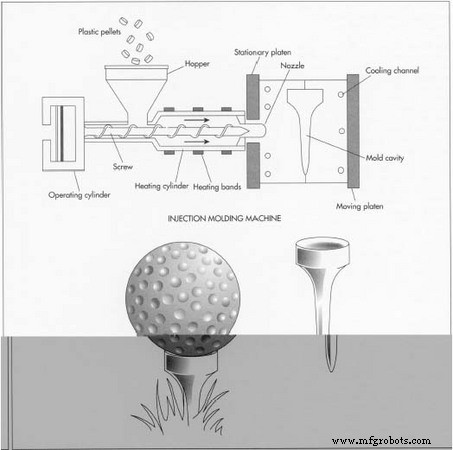
Shaping the Tee
- For plastic tees, the molded pieces are trimmed, ensuring smooth edges and consistent dimensions.
- Wooden slats are assembled—glued side‑by‑side—to recreate the full tee shape before being cut into final lengths.
Coating and Packaging
- Wooden tees are sanded and coated with a weather‑resistant paint; logos may be engraved or painted for premium models.
- Plastic tees receive a clean finish, and any excess residue is removed by shaking or cleaning.
- Finished tees are weighed, bagged, and boxed. Packages are palletised for shipment to distributors worldwide.
Quality Control
Given the high volume—thousands of tees per day—complete inspection is impractical. Instead, statistical sampling ensures compliance with size, shape, and consistency standards. Visual inspections identify deformities or labeling errors, while precision instruments (vernier calipers, micrometers, microscopes) verify dimensional accuracy. Non‑conforming tees are re‑melted or re‑formed, and equipment is recalibrated to prevent recurrence.
The Future
As golf’s popularity surges, manufacturers are intensifying efforts to blend performance with sustainability. While current biodegradable options often lack the durability of wood or plastic, ongoing research aims to enhance strength without compromising environmental benefits. Innovations such as reinforced corn‑based resins and improved animal‑by‑product composites promise a new generation of tees that protect the game and the planet.
Manufacturing process
- How Titanium Alloys Transform Golf Club Performance
- Golf Clubs: From Ancient Roots to Cutting‑Edge Design
- Golf: A Global Sport With Rich Heritage & Modern Appeal
- Golf Cart Production & Quality: Design, Manufacturing, and Future Innovations
- Securing In‑Cabin AI with a Trusted Execution Environment on a Secure FPGA SoC
- The Comprehensive Guide to Golf Course Maintenance
- Pipe Tee Fittings: Definition, Applications, and Installation Tips
- Understanding Tee Joints: Types, Applications, and Construction
- High-Performance Tee Forming Machine for Optimal Pipeline Productivity
- Motoman Picking Robots Align Golf Balls for Precise Tee Placement