



Spinning Wheels: History, Craftsmanship, and Modern Production
Background
A spinning wheel transforms loose fibers into continuous yarn or thread, the fundamental material for weaving cloth. By twisting fibers together and winding the resulting thread onto a bobbin or stick, the wheel creates a ready‑to‑use yarn for handlooms or sewing projects.
Spinning wheels accommodate a wide range of fibers—wool, plant bast fibers such as flax, hemp, and jute, and seed fibers like cotton—each with distinct staple length, strength, and quality. The wheel’s design can be tuned to suit these fibers, influencing the required bobbins, wheel size, and overall configuration for optimal efficiency.
History
Humanity has spun yarn for centuries. The earliest documented method, the drop spindle, dates back to ancient Egypt where flax was twisted into linen. The spinning wheel itself emerged in the 6th‑century Chinese silk and ramie workshops, though some scholars argue its independent invention in India for cotton.
Early wheels were rimless, powered manually or by hand crank, and soon spread westward. By the 14th century, rim‑reinforced designs dominated. Flemish settlers in the British Isles introduced substantial improvements, culminating in the 16th‑century “great wheels” of Britain that spun wool with unprecedented speed. Subsequent refinements continued until the industrial revolution, when Richard Arkwright’s water‑powered spinning frame and Samuel Slater’s New England mills produced the first machine‑spun yarn, rendering the traditional wheel largely obsolete for mass production.
Today, spinning wheels are primarily crafted by hobbyists and artisanal producers. Less than 1,000 units are built annually in North America, prized by handspinners for their craftsmanship and heritage.
Raw Materials
Modern wheels are constructed from hardwoods—common choices include maple, cherry, and walnut—combined with wood glue, clear lacquer or urethane, and small metal components such as brass or steel wires for the drive system. North American manufacturers source timber from reliable suppliers across the continent, ensuring the absence of knots, insect damage, and other defects that could compromise performance.
Design
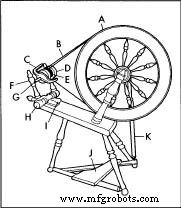
A classic wheel features three splayed legs, a foot treadle connected to a footman that turns the drive wheel, and a horizontal stock (the bed). The drive wheel, the wheel’s most visible element, contains turned spindles that pull thread along its rim. The bobbin—a grooved wooden spool—fits into a U‑shaped flyer that guides and evenly distributes the yarn as it is wound. Additional components include the distaff and distaff arm for holding raw fiber, the flyer whorl, and the tension knob. A single wheel may contain over 100 miniature parts working together to produce high‑quality yarn.
Manufacturing Process
- Initial Rough Cutting: Rough‑cut planks (6 in. wide, ~10 ft. long) are hand‑cut into preliminary shapes for the wheel rim, spokes, and treadle.
- CNC Shaping: The rough pieces are fed into computer‑numerically controlled (CNC) routers, shapers, or lathes that produce precise components with minimal manual labor.
- Sanding and Finishing: CNC‑finished parts are sanded through a series of belt and drum sanders. Surfaces may receive a clear, water‑based lacquer or remain natural for aesthetic preference.
- Assembly: Hand‑glued and bolted joints bring the wheel together. Many manufacturers ship partially assembled kits, allowing the end‑user to complete the final assembly safely.
- Quality Assurance: Inspect each component for dimensional accuracy, surface integrity, and mechanical fit before shipping.
Quality Control
Quality hinges on selecting defect‑free timber and precise CNC programming. Manufacturers negotiate with trusted lumber suppliers to guarantee wood free of knots and insect damage. Any irregularities can be identified during the sanding phase, and poorly formed parts are reworked or discarded.
Byproducts and Waste
Wood chips and sawdust from CNC operations can be sold to chipboard producers or used as bedding for livestock. Manufacturers favor water‑based finishes to eliminate volatile organic compounds (VOCs), complying with federal environmental regulations.
The Future
Spinning wheel production remains a niche, artisanal craft with a limited annual output. While North American makers produce a few thousand units yearly—primarily for hobbyists and traditional textile enthusiasts—the global market is largely served by New Zealand manufacturers, who have a longstanding wool‑spinning heritage. The continued viability of this industry depends on the enthusiasm of contemporary spinners and the growing demand for hand‑spun yarn in sustainable fashion and home crafting.
Where to Learn More
Books
- Baines, Patricia. Spinning Wheels: Spinners and Spinning. New York: Charles Scribners Sons, 1977.
- Nylander, Jane. Our Own Snug Fireside. New Haven: Yale University Press, 1994.
Other Resources
- Lendrum Web Page (December 2001).
- Oral interview with Gord Lendrum, owner of Lendrum Spinning Wheels, Odessa, Ontario, October 2001.
- "Spinning Wheel." Encyclopedia Britannica CD Edition. Encyclopedia Britannica, Inc., 1994‑1998.
Manufacturing process
- Ferris Wheel: History, Design, and Manufacturing Insights
- Antilock Brake System (ABS): Safeguarding Your Vehicle on Slippery Roads
- Grinding Wheels Explained: History, Materials, and Manufacturing Process
- ESE E2: Revolutionary One‑Piece Carbon Fiber Wheel Ready for Performance
- Dymag Secures £5M Funding to Expand Carbon Fiber Wheel Production to 50,000 Units Annually
- Build an Arduino Mecanum Wheels Robot: 360° Mobility DIY Guide
- Industrial Wheels 101: Choosing the Right Track System for Your Facility
- Thread Rolling Heads: Ensuring Reliable Wheel Stud Performance on the Racetrack
- A Comprehensive Guide to Automobile Steering Wheels
- Metal Spinning Explained: CNC Lathe Process for Precise, Seamless Metal Parts