



The Carousel: From Ancient Revolving Rides to Modern Craftsmanship
Background
Carousels trace their roots back roughly 1,500 years to ancient Byzantium, where riders were spun around a central pole on woven baskets. In the 12th‑century Ottoman and Arab courts, a similar game—called carosello—featured horsemen tossing perfumed water‑filled spheres between riders; the loser wore the fragrance, the winner rode on.
By the 1500s the French court had transformed this pastime into an elaborate pageant. Spectacularly adorned horses and riders galloped in circles while attempting to lasso a brass ring that would cascade ribbons from a tree or posts. The contest was later adapted for wooden “horses” on a rotating platform, a concept that paved the way for the modern carousel.
Local craftsmen soon began building smaller, hand‑powered carousels for commoners and children. In 1866, English engineer Frederick Savage combined steam power with his rides, dazzling European fairgoers. His overhead‑gear system also introduced the up‑and‑down motion of suspended horses. Steam‑powered carousels crossed the Atlantic around 1880, and by the late 19th century, the United States boasted a thriving carousel industry fueled by European immigrants such as Gustav Dentzel, Charles Looff, Charles Dare, and Allan Herschell.
The American craze peaked between 1900 and the Great Depression. Carvers produced ornate horses—80% of all figures—adorned with flashing eyes, flowing manes, and heraldic crests. The Herschell‑Spillman Company diversified the menagerie, crafting kangaroos, giraffes, and even sea monsters. Yet the rise of motor vehicles and new materials (cast aluminum, fiberglass, plastic) began to eclipse traditional wooden carousels, leading to a decline in craftsmanship.
In the 1970s the National Carousel Association was founded. Antique horses entered the auction market—some fetching $60,000—sparking renewed interest among collectors. Today, only a handful of U.S. makers continue the craft, though hobbyists persist in carving and restoring historic mounts.
The Basics of Carousel Operation
At the heart of every carousel is a stationary center pole—metal or wood—upon which a motor, clutch, and drive belt transmit motion through a series of gears and shafts. The vertical shaft turns cranking rods that lift and lower each horse about 30 times per minute. A typical platform with horses and riders can weigh 10 tons and is driven by a 10‑horsepower electric motor, producing a gentle gallop of 5–11 mph for riders on the outermost row.
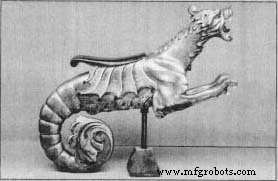 Carousel griffin made by the Hershell‑Spillman Co. of North Tonawanda, New York. (Henry Ford Museum & Greenfield Village, Dearborn, Michigan.)
Since the 1700s, carousels have delighted crowds with colorful figures and music. By 1800 they were marketed as both amusements and exercise. Post‑Civil War manufacturers popularized the ride, and the carousel became a staple of fairgrounds and parks.
In Greenfield Village, Dearborn, Michigan, a 1913 Hershell‑Spillman merry‑go‑round operates half the year, featuring horses, lions, zebras, and leaping frogs. Its one‑man band organ plays classic tunes, keeping the carousel’s charm alive for visitors of all ages.
Nancy EV Bryk
Raw Materials
The core components of a carousel are metal and wood. Metal parts include the motor, gears, bearings, and cranks; horse hangers and platform suspension rods are brass‑sleeved, while the center pole is steel. Wood components—basswood horses, an oak platform, sweeps, rounding boards, panels, and mirror frames—have traditionally been used; modern builds may incorporate plastic or fiberglass. The canopy is canvas, and the music comes from a band organ—either electric or mechanical—that operates similarly to a player piano.
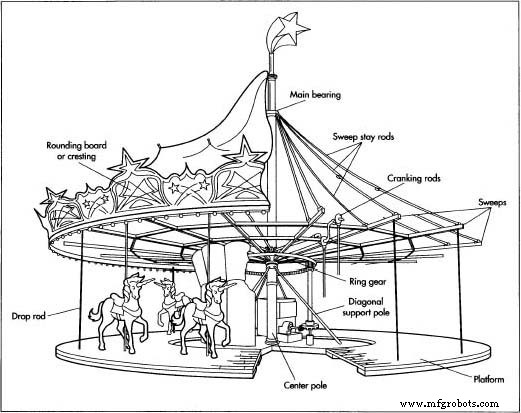 A typical carousel platform with horses and riders may weigh 10 tons and be driven by a 10‑horse‑power electric motor.
Design
Design begins at the center pole’s top bearing, which supports the umbrella‑like sweeps and the rotating platform. A center bearing midway along the pole keeps the carriage stable. The motor turns the entire structure; a series of diagonals and a cross‑brace align the pole with the ground. A 15‑inch (38.1 cm) pole can comfortably support around 50 horses and riders.
The Manufacturing Process
While the fundamental process remains unchanged, new wooden‑horse carousels are now rare—about ten in the U.S. over the past 60 years. Modern builders typically work from scratch or refurbish existing mechanisms.
- Builders consult customers to determine size and cost, balancing maintenance needs. Fixed carousels are built around a rigid center pole; traveling models feature a hinged steel pole that folds for transport.
- A band organ—often from Stinson Organ Company, Ohio—provides the soundtrack. The organ’s bellows push air through wooden pipes; perforated paper rolls drive the music, but many new carousels use digital audio due to maintenance costs.
- Collectors pay high prices for antique horses—up to $60,000—highlighting the value of authentic, hand‑carved mounts. Hobbyists now purchase body blocks for carving.
- Carvers choose a design—either thematic or historically faithful—and create full‑scale sketches. The “romance” side is typically more elaborate.
- Full‑scale paper patterns are glued to basswood blocks. Basswood’s close grain and strength make it ideal for carving.
- Carvers rough‑cut the shape, then refine details by hand, guided by grain direction and artistic vision. A complete carving, including footrest and optional stirrups, takes roughly 35 hours.
- Finished pieces are stained, primed, painted, and varnished. Decorative touches—gold leaf, rhinestones, horsehair tails—enhance realism. Old paint removal can be labor‑intensive, especially for pieces with 30 layers.
The Future
Carousel maker Chuck Kaparich notes a modest resurgence: historic town centers and malls are installing new rides or refurbishing old ones to attract visitors. He predicts the trend may last 10–20 years, but the timeless charm of the carousel should continue to inspire future generations.
Manufacturing process
- The Art and Craft of Headstones: History, Materials, and Modern Manufacturing
- The Spork: Evolution, Materials, and Modern Manufacturing
- The Evolution and Craft of the Modern Swimsuit: From Ancient Pools to High‑Tech Fabric
- The Art and Evolution of the Corkscrew: From Ancient Tool to Modern Engineering
- Footbag: From Ancient Training Tool to Global Sport
- The Craft and Science Behind Everyday Shoelaces
- Skateboarding: History, Design, and Modern Manufacturing
- Doorknob: History, Design, and Modern Manufacturing
- The Evolution of Galoshes: From Medieval Boots to Modern Innovation
- Sofa: From Ancient Luxury to Modern Comfort – A Comprehensive Guide