



Sofa: From Ancient Luxury to Modern Comfort – A Comprehensive Guide
Background
Often called a couch or davenport, a sofa is a long upholstered seat featuring both arms and a back. It has evolved from a symbol of elite comfort in ancient palaces to a staple of modern living spaces, reflecting humanity’s shift from nomadic life to design‑conscious homes.
History
Upholstery traces back to ancient Egypt, where pharaohs’ tombs were furnished with luxurious, long‑lasting upholstered seats. The Romans, too, reserved such items for royalty and the upper classes. In the West, upholstery matured gradually as building techniques improved. Before the 1500s, woven tapestries provided insulation, while hard benches served as communal seating.
As climate control improved, fabrics transitioned from purely functional to decorative. German artisans pioneered horsehair padding—a key component of modern upholstery—while English craftsmen favored sea moss, and Italians introduced the now‑standard backrests and arms during the Renaissance. Upholstered chairs existed earlier, but the sofa with a down cushion emerged as an extension of the upholstered chair, refining stuffing techniques from tufting to button‑securing.
In the eighteenth century, the “upholder”—a designer‑decorator who brought an architect’s vision to life—emerged. Cabinet makers such as George Hepplewhite, Matthias Lock, Henry Copland, and Thomas Chippendale expanded into upholstery, publishing influential pattern books like The Cabinet‑Maker and Upholsterer’s Guide that set industry standards.
The nineteenth century ushered in industrialization. In 1850, coil springs were invented, allowing modern sofas to distribute weight evenly. The sewing machine accelerated upholstery production and enabled new techniques such as precise welting.
Raw Materials
The frame is traditionally wood—most often kiln‑dried maple free of knots, bark, or defects—but steel, plastic, and laminated boards are also used. Show pieces may feature mahogany, walnut, or exotic fruitwoods for carved legs or moldings.
Paddings come mainly from animal hair (hog or horse), foam, or polyester fiberfill. Pre‑processed rubberized hair, bonded with glue, is common in mass production.
Cushions are built from polyurethane foam, polyester fiber, down, cotton, latex, or cotton‑wrapped springs.
Cover fabrics include wool, nylon, cotton, acetate, rayon, and polyester, each offering distinct durability and feel. Many are treated with anti‑stain coatings for added protection.
Springs are tempered steel. A typical sofa uses 15 yd (13.71 m) of burlap, 10 yd (9.14 m) of muslin, roughly 1,000 tacks, 200 yd (182.8 m) of twine, and hundreds of yards of machine‑sewn thread.
Design
Standard sofas come in three primary sizes: full (84 in/2.13 m), two‑seater, and loveseat (60–80 in/1.52–2.03 m). Variants include modular units, daybeds, and convertible sofa beds. Ornamentation can enhance aesthetics without sacrificing durability.
Design adapts to intended use and user demographics. For example, a deep seat suits taller occupants but may feel cramped for shorter users. Arm styles often define the sofa’s character, influencing its overall appeal. Over‑stuffed models feature multiple layers of muslin in the foundation for added comfort.
The Manufacturing Process
Crafting a single sofa demands 300–600 hours of skilled labor. While power tools assist, hand tools such as regulators, ripping tools, and diagonal cutters remain essential for precision.
 A traditional Victorian sofa purchased by Mary Todd Lincoln after President Abraham Lincoln’s assassination. (From the collections of Henry Ford Museum & Greenfield Village.)
Mary Todd Lincoln’s suite—featuring a sofa, table, armchairs, and side chairs—was likely crafted by J & J.W. Meeks of New York. The Victorian sofa exemplifies mid‑nineteenth‑century luxury, incorporating coil springs for plush support and carved rosewood lamination that withstands intricate designs.
Modern techniques, such as bent plywood used by Charles Eames, echo the robustness of historic craftsmanship while offering minimalist aesthetics.
Classic hand‑tied springs differ from factory‑mounted spring grids, sparking debate over tradition versus efficiency. Below is a step‑by‑step outline based on the handmade process.
Framing
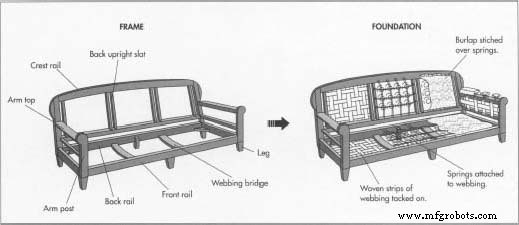
- Construct a defect‑free wooden frame thick enough to support heavy webbing. Attach arms, back, seat, and legs using double‑dowel glue joints reinforced with braces, gluing and screwing each part. Frame each section with reinforcing slats for separate spring and padding attachment.
Webbing and Springs
- Lay jute (burlap) webbing across the frame, tacking it in place. Bind springs with flax twine, securing them front‑to‑back and side‑to‑side. Heavy‑gauge front‑row springs may receive additional wire fastening. Repeat for the back, treating each section independently if split into multiple panels. Wrap each area in burlap, then tighten to prevent spring movement over time.
Padding
- Encase each section in burlap envelopes, then stitch. Apply a 15 lb (6.81 kg) padding layer, backed with lighter burlap, dividing the seat into platform and nose areas. Shape the front edge with hand stitching, then add a final thicker layer to fill gaps. Cover with muslin, stitching into place and tacking edges.
- Repeat for arms, back sections, and any additional panels, ensuring parallel alignment. Finish with wood staining or finishing as desired.
Fabric
- Measure and record every panel in a cutting list. Plot fabric on chalk, ensuring seam alignment. Sew panels together if needed before attaching to padded frames. Cover seat platform and nose, arms, and back sequentially, using cotton batting under the fabric. Create fan‑pleated arm fronts by folding fabric into pleats. Replace temporary tacks with permanent ones.
- For larger panels like the outer back, ensure webbing gaps are stuffed and padded. Finish with welted edges or decorative trim, securing with stitching and tacking.
Finishing
- After fluting the base with cambric, apply final touches: skirts, welted arm panels, and separately constructed cushions—usually two‑pad cores encased in ticking with a removable zipper for cleaning.
Quality Control
Quality control hinges on company standards rather than regulation. Warranty periods range from five to ten years, with some manufacturers offering lifetime guarantees.
The Future
Sofas remain handcrafted by artisans and produced in factories alike. Educational pathways exist—North Carolina State University, for example, offers an industrial engineering bachelor’s degree focused on furniture manufacturing, covering product engineering, facilities design, and industry‑specific software.
Manufacturing process
- The Art and Craft of Headstones: History, Materials, and Modern Manufacturing
- The Spork: Evolution, Materials, and Modern Manufacturing
- The Evolution and Craft of the Modern Swimsuit: From Ancient Pools to High‑Tech Fabric
- The Art and Evolution of the Corkscrew: From Ancient Tool to Modern Engineering
- Footbag: From Ancient Training Tool to Global Sport
- The Craft and Science Behind Everyday Shoelaces
- Skateboarding: History, Design, and Modern Manufacturing
- Doorknob: History, Design, and Modern Manufacturing
- The Evolution of Galoshes: From Medieval Boots to Modern Innovation
- The Carousel: From Ancient Revolving Rides to Modern Craftsmanship