



Solar Heating Systems: From Passive to Active Solutions for Sustainable Home Heating
\n\n
Background
\n\nIn one second, the Sun emits 13 million times more energy than the entire United States consumes in a year. While only a tiny fraction reaches Earth, that amount would comfortably power the entire planet.
\n\nSolar energy first proved its electrical potential in the 1950s, when NASA required a reliable power source for space satellites. The pioneering silicon cells produced at Bell Labs still convert only about 18% of sunlight into electricity. Despite this modest efficiency, solar power has successfully driven high‑profile projects such as the International Solar Challenge race.
\n\nHeat capture from the Sun has proven especially effective for domestic hot water and building climate control. Swimming pools routinely use solar collectors. For residential space heating, two main system types exist:
\n\n- \n
- Passive solar heating admits sunlight directly into a building through south‑facing windows (north‑hemisphere) or via a wall or roof that absorbs, stores, and transfers heat into the interior. A variant—an isolated‑gain system—stores heat in a separate chamber such as a rock bed. \n
- Active solar heating uses water or air as a heat‑transport medium. Collectors on a south‑facing roof channel heat to rock beds or water tanks. The stored heat can then be delivered through ducts, fan‑coil units, or direct air circulation. \n
Cooling systems are likewise divided into passive and active designs, leveraging night‑time airflow and condensation to lower indoor temperatures.
\n\nDifferent collector types match specific applications. Flat‑plate collectors, with a glass top and black absorber plate, suit domestic use. Concentrating collectors—shaped like troughs or bowls—serve industrial applications.
\n\nHistory
\n\nThe Sun has always been humanity’s primary heat source, but the first documented human‑made solar collector dates to 1776 when Swiss scientist Horace de Saussure built a simple “hot box.”
\n\n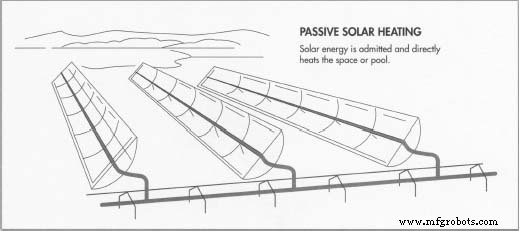 \n\n
\n\nSir John Herschel later employed hot boxes to cook food during his 1830s African expedition. Solar thermal cooking and water distillation then spread in parts of Africa.
\n\nIn the United States, pioneers in the late 1800s used black pots and pans to heat water during daylight, sparking widespread adoption in regions that otherwise depended on imported fuels. By 1897, nearly 30% of homes in Pasadena, California, used solar water heaters.
\n\nSolar technology grew steadily through the 20th century, peaking during the 1970s energy crisis. After the crisis waned, interest receded, only to rise again in the 1990s as concerns over fossil‑fuel emissions and nuclear safety intensified.
\n\nRaw Materials
\n\nSolar heating systems vary, but the following focuses on a basic residential passive and active configuration.
\n\nA passive system requires a black flat‑plate collector panel: a steel absorber plate topped with two glass sheets, surrounded by fiber‑glass or polyurethane foam insulation with an aluminum foil moisture barrier. The unit is encased in a shallow wooden, galvanized‑steel, or aluminum box. A heat‑storage bin—filled with dry pebbles or rocks—captures excess heat. A differential thermostat provides manual temperature control, and an air‑handling module (ducts, filters, blower, automatic dampers) circulates the warmed air.
\n\nAn active system that stores heat in water needs a flat‑plate collector with one or two transparent layers, black metal tubing, and insulation. The system also incorporates a water pump, storage tank, heat‑exchanging coils, an auxiliary heater, a fan, filters, and a control valve. If rock storage is used instead of water, an insulated bin holds the rocks and eliminates the need for pumps and coils.
\n\nAll solar heating installations use caulking, aluminum siding, and closure strips made of rubber, paint, or wood to seal joints and protect the system.
\n\n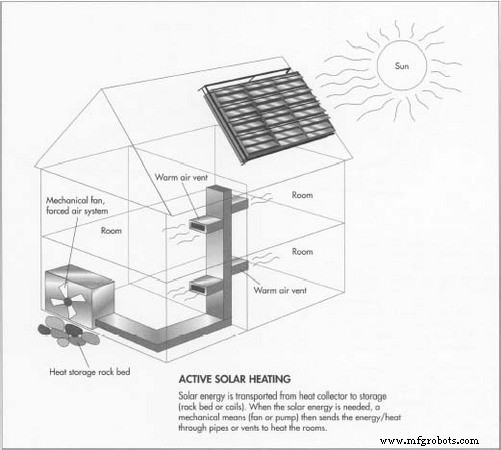 \n\n
\n\nThe Manufacturing Process
\n\nCollectors
\n\n- \n
- Flat‑plate collectors are mounted on pitched roofs or vertical walls by attaching shallow sheet‑metal manifold pans—resembling large baking pans—at each end and securing them to the rafters. Caulking is applied around the manifold’s upper edge. Sheathing is then installed, and all seams are sealed with caulk. Manifold slots are cut in the sheathing, and blocking is fastened around the perimeter. \n
- The absorber plate is positioned over the sheathing, extending to the outer manifold blocking. End closures—usually rubber—seal the ends, and the top and bottom edges are caulked. \n
- Battens are fastened to the absorber plate, and a glazing system—a single glass layer on roofs or double on walls—is installed. \n
- Aluminum glazing bars frame the collector’s perimeter. \n
Air Handling and Control System
\n\n- \n
- In a passive system, the air‑handling unit consists solely of ductwork between the collector and living space, a fan, and a manual switch. An isolated‑gain system adds a separate storage chamber and ductwork connecting it to the building. \n
- In an active system, a storage bin (rocks or water) stores surplus heat. Ductwork with on‑off dampers links the collector to the bin, the bin to the house, and the collector directly to the house. Two fans circulate air. \n
Storage
\n\n- \n
- A rock storage system uses an insulated bin filled with small rocks (1–5 in, 2.5–12.7 cm) spaced to allow air to pass through duct connections. \n
- A water storage system mirrors the rock setup but stores heat in water instead of rocks. \n
Quality Control
\n\nFor residential installations, the fit of end closures and caulking integrity are verified with a smoke‑bomb test before glazing. This test detects leaks and ensures airtight performance.
\n\nThe Future
\n\nAs prototypes of solar‑heated and solar‑powered homes and commercial buildings mature, solar energy is shifting from experimental to mainstream. Environmental NGOs, the U.S. Department of Energy, and international bodies actively promote broader adoption and continue to innovate new applications.
\n\nThe DOE’s Solar Energy Research Facility showcases photovoltaic advances, while its building itself exemplifies the benefits of daylight‑driven design. Its window‑laden, stair‑step architecture demonstrates how solar heating can be integrated seamlessly into architecture.
\n\nThe American Solar Energy Society highlights practical solar projects through its annual solar home tours and informs members about legislative developments. For instance, in July 1996, the society lobbied for renewable‑energy funding legislation—an effort that, although not enacted, signaled congressional interest in solar energy. The International Solar Energy Society pursues similar goals on a global scale, advocating for increased reliance on solar power worldwide.
\n\nManufacturing process
- Solar Cells: From Early Experiments to Modern Photovoltaics – Technology, Production, and Future Outlook
- Solar Energy Equipment Market: Growth Opportunities for Manufacturers
- Designing Energy Transmission Systems: Key Considerations & Constraints
- DIY Sun‑Tracking Solar Power System with Arduino UNO
- Excited State: A New Era of High-Efficiency Solar Cells
- Seamless Integration of Renewable Energy into the Power Grid
- Expert Guide to Designing & Installing Solar PV Systems
- Praktikant VC Plus Lathe: Energy‑Efficient Precision Training Tool
- Harnessing Solar Energy: Your Complete Guide to Clean, Reliable Power
- Air-Cooled vs. Water-Cooled Energy Recovery: A Practical Guide