



Doorknob: History, Design, and Modern Manufacturing
Background
There are 114 million doorways across the United States, with roughly two million new ones added annually. Doors equipped with appropriate hardware seal these openings, protecting interior spaces from the elements. Early doors were simple hides or textiles; wooden doors became common in ancient Egypt and Mesopotamia, while stone, metal, glass, and even paper have also served as door materials. Doors operate by swinging, folding, sliding, or rolling, and most swinging doors are fitted with a lever or doorknob for effortless operation.
Doorknobs have been in use worldwide for centuries, first manufactured in the U.S. during the mid‑nineteenth century. Although spherical or ball‑shaped knobs are the hardest to turn, they remain the most widespread. Egg‑shaped knobs, by contrast, are the easiest for most users. Materials range from wood, ceramic, glass, plastic to various metals; brass is especially popular for its superior corrosion resistance.
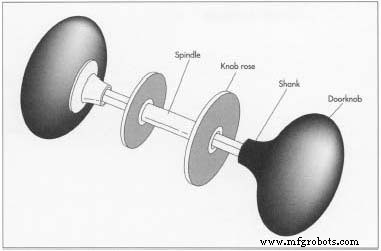
The average doorknob measures 2.25 in (5.715 cm) in diameter. Its core components are the knob rose, shank, spindle, and knob‑top. The knob‑top is the upper, larger part grasped by the hand. The shank projects from the knob, housing a hole or socket that receives the spindle. The knob rose—a round plate or washer—serves as the knob socket, attaching to the door surface. The spindle, a metal shaft, turns the lock latch.
History
American doorknob design and materials have evolved dramatically. Colonial hardware was wood‑based, featuring simple latches and strings. Round knobs appeared around independence, while decorative hardware—knobs included—emerged after the 1876 Centennial Exposition. Prior to that, 95 % of hardware was imported in 1838.
Glass knobs were scarce until a cost‑effective pressing method was introduced. Pressed glass knobs dominated from 1826–1850, followed by cut glass until 1910. Wooden knobs entered the market in the late 1800s but were phased out after 1910. China or ceramic knobs were largely imported from France and England until the mid‑1800s, when the first U.S. patent for clay knobs was granted.
Before 1846, metal knobs were assembled from two brazed pieces or three soldered pieces. Cast metal knobs appeared around 1846. The late 1800s saw composite metal knobs—iron or steel bodies veneered in bronze or brass—introduced as a more affordable option. The latter half of the nineteenth century brought numerous patents for spindle attachment methods and ornamental designs. In 1870, a compression casting technique accelerated hardware ornamentation.
Victorian doorknobs were frequently cast bronze with ornate patterns. During this era, twelve major firms and many smaller companies produced hundreds of ornamental designs across cast and wrought metal, glass, wood, and pottery. From 1830–1873, over 100 U.S. patents were granted for knobs. Collectors have catalogued more than 1,000 antique designs into 15 types based on shape, material, and pattern, with top grades typically cast bronze or brass.
Circa 1900, cast metal and glass knobs incorporated ball bearings in the shanks, reducing friction and eliminating endplay. Early 1900s favored bronze and porcelain as well.
Most doorknobs include a locking mechanism. Steel lock manufacturing began in 1896. Today, the spring lock—a simple push‑button in the knob’s center—remains the most common privacy lock, operable by finger, closed fist, or elbow. Some locks combine a spring lock with a key‑activated deadbolt, while others use electronic systems such as programmable chips that authenticate users.
Design
Hardware selection is usually driven by aesthetics, cost, and availability, seldom by function. To ensure usability, designers must evaluate not only appearance but also the knob’s size, shape, texture, and ergonomics. Ideal design features include: no sharp edges, an easy‑to‑grasp shape, a textured or non‑slip finish, and a shaft long enough to fit the user’s hand behind the knob.
When a new design is required, a 2‑D model is created using CAD software. A 3‑D prototype is then fabricated to produce the mold or die. For metal casting, a wooden or clay pattern is used to create the mold.
Raw Materials
Most doorknobs are metal, with brass being the most common. Brass is an alloy of copper and zinc, typically supplied as a rod or billet that is machine‑cut to the required length. Raw materials must meet American Society for Testing and Materials (ASTM) standards for physical, mechanical, chemical, thermal, and microstructural properties specific to each process.
The Manufacturing Process
Metal doorknob manufacturing involves several methods. Brass knobs are typically forged, a process that forces heated metal into shaped dies under high pressure, yielding components up to 250 % stronger than castings and often more cost‑effective.
Forging
- 1 The billet is heated to 1,400 °F (759.9 °C) in a gas‑fired furnace to soften the metal. It is then placed into specially designed steel dies that match the product profile. A press applies high pressure, forcing the billet into the die cavity and forming the knob shape.
- 2 After ejection, the knob is cooled, trimmed, tempered, and cleaned to remove heat scale.
Surface Preparation
- 3 The knob undergoes a series of finishing steps—coining, milling, drilling, and tapping—to prepare a surface ready for polishing.
 The knob is then buffed to a brilliant finish.
Coating
- 4 For added protection, an organic or inorganic coating is applied via multiple processes. Organic options include polyurethanes, acrylics, and epoxies, though solvent use can raise hazards. Many manufacturers now prefer inorganic coatings—electroplating or physical vapor deposition (PVD)—based on inert metals.
- 5 PVD uses sputtering and thermal evaporators in an airtight chamber evacuated to a high vacuum (less than one millionth of atmospheric pressure). The brass surface is meticulously cleaned, then electroplated with semiprecious materials before deposition.
Quality Control
Raw material composition must meet ASTM specifications for forging. Throughout manufacturing, process parameters are monitored and controlled to ensure the finished doorknob meets dimensional, surface finish, and functional standards, often dictated by building codes.
Byproducts/Waste
Forging produces minimal waste compared to other methods, as parts are forged close to final shape. The process also yields uniform composition, dimensions, and structure, reducing rejects.
The Future
Security and access control systems for doors will become increasingly sophisticated as electronics cost declines. While mechanical hardware will always be needed, electronic hardware is expected to grow faster, prompting new building codes to accommodate it.
The classic doorknob will continue to be vital in the building industry, and restoration projects will keep antique knobs or accurate reproductions in demand.
Manufacturing process
- The Art and Craft of Headstones: History, Materials, and Modern Manufacturing
- The Spork: Evolution, Materials, and Modern Manufacturing
- The Evolution and Craft of the Modern Swimsuit: From Ancient Pools to High‑Tech Fabric
- The Art and Evolution of the Corkscrew: From Ancient Tool to Modern Engineering
- Footbag: From Ancient Training Tool to Global Sport
- The Craft and Science Behind Everyday Shoelaces
- Skateboarding: History, Design, and Modern Manufacturing
- The Evolution of Galoshes: From Medieval Boots to Modern Innovation
- The Carousel: From Ancient Revolving Rides to Modern Craftsmanship
- Sofa: From Ancient Luxury to Modern Comfort – A Comprehensive Guide