



Cast Iron Stoves: History, Design, and Modern Innovations
Background
Cast iron stoves are durable heating devices crafted from iron alloyed with 2–4% carbon. They burn solid fuels—wood, coal, or modern pellets—to deliver reliable warmth and cooking heat. The stove’s core components include a grate for fuel placement, a hollow combustion chamber, flues that channel hot air, and baffles that regulate airflow, maximizing heat output while minimizing waste.
Humans have harnessed wood and other natural fuels for warmth and cooking since prehistoric times. Early fire‑management techniques—such as building a fire against a flat stone to reflect heat—were crude but effective. The Romans perfected the hypocaust, a system of underfloor flues that conveyed hot air throughout a room, a concept still seen in East Asian heating traditions.
In medieval Europe, open hearths were the norm, but by the 10th century, stone or brick chimneys began to appear in northern castles. Wealthy households enjoyed stone chimneys; poorer families used mud and wattle, a flammable but common construction that persisted in the U.S. until the 19th century.
Fireplaces were inefficient because much heat escaped via chimney smoke. Small, gently burning fires outperformed large, rapid fires. Innovations like the brass “curfew” sheet restricted airflow, keeping a fire steady overnight.
The first documented stove was a brick‑and‑tile model built in 1490 in Alsace. Scandinavian designs incorporated tall iron flues and baffles; Russian stoves could reach 8 ft (2.4 m) tall and heat four rooms simultaneously.
Cast iron emerged in China during the 6th century B.C. and reached Europe by the 12th century, yet its widespread use didn’t occur until the 17th century. The inaugural cast‑iron stove was produced in Lynn, Massachusetts, in 1642. Early models were simple rectangular plates bolted into a box—cast from molten iron poured into sand molds, a process still in use.
Benjamin Franklin’s 1744 “Pennsylvania fireplace” introduced a more efficient design that controlled hot‑air flow, ensuring a more complete burn and greater heat release. His 1786 prototype, though less successful, foreshadowed modern stoves that eliminate most smoke emissions.
Cast‑iron stove designs remained largely unchanged for two centuries. The 1970s oil crisis spurred a resurgence of wood‑burning stoves. EPA regulations in 1988 mandated emission standards for new models, prompting manufacturers to innovate highly efficient, low‑pollution stoves.
Raw Materials
Cast iron is an alloy of iron and 2–4% carbon, with trace silicon, manganese, sulfur, and phosphorus. For specialized applications, nickel, chromium, and molybdenum may be added to enhance heat resistance, wear, and corrosion resistance.
Modern stoves may contain only one‑third cast iron; the remainder is steel, which itself varies from 0.01–1.2% carbon. Advanced steels can include up to 2% carbon and may contain manganese, silicon, aluminum, nickel, chromium, cobalt, molybdenum, vanadium, tungsten, titanium, niobium, zirconium, nitrogen, copper, boron, lead, tellurium, and selenium.
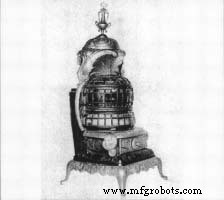 A cast iron stove produced by the Michigan Stove Co. in 1882. (From the collections of Henry Ford Museum & Greenfield Village, Dearborn, Michigan.)
Farm‑style breakfasts began to feature on large cast‑iron kitchen stoves after the 1850s, allowing cooks to prepare bacon, eggs, hash browns, and cinnamon rolls with precise burner temperatures—no thermostat, just seasoned experience.
By 1860, many households installed parlor stoves like this one on their hearths, vented through the chimney. The “art garland” model—known for its decorative scrollwork—used isinglass (thin mica sheets) in the grill, letting diners see the flames while mitigating heat exposure.
Nancy EV Bryk
Other materials occasionally appear in stove construction: ceramics, firebrick, and catalytic converters using platinum or palladium to reduce smoke at lower temperatures.
The Manufacturing Process
Making Cast Iron
- Iron ore is extracted from surface mines and sized to 0.3–1 in (7–25 mm). Oversized lumps are crushed; fines are sintered into larger chunks.
- The ore is mixed with coke and charged into a blast furnace. Hot air (1,650–2,460 °F / 900–1,350 °C) drives the reaction, producing molten pig iron—over 90% iron, 3–5% carbon, plus impurities.
- Molten pig iron is poured into large molds, then mixed with selected scrap metal and refined in a cupola to remove excess carbon and impurities, yielding cast iron.
Shaping Cast Iron
- Cast iron is poured into sand molds—a process known as sand casting. A pattern is packed in sand with bonding agents, hardened, then removed to create a cavity. Molten iron is poured in, cooled, and solidified into the desired shape.
Assembling the Stove
- Polished cast‑iron components are inspected and ground to a glossy finish, removing about 1.6 mm of surface.
- Components are bolted together—hand‑started then machine‑tightened—to ensure airtightness. Firebrick linings or catalytic converters are added concurrently.
- The finished stove is inspected for cracks, oiled to prevent rust, and packaged with expanded polystyrene foam in cardboard boxes for shipment.
Quality Control
Precision in alloy composition—especially silicon content—determines whether the iron is white or gray. Gray cast iron, used for stoves, balances hardness and machinability. Throughout assembly, each component is examined for pits, cracks, and leaks. Airtightness checks ensure smoke remains within the flues, and post‑oil inspections detect any metal leaks that could indicate structural flaws.
The Future
EPA mandates from the 1980s required wood‑burning stove manufacturers to curb emissions. Compliance has come in three forms: catalytic converters that burn smoke more completely; high‑tech designs that improve fuel efficiency; and pellet‑burning stoves that use compressed wood waste. Pellets are drier than firewood, burn cleaner, and feed automatically—making the cast‑iron stove a modern, eco‑friendly choice for the 21st century.
Manufacturing process
- Mastering Cast Iron Welding: A Professional Guide for In‑House Success
- Choosing the Right Iron Alloy: Ductile vs. Cast Iron Explained
- Cast Iron vs Cast Steel: Key Differences and Use Cases
- Wrought Iron vs Cast Iron: Key Differences Explained
- Master Cast Iron Welding: Proven Techniques & Expert Tips
- Cast Iron Castings: Fundamentals and Industrial Significance
- Custom Iron Castings Explained: Process, Types, and Applications
- CI Casting Explained: Composition, Color, and Crack Prevention
- Discover the Key Benefits of Gray Cast Iron in Modern Engineering
- Discover White Cast Iron: Properties, Uses, and Benefits