



Match Manufacturing: History, Materials, and Production Process
Background
A match is a thin wooden stick or cardboard strip that bears a solidified mixture of flammable chemicals on one end. When struck on a rough surface, the friction generates enough heat to ignite the chemicals and produce a small flame. Two main types exist: strike‑anywhere matches, which ignite on any rough surface, and safety matches, which require a specially prepared striking surface.
History
The earliest documented use of matches dates back to 577 CE, when women in a northern Chinese town coated sticks with a chemical mixture to start fires for cooking and heating, allowing them to conserve fuel by extinguishing fires between uses. The technique was lost to history until 1826, when John Walker of England invented the first friction match. Walker’s matches, ignited by drawing the head through a folded paper coated with ground glass, were sold in 1827 but were difficult to light and did not achieve commercial success. In 1831, French chemist Charles Sauria introduced a strike‑anywhere match using white phosphorus, making ignition easier. However, the match’s high flammability and the toxicity of white phosphorus led to accidental fires and severe health problems such as phossy jaw, a jawbone degeneration caused by inhalation of white phosphorus fumes. Despite the risks, white‑phosphorus matches remained in use until the early 1900s, when regulatory action in the United States and Europe forced manufacturers to switch to non‑toxic alternatives. A pivotal safety innovation came in 1844 when Swedish inventor Gustaf Pasch proposed separating the combustion ingredients onto a distinct striking surface. Coupled with the discovery of nontoxic red phosphorus, Swedish chemist J. E. Lundström introduced safety matches in 1855. Though safer, many consumers still favored strike‑anywhere matches, and both types continue to be manufactured today. The first matchbook was patented by Joshua Pussey in 1892, and the Diamond Match Company acquired the rights in 1894. Initially met with skepticism, sales surged after a brewing company purchased 10 million matchbooks for advertising. Early production was manual; automation began with Ebenezer Beecher’s 1888 automatic match machine. Today, continuous‑operation plants can produce up to 10 million matches in an eight‑hour shift, monitored by a small team of operators.
Raw Materials
Matchsticks are typically made from porous, straight‑grained woods such as white pine or aspen, which can absorb chemicals and withstand bending forces. The sticks are soaked in ammonium phosphate—a fire retardant that prevents smoldering after the match extinguishes—and then dipped in hot paraffin wax to provide a brief fuel burst that transfers the flame from the head to the stick. Once the wax burns off, the ammonium phosphate stops further combustion.
The head of a strike‑anywhere match consists of a tip and a base. The tip contains phosphorus sesquisulfide (a non‑toxic alternative to white phosphorus), potassium chlorate, powdered glass, inert fillers, animal glue, and optional zinc oxide for a whitish tint. The base has a reduced amount of phosphorus sesquisulfide, along with sulfur, rosin, a small amount of paraffin, and a water‑soluble dye for color. Safety match heads are a single composition of antimony trisulfide, potassium chlorate, sulfur, powdered glass, inert fillers, animal glue, and an optional dye. Antimony trisulfide cannot ignite from friction alone; ignition requires a striking surface containing red phosphorus, powdered glass, and an adhesive such as gum arabic or urea formaldehyde. Friction converts a trace of red phosphorus into white phosphorus, which reacts with potassium chlorate to ignite the antimony trisulfide.
Match books and matchboxes are made from cardboard. The thin strips of cardboard that hold the matches in matchbooks are called a comb.
The Manufacturing Process
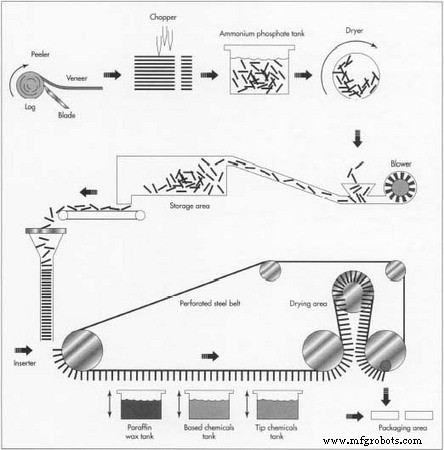
Matches are produced in several tightly controlled stages, ensuring consistency, safety, and quality. The process is illustrated below:
1. Cutting the Matchsticks
- Logs of white pine or aspen are debarked and rotated in a debarking machine.
- Logs are cut into ~1.6 ft (0.5 m) lengths and peeled into 0.1 in (2.5 mm) thick veneers. The residual post is discarded or repurposed for paper or chipboard.
- Veneer sheets are stacked and fed into a chopper that can produce up to 1,000 matchsticks in a single stroke.
2. Treating the Matchsticks
- Sticks are soaked in a dilute ammonium phosphate solution to act as a fire retardant.
- They are then tumble‑dried in a rotating drum, which also polishes and removes splinters.
- After drying, sticks are conveyed to storage or directly to the matchmaking line.
3. Forming the Match Heads
- Sticks are fed onto a perforated steel belt; plungers seat them firmly into holes.
- The belt dips the sticks into hot paraffin wax, then into a solution of head chemicals.
- For strike‑anywhere matches, a second dip coats the tip with a finer solution, giving the characteristic two‑tone appearance.
- Matches are dried slowly on the belt for 50–60 minutes to ensure proper ignition.
4. Packaging
- Cardboard boxes are cut, printed, and assembled. For safety matches, the striking strip is applied automatically.
- Dry matches are released from the belt into hoppers that count the exact number per box.
- Inner boxes are filled and then sealed with outer portions on a parallel conveyor at a rate of ~1 box per second.
- Finished boxes are grouped and packed into corrugated cartons for shipment.
Quality Control
Each component of the match head is weighed and measured precisely to prevent performance variation. Operators conduct continuous visual inspections throughout the process, and strict safety protocols are enforced to prevent accidental ignition in a facility that may hold over a million matches simultaneously.
The Future
In the United States, match sales have declined due to the rise of disposable lighters, reduced tobacco use, and automated gas‑stove lighting devices. Book matches continue to dominate sales in the U.S. due to their advertising value. Globally, matches will remain in demand, but production is likely to shift to regions where labor and raw‑material costs are lower.
Manufacturing process
- Python Regular Expressions (re Module) – A Practical Guide
- Why OSGi Is the Ideal Framework for Modern IoT Solutions
- Can Open‑Source Hardware Rival Linux’s Legacy?
- Renewable Energy & Composite Materials: A Synergistic Revolution
- Achieving Carbon Neutrality with CMMS: A Strategic Path for Sustainable Operations
- Master Python Regular Expressions: re.match(), re.search(), re.findall() – Practical Examples
- 4 Date Coders That Align With Your Operational Requirements
- Master Python Regular Expressions: A Practical Guide
- Streamline Fusion 360 Design: Associative Match Connects Form and Parametric Bodies
- How Cloud Migration Enhances Asset Tracking for Remote Teams