



The Comprehensive Guide to Vehicle License Plates: History, Design, and Future
Background
Metal plates affixed to motor vehicles are commonly called license plates, but the correct terminology is registration plates. The vehicle’s driver must hold a valid license, and the vehicle itself is registered; the plate serves as the public identifier for both. In many southern states the plates are also referred to as license tags.
Across the United States and Canada, each state or province manages its own system for designing, coloring, numbering, and issuing plates. Law enforcement relies on subtle distinctions—color combinations, embossed captions, and specific alphanumeric patterns—to quickly identify vehicle type, registration status, owner information, and any special designations such as military or disability status.
All jurisdictions issue permanent or semi‑permanent plates that are intended to last throughout ownership or for a period beyond one year. When registration fees are paid annually, a decal is affixed to the plate to indicate revalidation. Out of the 51 U.S. jurisdictions (the 50 states plus Puerto Rico), 31 require a front and rear plate, while the remaining jurisdictions mandate only a rear plate. Economic pressures have spurred a trend toward single‑plate solutions.
Passenger car plates may include county of residence, owner occupation, registration expiry codes, government department identifiers, and special codes for officials or disabled drivers. Commercial vehicles—buses, trucks, and trailers—receive plates of distinct color and code sets, and they typically undergo more frequent changes due to higher tax obligations based on miles, fuel use, and vehicle weight.
History
Regulation began as early as 1892 when states recognized the need to manage the rapid growth of motorized vehicles. The advent of automobiles, horses, and pedestrians threatened road integrity and public safety, prompting the creation of vehicle registration bureaus.
In 1903, Massachusetts became one of the first states to issue driver licenses and vehicle registration plates, anticipating that motor vehicles would soon outpace horse‑drawn carriages. The terminology of the era still lingers: many vintage plates carry the designation “Horseless Carriage,” and historic vehicle plates are issued to owners of vehicles manufactured after 1922 that are at least 25 years old.
Unique regional practices persisted: Alabama’s “mule tags” for trucks operating within a 15‑mile radius, a measurement rooted in the distance a mule could travel in a day; early motorcycle registrations employed small plates with drivers carrying brass watch fobs that bore the registration details.
Early manufacturing employed sheet iron, then tin around 1920. Arizona’s copper tags (1932‑1934) and Delaware’s porcelain plates (last produced in 1942) illustrate the material diversity. During World War II, soybean‑based fiberboard was used to conserve metal, a wartime necessity that even satisfied goats’ taste for the resulting plates.
In the 1920s, inmate labor was harnessed to produce plates, providing productive work and lowering costs. By 1923, automobile manufacturers were required to supply lights for plate illumination. Georgia pioneered the reflectorized plate in 1941 and introduced decals for annual updates, eliminating the need to replace plates yearly. Standard plate dimensions (6 × 12 inches) were adopted in 1957.
Until the mid‑1960s, many states displayed police troop codes, county names, or congressional districts on plates. By 1991, only 10 states retained such codes; the rise of computer technology reduced the need for lengthy printed identifiers.
Raw Materials
License plates are forged from aluminum blanks, pre‑printed and colored reflective sheeting, and protective paint. The blanks are typically pre‑cut by metal manufacturers and supplied to correctional institutions or private plate producers. Decals for renewal or county designations are printed on reflective sheeting identical to that used on the plates themselves.
Design
Design constraints include a standard size and thickness that accommodate most vehicle mounts. Ongoing improvements focus on color schemes and reflective coatings to enhance visibility for law enforcement.
Beyond these constraints, plate designs can be highly creative. Vanity plates—also known as personalized, custom, or prestige plates—have become popular in the last 30 years as states tap into the public’s desire for individuality. In California, revenue from vanity plates supports environmental projects, earning the designation “Environmental License Plates.” Canada refers to them as “Personalized Number Plates.”
Special plates honor individuals and causes: survivors of the Pearl Harbor attack, recipients of the Purple Heart or Congressional Medal of Honor, graduates of universities, and veterans. Florida, for instance, has sold over 50 specialty tags, including the Astronauts’ Memorial plate to raise funds for the Challenger memorial, manatee protection, and the Florida panther.
Modern manufacturing involves applying a pre‑printed reflective sheet to the unstamped metal blank. The sheet is affixed, stamped to create raised characters, and the characters are colored with ink. A clear, protective coating follows, ensuring durability and uniform reflectivity. The process yields fully reflectorized plates, making them highly legible under headlights and flashlights.
In the example image below, the plate features a reflective sheet with colored characters and a protective clear coating—an illustration of contemporary production techniques.
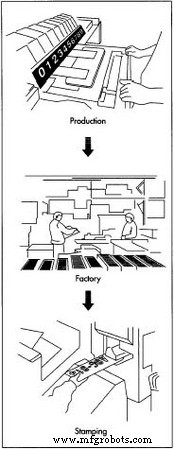
The Manufacturing Process
O/D Method
- Metal blanks are pressed to create rounded edges and stamped with alphanumeric characters.
- The entire plate is painted in its base color, and raised characters are painted in a contrasting color using an automated roller set to the correct height.
- The two‑color plate receives a reflective coating—a paint‑like substance of fine glass beads that refracts light, producing a brighter appearance. These plates are partially reflective due to uneven coating across the dual levels.
New Method
- A pre‑printed reflective sheet—containing the plate’s main color, decorative elements, and embedded reflective material—is affixed to the blank. The stamped plate creates raised characters that are inked, allowing the reflective material to shine through uniformly.
- Because ink is less durable than paint, a clear protective coating is added. These fully reflectorized plates enhance law‑enforcement readability and overall safety, though they incur higher production costs.
Quality Control
State motor‑vehicle departments, guided by state legislation, set manufacturing standards. The Interstate Commerce Commission provides additional requirements related to interstate traffic, licensing, and taxation. Prior to production, number designations for vanity and special plates receive state approval. Manufacturing facilities—whether correctional institutions or private contractors—are subject to strict inspection of stamped metal, paint, and final coating before packaging and distribution.
Byproducts/Waste
License‑plate production generates negligible waste. Metal blanks are precisely sized, and only minor trims from reflective coating sheets are disposed of. The industry has grown around collectible plates, offering sports‑team, personalized, and humorous designs, but this does not significantly impact environmental footprints.
The Future
License plates remain essential for vehicle registration, tax collection, and law‑enforcement. Emerging technologies may embed barcodes, QR codes, or RFID chips directly onto plates or within vehicles. Scanners—handheld for officers or fixed for toll and toll‑collection systems—could instantly retrieve a vehicle’s full registration history, ownership records, and even automated toll payments.
Collectors continue to find value in historic plates. The Automobile License Plate Collectors Association (ALPCA) awards an annual “Best Plate” to one state, fostering tourism and interest. Many jurisdictions also sell sample plates that showcase colorful designs and historical significance, making license plates a cultural artifact as well as a regulatory tool.
Manufacturing process
- Key Performance Parameters of Electron Tubes
- Understanding the Alternator: How It Powers Your Car and Signs of Failure
- Steel Plates: Uses, Benefits, Types, and Key Applications
- IoT4Car: Capture & Analyze Vehicle Telemetry with Arduino MKR1000
- Precision Plate Rolling: Crafting High-Quality Steel Plates in Our Mill
- Alloy 31 Stainless Steel Plate – Superior Strength & Ductility for Extreme Environments
- G.AL® 7075GF High-Strength Rolled Aluminum Plate – Precision-Finished for Rapid Machining
- Alloy 52 Plate – High-Performance Nickel-Iron Composite for Industrial Applications
- Vehicle Chassis Layout: Engine Position & Drive Configurations Explained
- Single Plate Clutch Explained: How It Works and Why It Matters