



The Legacy and Evolution of the Classic Jukebox
Background
A jukebox is a coin‑operated music player that delivers a curated selection from vinyl records or compact discs. First called “nickel‑odeons” in the late 1930s, the term “jukebox” emerged later and its origins remain debated. Some scholars trace it to the African word jook, meaning to dance, while others link it to the juke joints—roadside bars popular among African Americans in the South during that era.
During the mid‑1950s, the United States boasted roughly 750,000 jukeboxes. The 1970s and 1980s saw a decline, but the advent of CD technology and a thriving antiques market have revitalized the industry, bringing the current count to approximately 250,000 units.
History
Thomas Edison’s 1877 phonograph introduced the concept of a coin‑operated music machine, using wax cylinders. By November 23, 1889, Louis Glass installed a similar device in San Francisco’s Palais Royale Saloon, calling it a “nickel‑in‑a‑slot.” This name was shortened to nickelodeon.
In 1906, John Gabel patented the “Automatic Entertainer,” replacing wax cylinders with 78‑rpm discs and offering multiple selections. Gabel’s model dominated until the mid‑1920s.
The introduction of electric amplification was pivotal. In 1927, Automated Musical Instruments Inc. (AMI) developed a loudspeaker system that made the music audible to larger crowds. The amplified machines sold 50,000 units in a single year, propelling the jukebox into the cultural mainstream and providing affordable entertainment in speakeasies during Prohibition.
The Great Depression saw record sales drop from $75 million in 1929 to $5 million in 1933. Jukebox popularity helped revive the industry, bringing sales back to $25 million by 1938. By 1940, the U.S. housed 400,000 jukeboxes.
The 1940s solidified the industry’s giants: Seeburg, Rock‑Ola, and Wurlitzer. Designers like Paul Fuller revolutionized Wurlitzer models with rotating lights, Art Deco cabinets, and bubble tubes, creating the iconic Wurlitzer 1015 (1946) which sold 56,246 units. Seeburg’s 1948 Select‑O‑Matic 100 introduced the first 100‑selection jukebox, expanding musical diversity. By 1956, 200‑selection models were common.
The rise of fast‑food chains and cassette tapes, coupled with declining 45‑rpm production, diminished jukebox prominence by the mid‑1970s, with the count falling to 225,000.
Renewed interest in antiques and CD technology revived the market in the 1980s. Refurbished classics became collectible, with a Wurlitzer 1015 originally priced at $750 now worth around $12,000. New CD‑based models offer 1,000 song selections on 100 discs. Today, production has returned to roughly 250,000 units, and classic models like the Wurlitzer 1015 are re‑manufactured in Germany, while Rock‑Ola continues production.
Raw Materials
A modern jukebox contains 700–800 components, including wood cabinets, injection‑molded plastic parts, stereo electronics (amplifiers, woofers, tweeters), turntables or disc players, lighting, mirrors, records or CDs, and the selection mechanism. Many components are sourced from specialized suppliers; others are built in‑house, excluding the media.
Cabinets are constructed from multiple wood layers—typically Italian poplar, Finland ply, walnut, olive ash, alder, maple, and Corinthian burl elm. Metal trim and grills are cast from die‑cast metal and plated with copper, nickel, or polished chrome.
Design
Designers create prototypes using CAD/CAM software, producing a handful of units for test marketing in venues such as restaurants and taverns. After a few months of real‑world feedback, the design is approved for mass production.
The Manufacturing Process
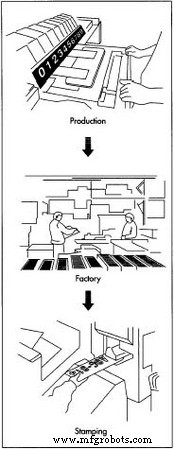
Although many parts are machine‑crafted, each jukebox is hand‑assembled, resulting in a modest output of about ten units per day.
- Plywood or solid‑wood panels are cured, molded into the basic shape, and cut to accommodate metal trim. The cabinets are varnished and stained, then riveted to the metal trim.
- All sheet‑metal parts are laser‑cut to precise specifications.
- Fluorescent lighting fixtures and bubble tubes are installed, with polarized lighting systems enabling dynamic color changes.
- Electronic components are mounted inside the door, which is then attached to the cabinet. Record or CD storage and changer mechanisms are installed.
- After assembly, the unit undergoes a 24–48‑hour test period. Inspectors verify lighting, sound, selection, and payment mechanisms to ensure flawless operation before shipment.
Quality Control
Quality control is integral to every step. After each stage, qualified technicians inspect the integrity of the work. During final inspection, a comprehensive review of all components—lighting, sound, selection, money handling—ensures the unit meets stringent standards before leaving the factory.
The Future
Since the late 1980s, demand for new jukeboxes has remained steady. Collecting refurbished units has blossomed into a multimillion‑dollar secondary market, with enthusiasts organizing through the American Historic Juke‑Box Society and hosting vintage shows nationwide. While nostalgia continues to fuel interest in the past, the jukebox remains a vibrant part of contemporary culture, bridging classic charm with modern technology.
Manufacturing process
- What Are Music Wire Springs? Strength, Durability, and Modern Applications
- Designing UX for Seniors: A Comprehensive Guide
- Sheet Music: From Medieval Manuscripts to Modern Publishing – An Industry Overview
- Build Your Own LUMAZOID: A DIY Arduino Music Visualizer
- Modern Jukebox: Raspberry Pi & Arduino LED Music Player
- Musical Board Books: Boosting Mood & Memory for All Ages
- Create Musical Tones with Arduino: A Step‑by‑Step Guide
- EL Tape Music Visualizer – Illuminate Your Sound with Arduino
- Build a Polyphonic Avengers Theme Player with Arduino UNO
- Create an AM Music Transmitter Using Arduino Nano