



Jam and Jelly Production: History, Ingredients, and Modern Manufacturing
Jam and jelly are fruit spreads crafted from ripe fruit, sugar, and pectin. While jelly derives solely from fruit juice, jam incorporates the fruit’s flesh, yielding a thicker, fruit‑laden consistency. Some manufacturers also produce vegetable‑based jellies.
Historical Context
Preserving fruit in a spread dates back to ancient civilizations that sun‑dried foods to extend shelf life. The first documented method for jam appears during the Crusades, when soldiers introduced Middle Eastern techniques to Europe.
Home preservation remained the norm until the nineteenth century, when industrial processing began. The core process—chopping fruit, cooking it with sugar and pectin, then sealing the result in sterilized jars—has persisted to this day.
In 1810, French confectioner Nicolas Appert pioneered a key preservation step: filling jars to the brim, expelling air, and submerging them in boiling water. This technique dramatically reduced spoilage and laid the groundwork for modern canning.
During the United States’ westward expansion, figures like Johnny Appleseed (John Chapman) planted apple orchards across the Midwest, ensuring a steady supply of fruit for pioneers. Ohio’s Jerome Smucker leveraged these apples to launch a cider mill in 1897 and soon began producing apple butter, which he sold locally from stoneware crocks.
Concord, Massachusetts, yielded the iconic Concord grape thanks to Ephraim Wales Bull. Dr. Thomas Branwell Welch later founded a grape‑juice company in 1869, and in 1918, Welch’s first jam—Grapelade—secured a military contract. The brand’s Concord grape jelly debuted in 1923.
Post‑World War II, food scientists introduced aseptic canning: heating the product and the container separately to preserve flavor and nutrition while ensuring sterility.
The early 1970s saw a surge in sugar prices, prompting the adoption of high‑fructose corn syrup (HFCS). Major processors—including Archer Daniels Midland, Amstar CPC International, Cargill, H.J. Heinz, and Anheuser‑Busch—opened HFCS production lines to meet demand.
Raw Materials
Jams and jellies can be made from a single fruit or a blend. Harvest typically occurs in the fall, with ripeness levels tailored to each variety. Pears, peaches, apricots, strawberries, and raspberries perform best when slightly underripe, whereas plums and cherries are ideal when just ripe. Producers often establish close relationships with farmers and locate manufacturing plants within 12‑24 hours of harvest to preserve quality.
Sugar—ideally cane sugar chips, which resist crystallization—or HFCS is added to sweeten the mixture. Suppliers source both ingredients separately.
Pectin, the natural gelling agent, varies by fruit. Apples, blackberries, cherries, citrus fruits, grapes, quinces, and cranberries contain abundant pectin. Low‑pectin fruits such as strawberries and apricots may require blending with high‑pectin varieties or adding extra sugar. Industrial pectin extraction from dried apples is also common.
Citric acid, usually derived from lime or lemon juice, balances the pH to the optimal 3.1, essential for gel formation. Citric acid is sourced from external suppliers.
Optional flavorings—vanilla, cinnamon, mint, or alcoholic spirits like rum or Kirsch—can be incorporated to create diverse product profiles. These additives are also procured from specialized suppliers.
Manufacturing Process
Ingredients are measured precisely: 1% pectin, 65% sugar, and an acid concentration yielding pH 3.1. Excess pectin hardens the spread; excess sugar creates stickiness.
Inspection
- Upon arrival, fruit undergoes a quality check based on color, ripeness, and flavor. Accepted fruit enters a funnel‑shaped hopper that feeds it into cleaning and crushing pipelines.
Cleaning, Crushing, and Chopping
- A gentle water spray removes surface dirt as fruit travels through the pipes. Depending on the desired product—jam or jelly—paddles either push whole fruit or only juice through perforations, leaving stems and debris behind. Citrus and apples may be peeled, cored, sliced, or diced manually, while cherries are soaked, pitted, and crushed.
Pasteurization
- The fruit or juice reaches cooking vats where it is heated just below boiling (≈212 °F / 100 °C) and then rapidly cooled to just below freezing (≈32 °F / 0 °C). This pasteurization step eliminates spoilage organisms. For jelly, pulp is further filtered to remove seeds and skins before storage in refrigerated tanks.
Cooking
- Measured amounts of fruit, sugar, and pectin are blended in industrial kettles. The mixture typically undergoes three heating–cooling cycles. Flavorings, if any, are added at this stage. Once the desired thickness and sweetness are achieved, the product is transferred to filling machines.
Filling and Sealing
- Presterilized jars travel along a conveyor belt. Precision spouts dispense the exact volume of jam or jelly into each jar. The jars are then vacuum‑sealed, expelling all residual air to further ensure sterility.
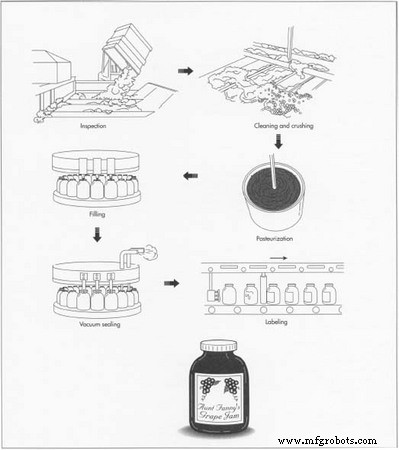 The entire process—from inspection to vacuum sealing—is automated to maintain consistency and safety.
Labeling and Packaging
- Sealed jars pass through a labeling machine that affixes preprinted labels, compliant with regulatory requirements that mandate accurate, truthful information. After labeling, jars are packed into cartons for distribution. Depending on scale, labeling may be mechanical or manual.
Quality Control
U.S. regulations stipulate a minimum of 45 parts fruit or juice to 55 parts sugar. The FDA requires that all heat‑processed canned foods be free of live microorganisms. Production facilities maintain detailed logs of cooking times and temperatures, which the FDA audits regularly. Additional controls cover workplace cleanliness and worker hygiene, with taste, color, and consistency tested throughout the process.
Future Trends
While the fundamental production method remains stable, innovation focuses on flavor diversification. Vegetable jellies—such as pepper and tomato—have gained traction, and more exotic options like garlic jelly are appearing on grocery shelves. Advances in processing technology continue to improve shelf life and nutritional retention without altering the core manufacturing steps.
Manufacturing process
- Canals & Locks: Engineering, History, and the Future of U.S. Water Transport
- Jawbreaker: The History, Ingredients, and Craft of a Classic Hard Candy
- Shortbread: From Scottish Heritage to Modern Production
- The Evolution and Craftsmanship of Bows & Arrows: From Ancient Hunting to Modern Engineering
- Fruit Leather: Production, History, and Quality Control Explained
- Molasses: From Sugar Production to Culinary and Industrial Applications
- Fruitcake: History, Production, and Cultural Significance
- The Sweet Journey of Maple Syrup: From Native Roots to Modern Delight
- The Sweet Legacy of Jelly Beans: History, Production, and Future Trends
- Sugar: From Ancient Roots to Modern Production