



The Evolution and Craftsmanship of Bows & Arrows: From Ancient Hunting to Modern Engineering
A bow is a long, flexible staff whose ends are bound by a string, causing the shaft to bend. An arrow is a slender shaft capped with a pointed head and fitted with feather or vane stabilizers near one end. The arrow’s notched end sits against the bowstring, and when the archer releases the string, stored potential energy is transformed into kinetic energy that propels the arrow forward with remarkable speed. Bows are primarily used for hunting and target shooting.
Background
Archaeological evidence indicates that hunters employed bows and arrows as far back as 50,000 years ago. Indigenous peoples around the globe—except Australia—used these weapons for hunting, warfare, and sport. In ancient Egypt, China, and India, archery evolved into a respected pastime and competitive discipline.
Early bows were fashioned from flexible materials such as bamboo and wood, with gut or sinew strings. Native American and Asian bowyers independently pioneered composite construction by bonding layers of sinew to the bow’s back and horn to its face. This technique, documented in Central, North, and Southwest Asia as early as 4,500 years ago, created bows that were both stronger and more resilient. Northern European craftsmen took a different route, bonding sapwood to heartwood by the fourth century AD to achieve comparable performance.
Arrows traditionally used wooden shafts, while the heads were fashioned from hardwood, bone, horn, flint, bronze, or later, steel. In India, the third century BC saw the first all‑metal arrow, and by the seventeenth century, steel bows gained popularity across the subcontinent.
Until the late sixteenth century, archery dominated warfare, with standard bows outclassing mechanically assisted crossbows. The advent of practical firearms shifted the focus toward hunting and target shooting.
Between 1929 and 1946, seven scientist‑archers pioneered experimental studies of bow performance using high‑speed photography. Their collective findings, published in scientific journals, culminated in the 1947 book Archery: The Technical Side. These analyses laid the groundwork for post‑World War II innovations, including plastics, fiberglass, and pistol‑style grips.
Design
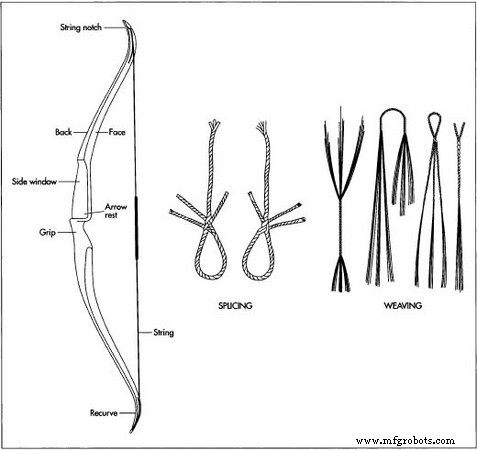
The simplest bow, the longbow, features a straight shaft. Recurve bows introduce permanent curves that concave the back at each end, enhancing power and stability. The pinnacle of modern design is the compound bow, which attaches the string to a system of pulleys, providing a mechanical advantage and higher draw weight.
A recurved bow comprises a rigid riser and two flexible limbs. Typical total length ranges from 50–70 in (125–175 cm), with a 20‑in (50 cm) riser that offers a comfortable grip and a shelf for the arrow. Limbs may be permanently affixed or removable, allowing customization of performance characteristics.
Raw Materials
Single‑piece wooden bows are prone to warping from moisture or cold, losing springiness and power. Fiberglass bows mitigate these issues but may underperform compared to composites. The best performance arises from layered composites—wood, fiberglass, or carbon fiber—bonded with high‑strength adhesives. Common woods include red elm, maple, cedar, bamboo, and exotic varieties like bubinga.
Historically, bowstrings were crafted from sinew, rawhide, gut, hemp, flax, or silk. Modern longbows often use linen thread, while compound bows favor steel wire. Recurve bows typically employ Dacron, a low‑stretch, durable material, reinforced with nylon at critical contact points. Nocking points—rubber or plastic inserts—ensure secure arrow attachment.
Arrow shafts have evolved from solid wood (ash, elm, willow, oak, cedar, Sitka spruce) to hollow forms made from aluminum, fiberglass, graphite, or carbon fiber. Vanes now favor plastic or molded rubber over natural feathers for durability and moisture resistance. Arrowheads, once flint or bronze, are now commonly steel and come in configurations ranging from simple points to multi‑blade designs, tailored to target or hunting needs.
The Manufacturing Process
The Bow
Below is a step‑by‑step outline for constructing a recurved bow with permanently attached limbs.
- 1. Cut material into rectangles for limb layers; dye wood as desired; apply glue and stack layers in sequence.
- 2. Mount the multi‑layer limb on a form that dictates curvature; cure in an oven at 180 °F (80 °C) for six hours.
- 3. Craft the riser from a solid aluminum block or laminated wood; outline the shape, insert pins for limb attachment, and drill matching holes.
- 4. Attach limbs temporarily, sand joints smooth, then remove limbs for final shaping.
- 5. Use a template to mark limb cuts; power‑saw and sand to taper ends, then file grooves for the string.
- 6. Shape the riser to form an arrow shelf and sighting window; contour the grip area with saws, sanders, and hand rasps.
- 7. Glue limbs to the finished riser; final shaping of limb tips; hand‑sand entire bow; apply clear epoxy finish.
The Bowstring
While commercial strings are available, many archers prefer hand‑made strings for precision.
- 8. Determine strand count based on thread strength and draw weight; divide into three sets, wax each, then twist and weave into a cord.
- 9. Create a loop by splicing or weaving; pre‑stretch by hanging a weight; adjust length as needed; finish with a final loop.
- 10. Reinforce with nylon in the center and near each end; attach a nocking point (rubber or plastic) at the arrow mounting spot.
The Arrow
Below are the steps for crafting a traditional wooden arrow.
- 11. Select a 2‑by‑4 board with grain running along the length; cut 3 in longer than desired arrow length; split one side to create a sharp edge.
- 12. Saw square blanks slightly larger than the target shaft diameter; heat and bend if necessary.
- 13. Plane each side for smoothness; trim corners to form an octagonal rod, then sand to a round dowel.
- 14. Cut a nock on one end or insert a plastic nock.
- 15. Coat shaft with polyurethane or varnish; apply cresting bands to identify maker or owner.
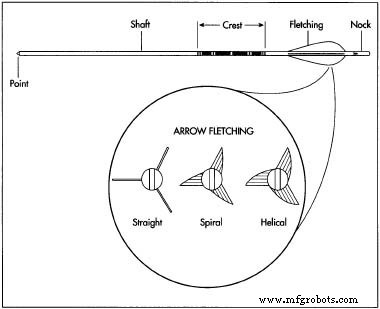
- 16. Fletch by gluing trimmed feathers or plastic vanes between cresting and nock; arrange feathers in parallel, spiral, or helical patterns, ensuring a cock feather faces away from the bow.
- 17. Mount an arrowhead appropriate for target or hunting use.
The Future
Building on 1930s analytical methods, contemporary researchers refine mathematical models to predict bow performance and assess design modifications. Innovations now include limbs with syntactic foam cores—a lightweight, high‑strength material combining epoxy resin with microscopic glass beads—and advanced accessories such as electronic sights that double as digital rangefinders. Stabilizers featuring hydraulic damping or weighted rods are also emerging to reduce bow twist and absorb recoil.
Manufacturing process
- Decoding Numbers and Symbols in Electronics
- Analyzing a Parallel R‑L‑C Circuit: Impedance, Current, and SPICE Simulation
- Analyzing Series-Parallel RC and RL Circuits with Complex Impedance
- Comprehensive Summary of Resistors, Inductors, and Capacitors in AC Circuits
- Canals & Locks: Engineering, History, and the Future of U.S. Water Transport
- Scratch & Sniff: The Science and Craft of Micro-Encapsulated Scent Printing
- Butter vs. Margarine: History, Production, and Health Insights
- The Craft of the Violin Bow: History, Materials, and Manufacturing
- Mastering C# While and Do‑While Loops: Syntax, Examples, and Best Practices
- Build a Raspberry Pi 3 & Arduino Laptop: Step‑by‑Step Guide