



Molasses: From Sugar Production to Culinary and Industrial Applications
Molasses, derived from the Latin melaceres—meaning honey‑like— is a thick, dark syrup that emerges as a by‑product of sugar refining. When sugar is extracted from sugarcane or sugar beet juice, the remaining liquid, rich in flavor and nutrients, becomes molasses. It is widely used for human consumption in baking, as a fermentable base for ale and rum, and as a key ingredient in animal feed.
History
The technique of crushing cane to obtain juice and boiling it until crystals form dates back to India around 500 B.C. The process slowly spread; Arab traders introduced it to Spain in the Middle Ages, and Christopher Columbus later brought sugarcane to the West Indies. By the early 19th century, the New Orleans region had begun cultivating sugarcane cuttings, marking the start of a transatlantic sugar economy.
Molasses played a pivotal role in the triangular trade of the 17th century. English rum, sold to African traders, facilitated the transport of enslaved people to the Caribbean, where the resulting molasses was shipped back to England, closing the loop.
While sugarcane remained the dominant source, the 18th century saw the emergence of beet sugar. German chemist Andreas Marggraf discovered sucrose in beet roots in the 1740s, and by 1793, Franz Karl Achard had perfected the extraction process. The first beet sugar factory opened in Prussia’s Silesia in 1802. During the Napoleonic Wars, Britain’s blockade of French sugar imports spurred France to invest heavily in beet sugar, leading to the establishment of large factories and the awarding of the Legion of Honor to pioneer Benjamin Delessert.
In the United States, beet sugar industry development lagged until the late 19th century; by 1900 the country operated 30 processing plants. Molasses also entered American cultural memory through events like the Molasses Act of 1733—an early tax on imported sugar and molasses—and the infamous Great Boston Molasses Flood of 1919, when a storage tank ruptured, releasing 12,000 tons of molasses and causing 21 deaths.
Prior to mechanization, laborers manually cut and stripped sugarcane, then pressed it with mule‑driven mills. The extracted syrup was cooked in large kettles over open fires until it thickened.

The Boston incident underscored the importance of engineering oversight. A 50‑ft tall, 90‑ft diameter steel tank—intended to hold up to 15,000 tons of molasses—fractured under pressure, sending a 15‑ft high wave of syrup through the North End. The disaster resulted in significant loss of life, property damage, and a reassessment of industrial safety standards.
Raw Materials
Sugarcane (Saccharum officinarum) and sugar beet (Beta vulgaris) are the foundational crops for molasses production. Sugarcane thrives in tropical and subtropical climates, growing 10–26 ft (3–8 m) tall with stems 1–2 in (2.5–5 cm) in diameter. The Everglades of South Florida produce 425,000 acres of cane annually, yielding 90 million gallons of blackstrap molasses. Beet roots, adaptable to temperate regions, contain about 15 teaspoons of sugar per root. At harvest, the tops are repurposed as cattle feed.
Key processing chemicals include milk of lime—burnt lime heated with sweet water—and carbon dioxide, both used to clarify the extracted juice.
The Manufacturing Process
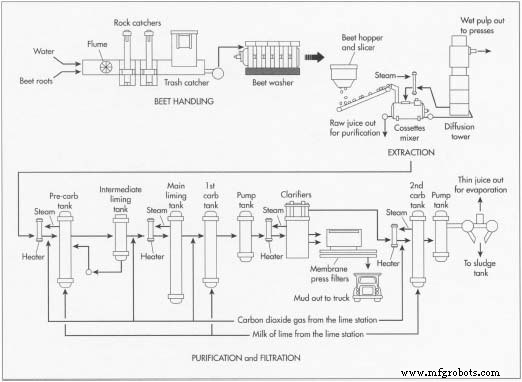
Washing and Cutting
- Canes are conveyed, washed with hot water to remove field debris, and then cut into short pieces by rotating blades.
- Beets are run through a flume that separates leaves, rocks, and other impurities. They are then sliced into thin strips called cossettes.
Extracting the Sugar Juice
- In cane mills, juice is extracted via diffusion—dissolving cut stalks in hot water or lime juice—or via milling, where heavy rollers press juice from the pulp.
- In beet factories, cossettes are diffused in hot water; the resulting juice is used to pre‑scald the strips for maximum sugar extraction.
Clarifying the Juice
- Milk of lime and CO₂ are added, and the mixture is heated and passed through carbon filters, producing a mud-like substance called carb juice.
- Carb juice is heated and clarified; the settled mud is removed, leaving a pale yellow liquid known as thin juice.
Evaporating and Concentrating the Syrup
- Thin juice is boiled in evaporators until water evaporates, forming a syrup. Vacuum boiling further concentrates the syrup without scorching.
- Crystallization yields massecuite, which is centrifuged to separate raw sugar crystals from the remaining syrup—molasses—pushed out through holes in the centrifuge.
Storage and Bottling
- Molasses is stored in large tanks and pumped to bottling lines where measured portions are filled into containers for distribution.
Byproducts and Waste
Beyond molasses, sugar processing generates several valuable by‑products:
- Bagasse—dry cane residue—is burned as fuel.
- Beet pulp is utilized in pet food manufacturing.
- Cane wax, extracted from the residue, finds use in cosmetics, polish, and paper coatings.
Manufacturing process
- What is VMC Machining? An Expert Overview of Vertical Machining Centers
- Jawbreaker: The History, Ingredients, and Craft of a Classic Hard Candy
- Shortbread: From Scottish Heritage to Modern Production
- Jam and Jelly Production: History, Ingredients, and Modern Manufacturing
- Molasses: From Sugar Production to Culinary and Industrial Applications
- The Sweet Journey of Maple Syrup: From Native Roots to Modern Delight
- Sugar: From Ancient Roots to Modern Production
- Imperial Sugar Elevates Workforce with Strategic Skill Development
- Revolutionizing Care: Self‑Powered Diaper Sensors Detect Urine Glucose Wirelessly
- Virgin Media O2 Business Partners with British Sugar to Launch Secure 4G Mobile Network