



The Evolution of the Mousetrap: From 19th‑Century Snap Devices to Modern Humane Traps
Scientists label the classic mousetrap as an “irreducibly complex” device—a marvel of simplicity that still outperforms more elaborate designs. The phrase “to build a better mousetrap” has become a metaphor for achieving perfection in an imperfect world.
Background
From pit traps carved into the earth to modern humane cages, the need to control pests has shaped human ingenuity for millennia. Early hunters and farmers devised simple snares to capture prey or protect grain. As societies grew and agriculture diversified, the focus shifted from survival to property protection and recreational hunting.
Today, rodents often infiltrate urban homes, industrial sites, and research facilities. Traps, poisons, and domestic predators such as cats are common tools for managing these unwanted visitors.
While the traditional snap trap is a basic combination of simple machines, it suffers from design flaws, operational difficulties, and ethical concerns. Consequently, inventors have pursued improved solutions, including humane cage traps that allow for safe release.
History
In 1895, John Mast of Lancaster, Pennsylvania, introduced the first commercially successful snap‑trap. His design was celebrated for its elegance and for avoiding accidental capture of pedestrians’ long skirts—a concern of the era. The bait pedal released a striker in less than three milliseconds after the mouse bit.
Mast earned a fortune, sold his company to Oneida Community Ltd. in 1907, and later Woodstream Corp. took over the production. Today, Woodstream manufactures up to 10 million mousetraps annually, closely following Mast’s original blueprint. The snap‑trap remained a low‑cost solution, retailing for five cents in 1900 and seven cents in 1962.
Since 1838, the U.S. Patent Office has granted 4,400 patents for mousetraps, yet fewer than 25 have been commercially profitable. The Patent Office lists 39 official subclasses—ranging from choking and squeezing mechanisms to electric shock and non‑return entrance designs—illustrating the breadth of attempted innovations.
In 1924, a janitor in an Iowa school, witnessing a mouse infestation, devised the “Catch‑All Multiple Catch Mousetrap.” This humane device captured mice without killing them, allowing for release and repeated use. A. E. “Brick” Kness founded Kness Manufacturing in Albia, Iowa, and today the company produces both the standard snap‑trap and the plastic‑based Catch‑All, exporting to 14 countries.
Raw Materials
Snap traps are constructed from pine or plastic bases, a 15‑gauge coil spring‑driven metal striker, a thin metal trigger rod, and a metal bait pedal. Staples secure the components.
Cage traps are made from sheet steel for the frame and high‑impact polystyrene for internal parts, sourced from external suppliers.
Design
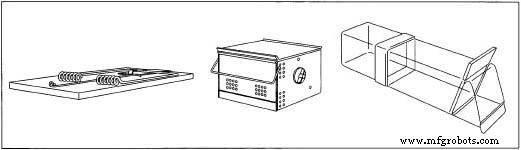
Both trap types rely on simplicity and durability. Cage traps typically feature a six‑sided steel body with a one‑way entrance and a sliding release door. Their design considers the animal’s size and behavior—stronger steel for larger species, lightweight construction for common house mice, and quick‑closing mechanisms to prevent escape.
Key design criteria include ease of baiting, reusability, capacity, material selection, and operational reliability.
Cage traps incorporate a trip pan that houses the bait. When the bait is removed, the trigger rod releases a latch that seals the exit. The tension is calibrated to the target animal’s weight, and steel construction prevents chewing damage.
The Snap Trap
Snap traps feature a wooden or plastic base—pine for its strength and cost, plastic for precision molding. The bait pedal is a small metal piece with a nub that pivots slightly, ensuring the trigger rod and striker are released with minimal movement.
Some manufacturers hand‑assemble traps; others employ fully automated lines that extrude copper‑coated steel strands into trigger rods and strikers, staple them to the mouseboard, and crimp the staples to prevent separation.
The Manufacturing Process
The production of the Catch‑All cage trap involves the following steps:
- Galvanized steel sheets (G90 Lock‑Forming Quality) are die‑cut into six widths. High‑impact polystyrene pellets are prepared for internal components.
- Steel parts—including body, ends, lid, and paddle—are cut, punched, and notched using dies that apply 5–40 tons of pressure.
- Polystyrene pellets are melted in an injection‑molding machine to form trip assembly pieces.
- Operators manually assemble the cage: body pieces snap together, the trip assembly is inserted and wound, and each trap is tested for proper function before packing.
Quality Control
Rigorous inspection ensures each component meets dimensional tolerances and cosmetic standards. Operators reject any part that fails to snap correctly, guaranteeing the durability of reusable traps.
Byproducts/Waste
Manufacturing generates no hazardous byproducts. Wood waste is disposed of, while metal and plastic scrap is recycled back to suppliers for remelting.
The Future
As long as mice persist, snap and cage traps will remain essential. Agricultural intensification and urban density increase the need for effective pest control. Rising consumer concern for humane treatment is expanding the market for cage traps in the U.S. and abroad, ensuring continued demand for American manufacturers. The only real competitor to a well‑designed mousetrap may well be the cat.
Manufacturing process
- What is VMC Machining? An Expert Overview of Vertical Machining Centers
- Expert Guide to Aluminum Laser Marking: Precision, Durability, and Industry Applications
- MIG vs. TIG Welding: Selecting the Right Arc Welding Technique for Your Project
- Comprehensive Guide to Laser Marking: Types, Benefits, and Applications
- Key Considerations for High‑Volume Swiss Machining
- The Evolution of the Mousetrap: From 19th‑Century Snap Devices to Modern Humane Traps
- Java Stack Class – Comprehensive Guide to Usage and Methods
- EPO Clarifies Patent Exclusions for Plants and Animals Derived Solely by Biological Breeding
- Nano‑Selenium in Monogastric Nutrition: How Gut Microbiota Drives Its Conversion to Active Selenoproteins
- Rendering Plants Explained: Turning Animal By‑Products into Food, Fuel, and More