



Inductors & Calculus: How Current Change Drives Voltage
Unlike resistors, inductors do not exhibit a constant resistance. Instead, their voltage–current relationship is governed by a clear mathematical principle:
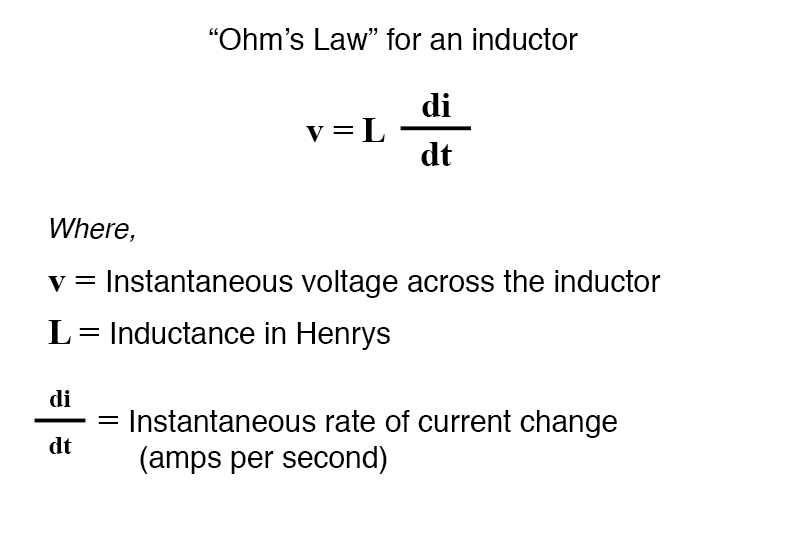
This expression mirrors the capacitor equation, linking the instantaneous voltage drop across an inductor (v) to the instantaneous rate of change of its current (di/dt). The variables are lower‑case because they represent values at a specific instant in time.
In practice, we write the instantaneous voltage as v (though e is also acceptable). The current rate‑of‑change, di/dt, is measured in amperes per second, with positive values indicating increasing current and negative values indicating decreasing current.
As with capacitors, an inductor’s behavior is fundamentally time‑dependent. Ignoring the minimal resistance of its coil, the voltage across an inductor is solely a function of how rapidly its current changes.
Consider a perfect inductor (zero ohms of wire resistance) in series with a potentiometer that can vary the current flowing through it:
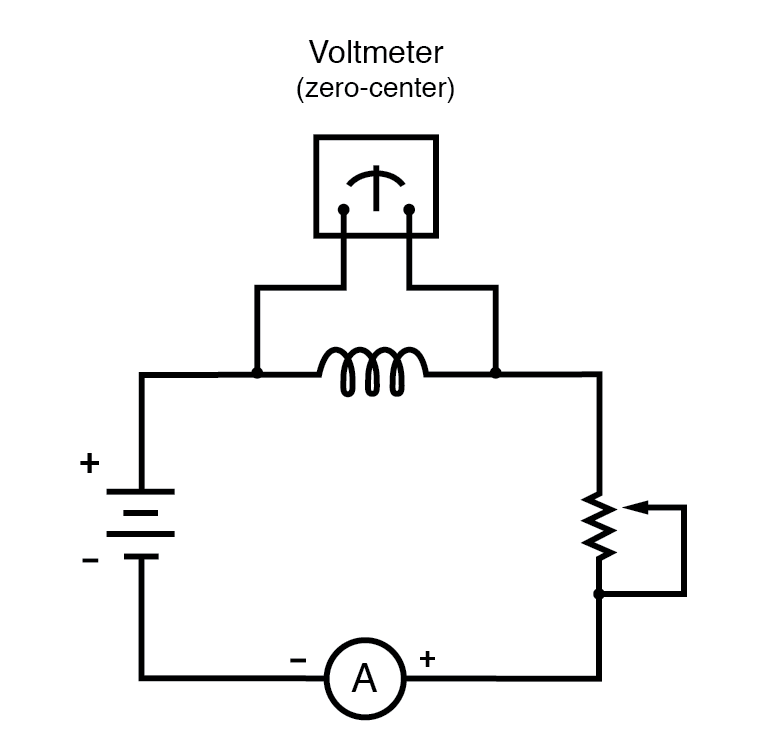
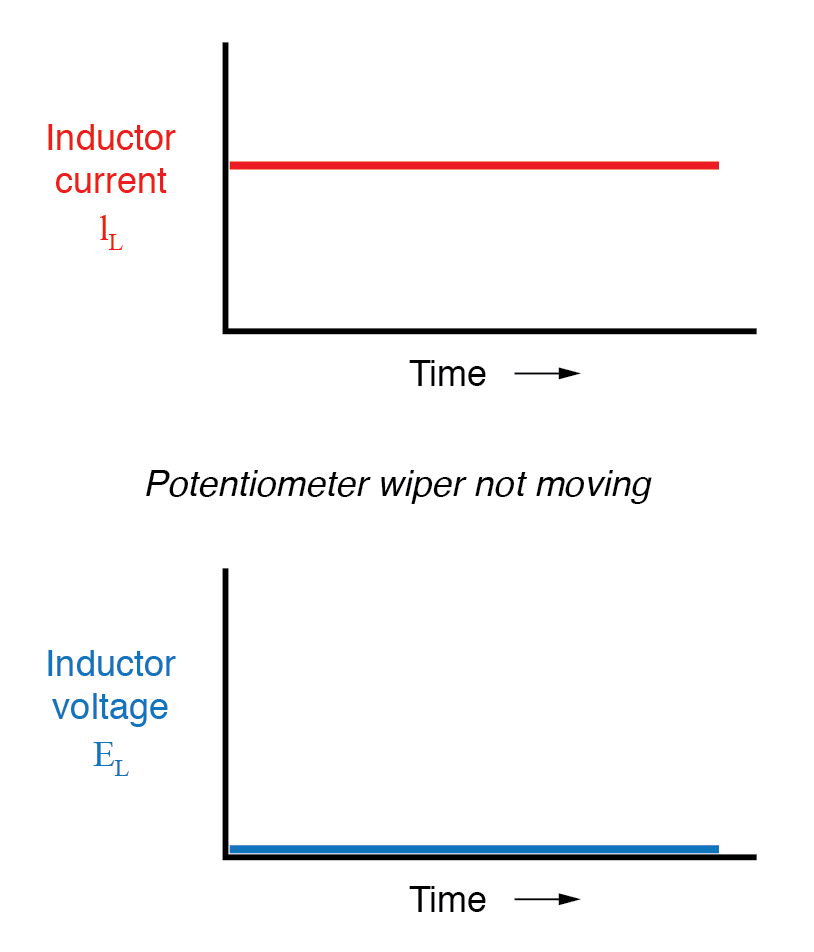
If the potentiometer wiper remains stationary, the current measured by the ammeter is steady and the voltmeter reads zero volts. In this case, di/dt equals zero, confirming that no voltage is induced across the inductor because the magnetic flux is constant.
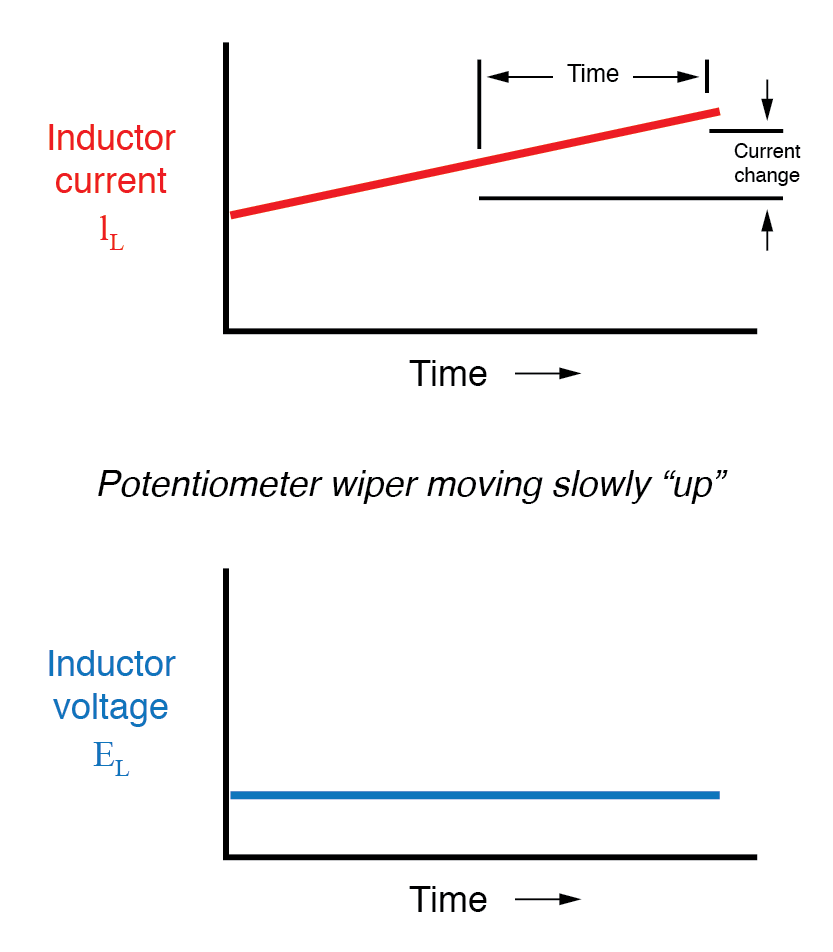
Moving the wiper slowly in the upward direction decreases the potentiometer’s resistance, thereby increasing current. The ammeter shows a gradual rise in current, meaning di/dt is a small positive number. Multiplying this fixed di/dt by the inductor’s inductance L yields a fixed voltage across the coil:
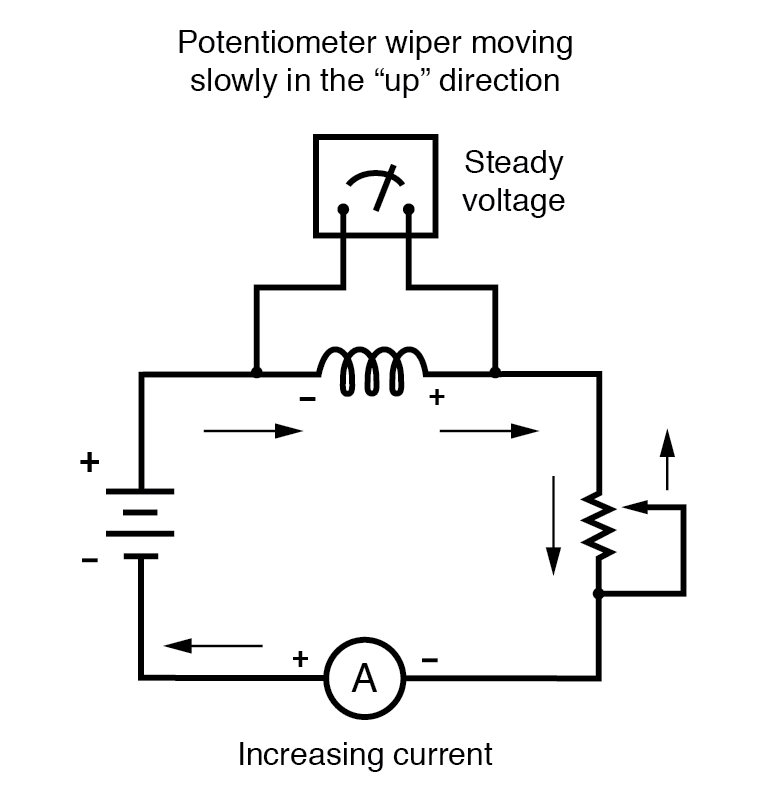
Physically, this corresponds to a slowly increasing magnetic field, which induces a voltage per Faraday’s law, e = N(dΦ/dt). The induced voltage has a polarity that opposes the change in current, embodying Lenz’s Law.
Inductor Current, Voltage vs. Time
In this scenario, the inductor acts as a load. The induced voltage is negative where electrons enter and positive where they exit.
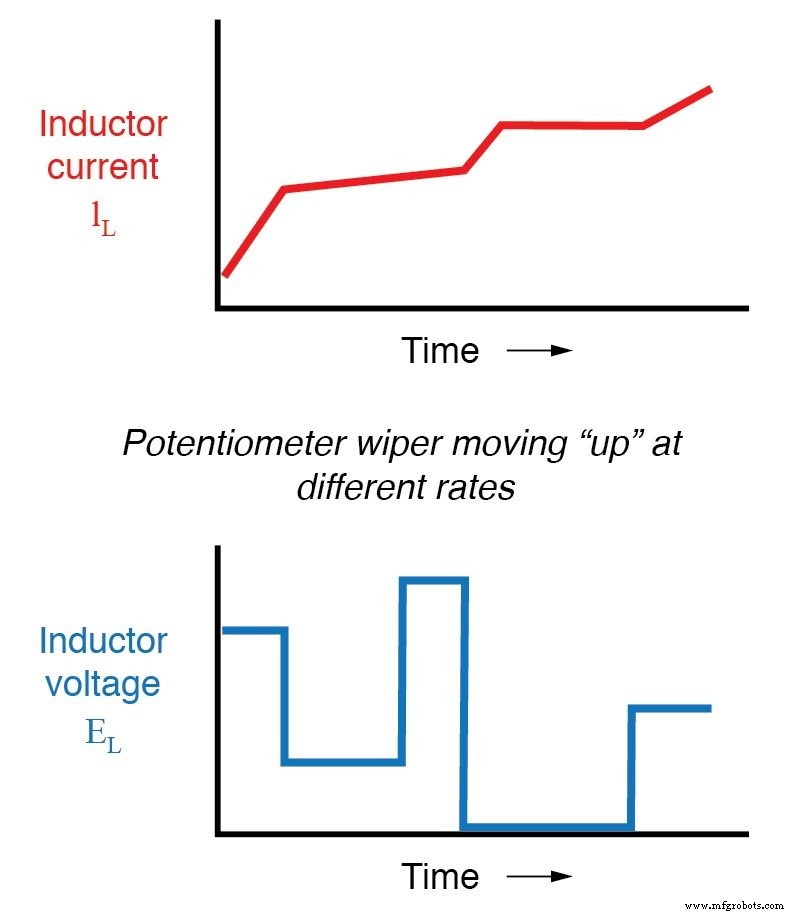
Varying the speed of the wiper’s upward motion changes the magnitude of the induced voltage while keeping its polarity constant. This demonstrates the derivative nature of the inductor’s response:
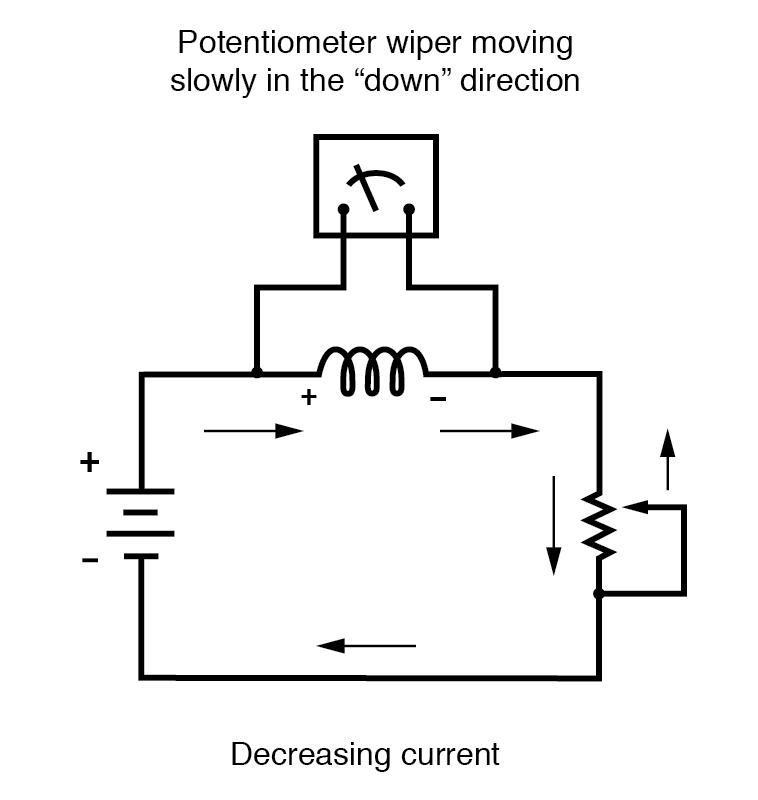
Reversing the wiper’s motion (moving downward) increases resistance, reducing current. The resulting negative di/dt produces an induced voltage that opposes this decrease, flipping the polarity of the voltage drop.
In both cases—whether the current is rising or falling—the magnitude of the induced voltage depends solely on |di/dt| and the inductance L. A di/dt of –2 A/s induces the same voltage magnitude as +2 A/s, merely with opposite polarity.
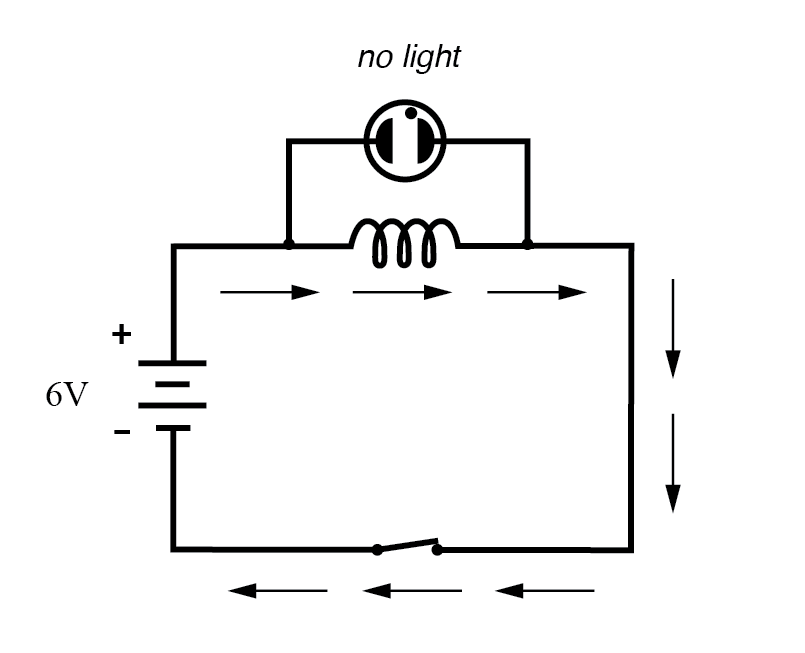
When a current change is extremely rapid, the induced voltage can become very large. For example, in a circuit where a 6‑V battery, a switch, an inductor, and a neon lamp are connected as shown:
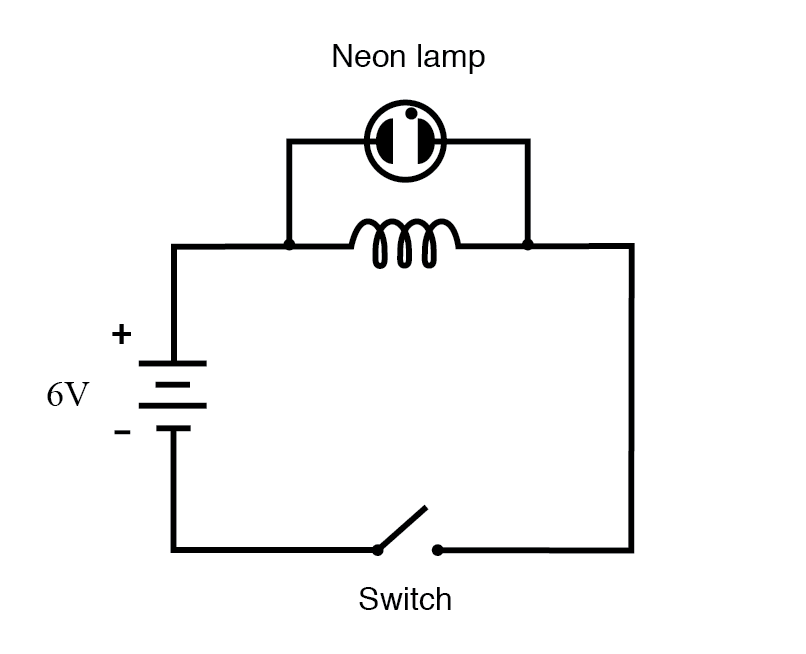
Closing the switch briefly opposes the rise in current, producing only a small voltage drop—insufficient to ionize the neon gas (≈70 V required). Thus the lamp remains off.
Opening the switch, however, introduces a large resistance almost instantaneously. The current collapses rapidly, yielding a large negative di/dt. The resulting high induced voltage can easily exceed 70 V, momentarily lighting the neon lamp before the current decays to zero:
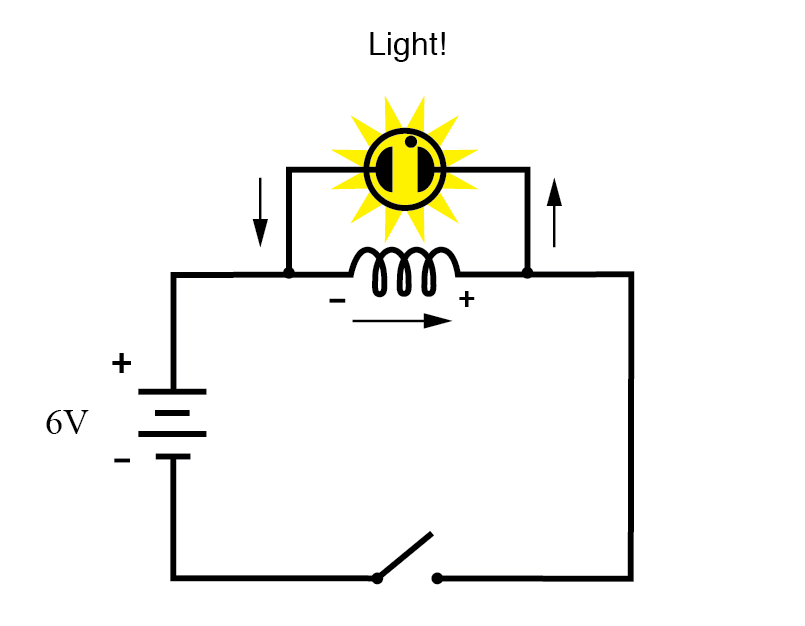
To maximize this effect, use an inductor with a high inductance (≥ 1 H).
RELATED WORKSHEETS:
- Calculus for Electric Circuits Worksheet
- Inductors Worksheet
- Inductance Worksheet
Industrial Technology
- Inductors Explained: Types, Functions, and Applications
- Diodes and Rectifiers: Fundamentals, Operation, and Key Parameters
- Understanding Voltage and Current: The Foundations of Electrical Flow
- Mastering Mesh Current Analysis: A Comprehensive Guide
- Capacitors & Calculus: How Voltage Change Drives Current
- Series vs. Parallel Inductors: How Inductance Adds or Diminishes
- Understanding Inductor Transient Response: Energy, Current, and Voltage Dynamics
- Calculating Voltage and Current in Reactive DC Circuits
- Advanced Analysis of DC Reactive Circuits with Non‑Zero Initial Conditions
- Understanding AC Inductor Circuits: Reactance, Phase Shift, and Power Dynamics