



Capacitors & Calculus: How Voltage Change Drives Current
Capacitors do not possess a fixed resistance like conductors. Their behavior is defined by a clear mathematical relationship between voltage and current:
In this equation, i represents the instantaneous current – the amount of current at a specific moment – as opposed to the average current (I) measured over a period. The term dv/dt comes from calculus and denotes the instantaneous rate of change of voltage over time (volts per second). While the letter v is conventionally used for instantaneous voltage, it could also be written as de/dt without changing the meaning.
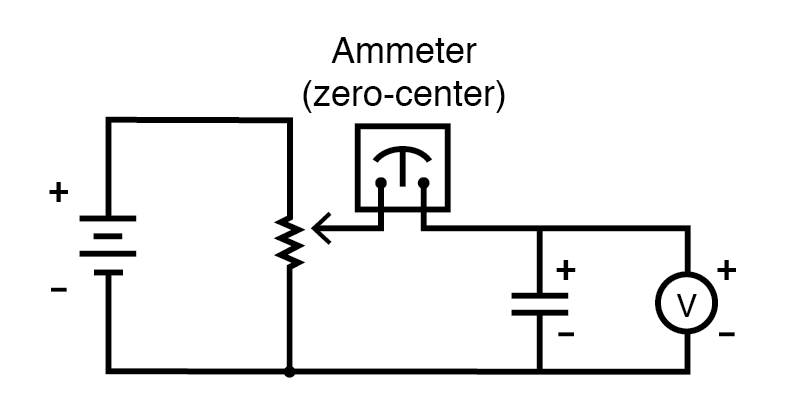
Unlike a resistor, where voltage, current, and resistance are independent of time, a capacitor’s current is directly tied to how quickly its voltage changes. Time becomes a critical variable. To illustrate this, consider a capacitor connected to a variable‑voltage source made with a potentiometer and a battery:
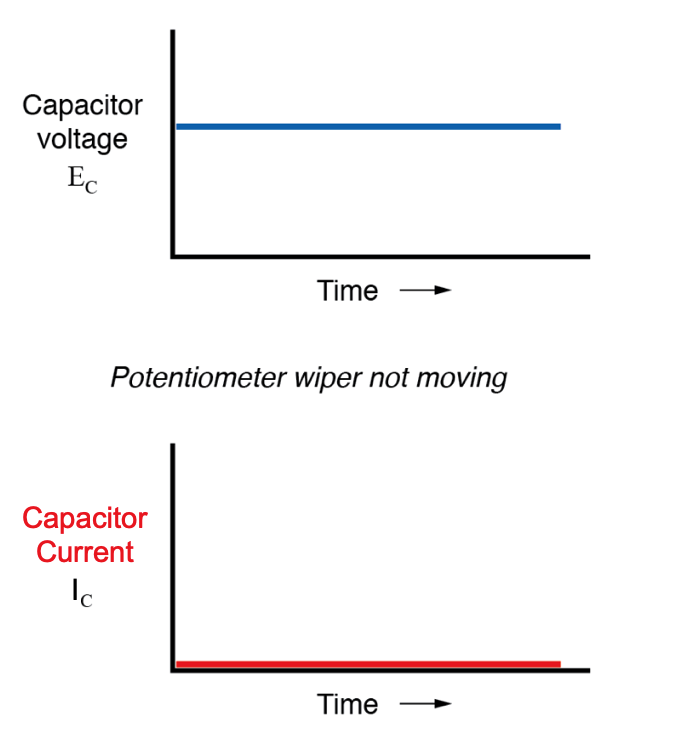
If the potentiometer’s wiper remains stationary, the voltmeter across the capacitor reads a constant value and the ammeter shows zero current. Here, dv/dt equals zero, so the equation predicts a zero instantaneous current – no electron flow is required when the voltage is steady.
When the wiper is moved slowly and steadily upward, the capacitor’s voltage rises gradually. The voltmeter indicates a slow increase, and assuming a constant rate of voltage increase (e.g., 2 V/s), dv/dt becomes a fixed value. Multiplying this by the capacitor’s capacitance yields a steady current that charges the capacitor. In this scenario, the capacitor behaves as a load, with current entering the positive plate and leaving the negative plate as energy accumulates in its electric field.
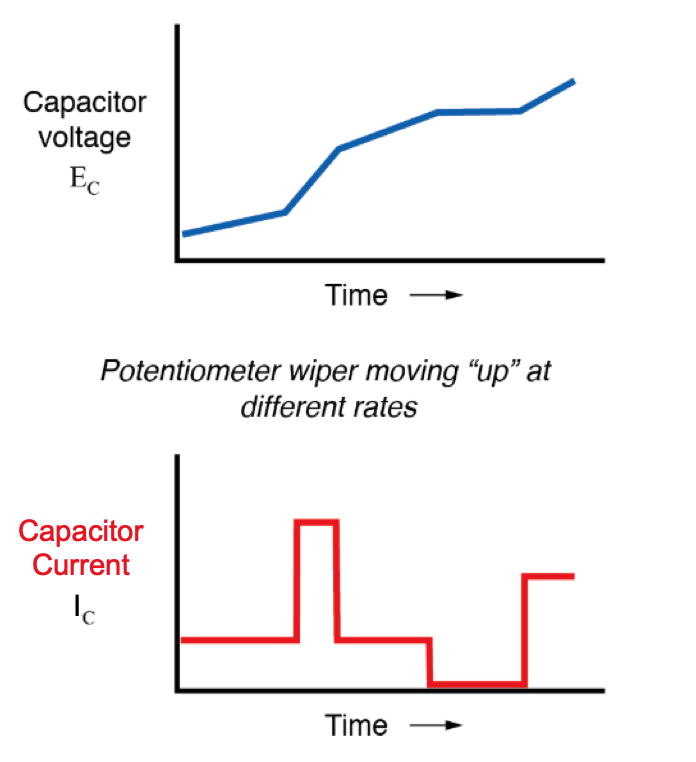
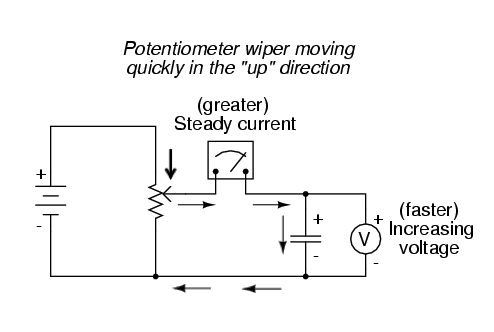
Moving the wiper at a faster rate increases dv/dt and, consequently, the current through the capacitor. The relationship remains linear: greater voltage change rates produce proportionally larger currents.
Calculus students first learn about rates of change. Here, the current through a capacitor is precisely the derivative of its voltage with respect to time:
\[\displaystyle i(t) = C\frac{dv(t)}{dt}\]
Thus, the capacitor’s current is directly proportional to how rapidly its voltage is changing. When the potentiometer’s wiper moves upward, the current follows the rate of that motion; when the wiper moves downward, the voltage decreases, the derivative becomes negative, and the current reverses direction, causing the capacitor to discharge.
Graphs of voltage versus time for different wiper speeds reveal that the current at any instant equals the slope of the voltage curve at that point. A steep slope corresponds to a large current; a gentle slope to a small current; and a flat segment (zero slope) to zero current.
In summary, a capacitor’s current is a direct, time‑dependent derivative of its voltage. The magnitude of the current depends solely on the rate of voltage change, while the direction depends on whether the voltage is rising or falling.
RELATED WORKSHEETS:
- Capacitors Worksheet
- Calculus for Electric Circuits Worksheet
Industrial Technology
- Understanding Voltage and Current: The Foundations of Electrical Flow
- Voltage and Current in a Practical Circuit: Understanding Their Relationship
- Ohm’s Law Explained: How Voltage, Current, and Resistance Interact in Electrical Circuits
- Understanding Insulator Breakdown Voltage and Dielectric Strength
- Understanding Series and Parallel Capacitors: How Capacitance Adds or Diminishes
- Inductors & Calculus: How Current Change Drives Voltage
- Understanding Capacitor and Inductor Transient Response in Series RC Circuits
- Calculating Voltage and Current in Reactive DC Circuits
- Advanced Analysis of DC Reactive Circuits with Non‑Zero Initial Conditions
- Understanding Mutual Inductance and Transformer Fundamentals