



Voltage and Current in a Practical Circuit: Understanding Their Relationship
In any circuit, energy is required to push charge against resistance. That energy manifests as a voltage drop between points separated by resistance.
In a simple series circuit the current—charge passing a point each second—is the same throughout, but the voltage between different pairs of points can differ markedly.
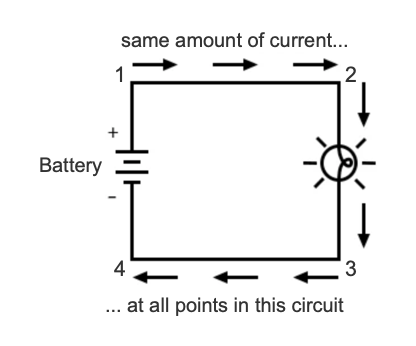
Consider the circuit below, labeling four nodes as 1, 2, 3, and 4. The current flowing from 1 to 2 equals the current through the lamp (2 to 3), and this same current continues through the wire from 3 to 4 and finally through the battery (1 to 4).
Because the current is uniform, the voltage between any two points is directly proportional to the total resistance of the path connecting them. In a typical lamp circuit, the lamp’s resistance far exceeds that of the connecting wires, so the voltage drop across the lamp (2–3) is substantial, while the drops across the wires (1–2 and 3–4) are minimal. The voltage between the battery terminals (1–4) equals the battery’s electromotive force, only slightly higher than the lamp’s voltage drop.
This relationship is analogous to a water‑reservoir system:
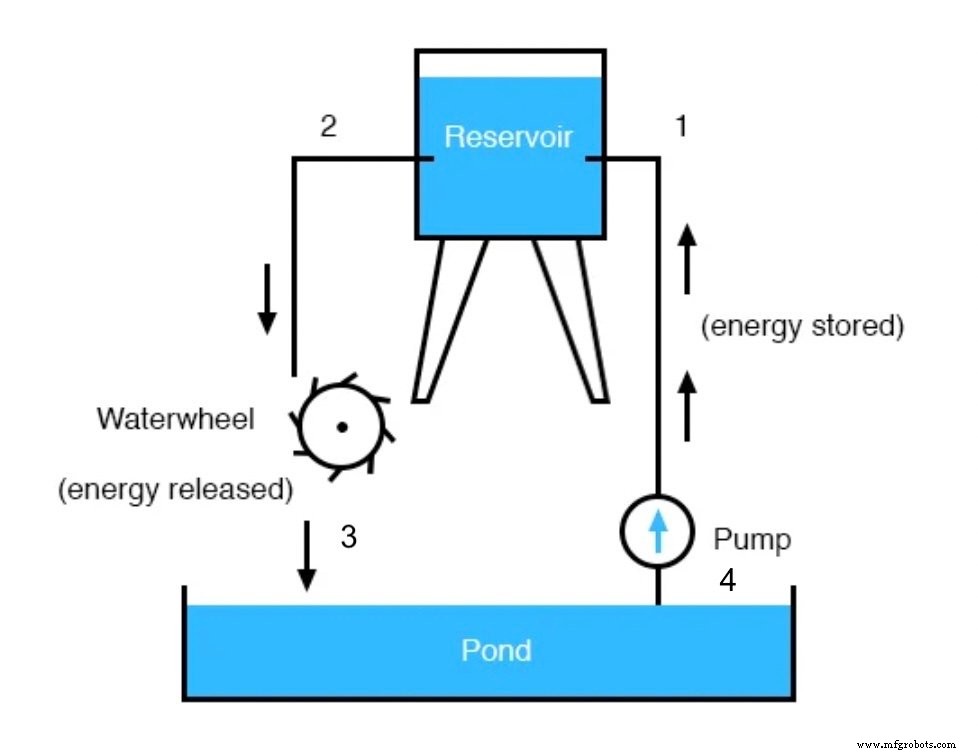
Water falling from point 2 to 3 through a water‑wheel experiences a pressure drop that mirrors the energy loss to the wheel’s resistance. Between points 1–2 and 3–4, where water flows freely through reservoirs, the pressure difference is negligible. Yet the flow rate remains constant throughout the system—just as current is constant throughout the electrical circuit.
In short, in simple series circuits the current is uniform everywhere, while the voltage varies depending on the resistance of each segment.
RELATED WORKSHEETS:
- Elementary Circuits Worksheet
Industrial Technology
- Essential DC Circuit Equations and Laws for Engineers
- Understanding Voltage and Current: The Foundations of Electrical Flow
- Wire Resistance in Circuits: Why Length & Shape Usually Don’t Matter
- Capacitors & Calculus: How Voltage Change Drives Current
- Calculating Voltage and Current in Reactive DC Circuits
- Advanced Analysis of DC Reactive Circuits with Non‑Zero Initial Conditions
- Understanding Mutual Inductance and Transformer Fundamentals
- Understanding Voltage‑Current Imbalance in Electric Motors: Causes and Troubleshooting
- Electronic Circuit Breaker: Design, Schematic, and Operation Explained
- High‑Performance Variable Voltage & Current Power Supply – Stable Output for Lab and Industrial Use