



Essential DC Circuit Equations and Laws for Engineers
Power Equation of Ohm’s Law and Joule’s Law
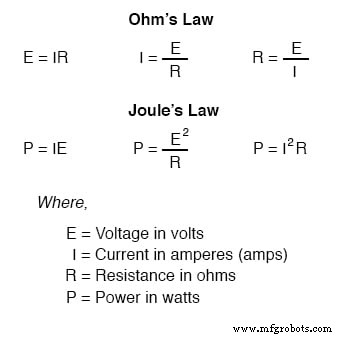
Note: The symbol V (often U in Europe) is frequently used to denote voltage instead of E. In many texts, designers use V exclusively for voltage, while E may represent the source voltage and V the voltage drop across a load. The symbols can also be interchanged, depending on context.
Kirchhoff’s Voltage and Current Laws
The algebraic sum of all voltages around any closed loop must equal zero.
— Kirchhoff’s Voltage Law (KVL)
The algebraic sum of currents entering and leaving a node must equal zero.
— Kirchhoff’s Current Law (KCL)
These laws underpin the analysis of any DC network, ensuring energy conservation and current continuity.
Related Worksheets:
- Ohm’s Law Worksheet
- Ohm’s Law Practice Worksheet With Answers
- Parallel DC Circuits Practice Worksheet With Answers
- Energy, Work, and Power Worksheet
- Algebraic Substitution for Electric Circuits Worksheet
CMOS 555 Long‑Duration Red LED Flasher – Precision Driver Circuit for Reliable Performance
Key Rules for Series Circuits: Current, Resistance, and Voltage
Industrial Technology
- Voltage Follower Amplifier: Design, Build, and Measurement Guide
- Build a Low‑Frequency Astable Multivibrator Audio Oscillator with Discrete Transistors
- Mastering AC Circuit Equations: Impedance, Reactance & Resonance
- Passive Averager and Op‑Amp Summer Circuits: From Averaging to Addition
- Voltage and Current in a Practical Circuit: Understanding Their Relationship
- Mastering Series RLC Circuit Analysis: From Impedance to KVL
- Analyzing Circuit Response to Multi‑Frequency Sources
- Efficient 12V to 5V Buck Converter Circuit Design
- Electronic Circuit Breaker: Design, Schematic, and Operation Explained
- Understanding LDO Circuits: Principles, Design Tips & Applications