



Understanding Series and Parallel Capacitors: How Capacitance Adds or Diminishes
When capacitors are wired in series, the resulting equivalent capacitance is always smaller than the capacitance of any single component in the chain. This happens because the total distance between the effective plates increases—each capacitor adds its own plate spacing to the overall gap. With all other factors held constant, a larger plate separation reduces capacitance.
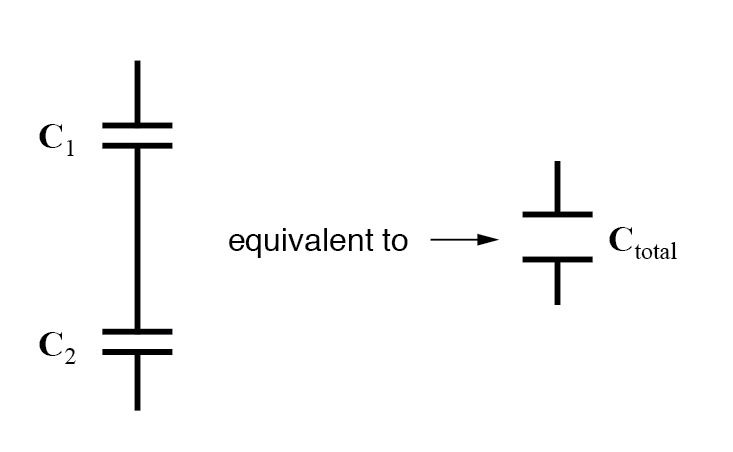
Mathematically, the series capacitance follows the same rule as series resistances, but inverted:
\(\displaystyle \frac{1}{C_{\text{eq}}}=\frac{1}{C_1}+\frac{1}{C_2}+\dots+\frac{1}{C_n}\)This formula ensures that the combined capacitance is always less than the smallest individual capacitor.
In contrast, when capacitors are connected in parallel, the equivalent capacitance is the simple sum of the individual values. Parallel connection effectively stacks the plate areas, increasing the total surface that can store charge. All else equal, a larger plate area yields a higher capacitance.
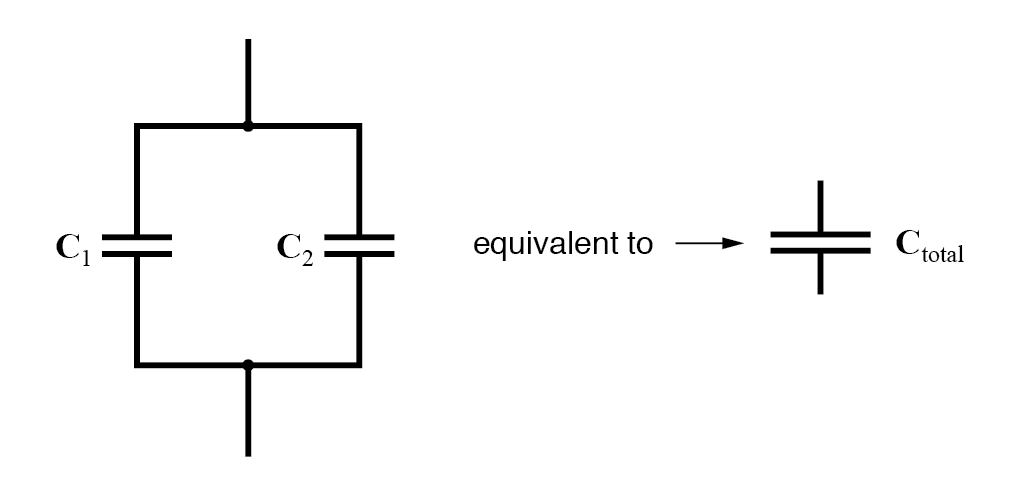
The parallel capacitance formula mirrors that of parallel resistances:
\(C_{\text{eq}}=C_1+C_2+\dots+C_n\)Thus, the total capacitance in parallel always exceeds any single component’s capacitance.
It’s important to remember that capacitors behave opposite to resistors: series adds resistance but decreases capacitance, while parallel reduces resistance but increases capacitance.
Quick Review
- Capacitance diminishes when capacitors are in series.
- Capacitance increases when capacitors are in parallel.
Industrial Technology
- Series and Parallel Component Calculations – Resistances, Inductances, Capacitances
- Understanding Series and Parallel Circuits: How They Work and Why They Matter
- Understanding Series-Parallel Circuits: How They Work & Why They Matter
- Capacitors & Calculus: How Voltage Change Drives Current
- Series vs. Parallel Inductors: How Inductance Adds or Diminishes
- Mastering Series RLC Circuit Analysis: From Impedance to KVL
- Analyzing a Parallel R‑L‑C Circuit: Impedance, Current, and SPICE Simulation
- New E3.series Course Bundles & Download – Affordable Training for Engineers
- Choosing the Right Battery Connection: Series, Parallel, and Series‑Parallel Configurations
- Which Bulb Glows Brighter: Series vs Parallel? Understand the Physics & Why It Happens