



Series and Parallel Component Calculations – Resistances, Inductances, Capacitances
Series and Parallel Resistances
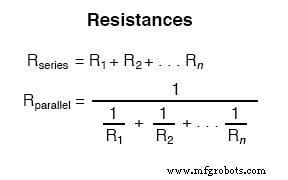
When resistors are connected end‑to‑end, the total resistance is the arithmetic sum:
Series: Req = R1 + R2 + … + Rn
In a parallel arrangement, each resistor shares the same two nodes, reducing the overall resistance. The reciprocal of the equivalent resistance equals the sum of the reciprocals of the individual resistances:
Parallel: 1/Req = 1/R1 + 1/R2 + … + 1/Rn ⇒ Req = 1 / (1/R1 + 1/R2 + … + 1/Rn)
Series and Parallel Inductances
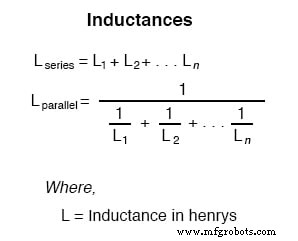
Inductors behave like resistors with respect to magnetic flux linkage. In series, the magnetic fields add:
Series: Leq = L1 + L2 + … + Ln
In parallel, the net inductance is less than any single inductor because the magnetic flux is shared:
Parallel: 1/Leq = 1/L1 + 1/L2 + … + 1/Ln ⇒ Leq = 1 / (1/L1 + 1/L2 + … + 1/Ln)
Series and Parallel Capacitances
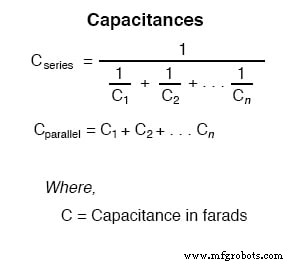
Capacitors store electric charge. When connected in series, the total capacitance decreases because the effective plate area is reduced:
Series: 1/Ceq = 1/C1 + 1/C2 + … + 1/Cn ⇒ Ceq = 1 / (1/C1 + 1/C2 + … + 1/Cn)
In parallel, the total capacitance is simply the sum of individual capacitances, increasing the stored charge capacity:
Parallel: Ceq = C1 + C2 + … + Cn
RELATED WORKSHEETS:
- Series-Parallel DC Circuits Worksheet
- Series and Parallel AC Circuits Worksheet
- Series-Parallel Combination AC Circuits Worksheet
Industrial Technology
- Understanding Series and Parallel Circuits: How They Work and Why They Matter
- Understanding Series-Parallel Circuits: How They Work & Why They Matter
- Understanding Series and Parallel Capacitors: How Capacitance Adds or Diminishes
- Series vs. Parallel Inductors: How Inductance Adds or Diminishes
- Calculating Voltage and Current in Reactive DC Circuits
- Mastering Series RLC Circuit Analysis: From Impedance to KVL
- Analyzing a Parallel R‑L‑C Circuit: Impedance, Current, and SPICE Simulation
- New E3.series Course Bundles & Download – Affordable Training for Engineers
- Choosing the Right Battery Connection: Series, Parallel, and Series‑Parallel Configurations
- Which Bulb Glows Brighter: Series vs Parallel? Understand the Physics & Why It Happens