



Accurate Capacitor Sizing: Practical Capacitance Equation
Capacitance Formula
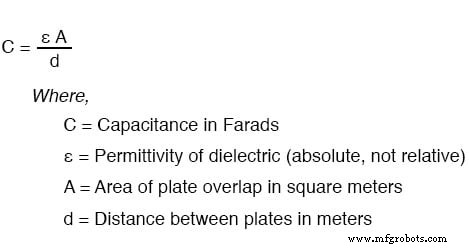
The capacitance of a parallel‑plate capacitor is calculated with the well‑known relationship:
Permittivity of Dielectric
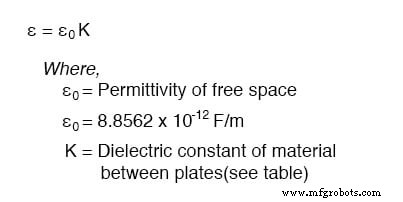
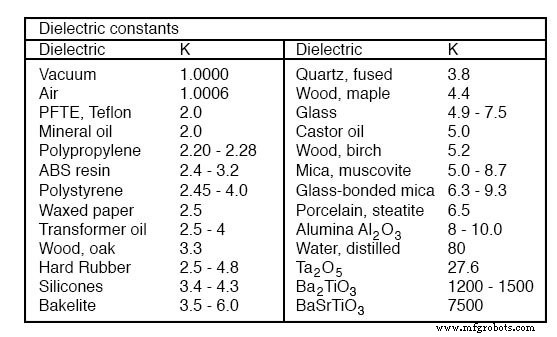
Dielectric permittivity (εr) is a material property that determines how much charge a capacitor can store at a given voltage. It scales the capacitance linearly and is crucial for accurate sizing.
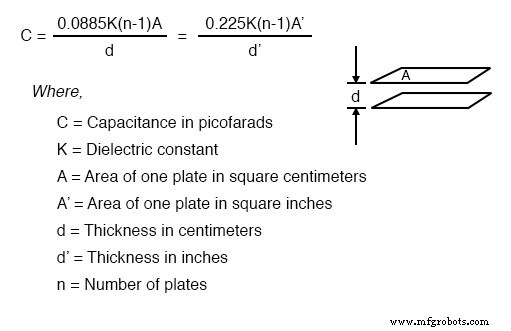
Using the practical dimensions of the plates, the following expression gives capacitance directly in picofarads (pF):
RELATED WORKSHEETS:
Series and Parallel Component Calculations – Resistances, Inductances, Capacitances
Precision Inductor Sizing: Wheeler’s Air‑Core & PCB Inductance Formulas
Industrial Technology
- Precision Inductor Sizing: Wheeler’s Air‑Core & PCB Inductance Formulas
- The Quadratic Formula: A Reliable Tool for Solving Second‑Degree Equations
- Differential Equations: Solving for Functions, Not Numbers
- Capacitor Types: Polarized, Non-Polarized, and Variable Explained
- Peak Detector: How It Works and Practical Applications
- How Plate Area, Spacing, and Dielectric Material Determine Capacitance
- Understanding Capacitor Transient Response: Charging Dynamics, Asymptotic Behavior, and SPICE Simulation
- AC Capacitor Circuits: Capacitive Reactance, Phase Shift, and Power Behavior
- Why Capacitors Beat Inductors: Lower Loss, Compact Size, and Superior Isolation
- Measuring Capacitance with a Digital Multimeter: A Practical Guide