



Precision Inductor Sizing: Wheeler’s Air‑Core & PCB Inductance Formulas
Inductance Fundamentals
The following image illustrates the core concepts behind Wheeler’s inductance equations.
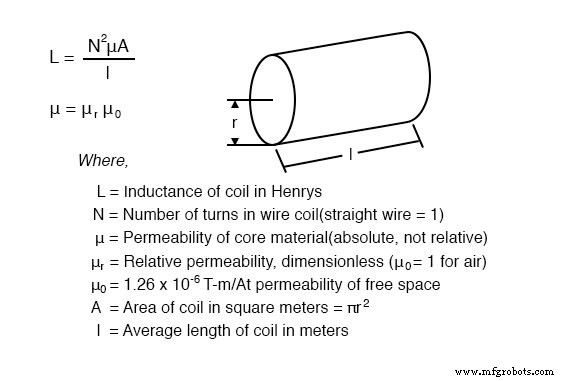
Wheeler’s formulas are the industry standard for estimating the inductance of air‑core coils, especially at radio frequencies. They provide reliable results with an accuracy of about 1 % when the geometric conditions are met.
Air‑Core Solenoid Formula
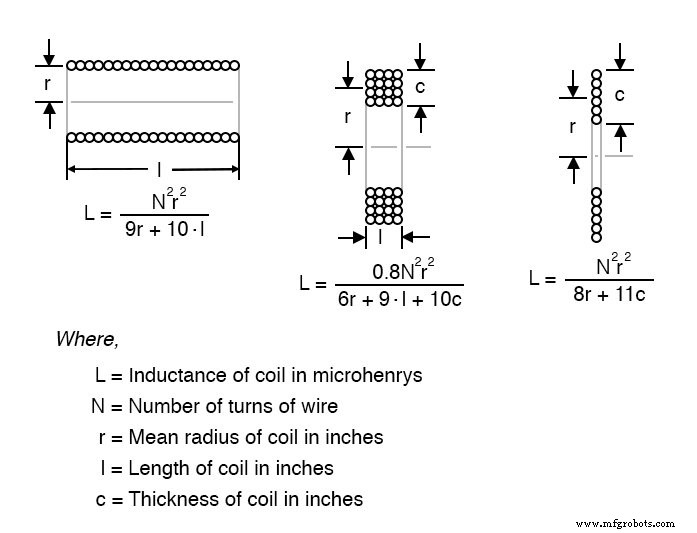
For a single‑layer, air‑core solenoid where the ratio 2r/l is less than 3, the following expression yields the inductance within 1 % of the measured value.
The "thick coil" variant maintains this level of precision when the denominator terms in the equation are nearly equal.
Wheeler’s Spiral Formula
Applicable when the spacing c exceeds 0.2 r, this formula delivers 1 % accuracy. Although derived for round wire, it can be used for printed‑circuit spiral inductors with a modest reduction in precision.
Square PCB Inductor Equations
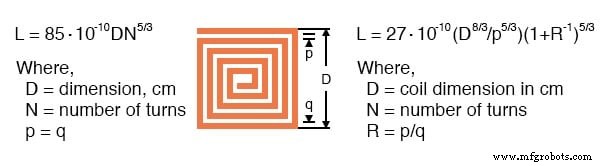
The inductance of a square printed‑circuit inductor is calculated using two distinct formulas, depending on whether the side lengths are equal (p = q) or unequal (p ≠ q).
Wire Gauge Reference
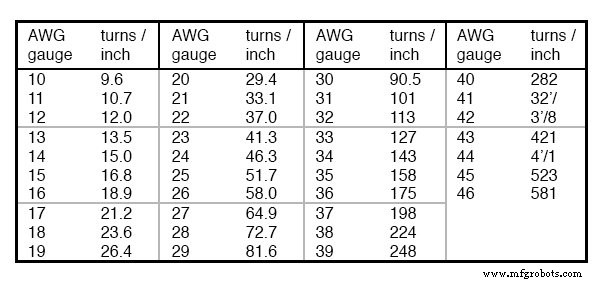
The accompanying wire table lists the "turns per inch" values for enamel magnet wire, enabling accurate application of the above formulas.
Related Resources
- Inductance Worksheet
Industrial Technology
- Variable Inductor Lab: Exploring Magnetic Permeability and Inductive Reactance
- Accurate Capacitor Sizing: Practical Capacitance Equation
- The Quadratic Formula: A Reliable Tool for Solving Second‑Degree Equations
- Differential Equations: Solving for Functions, Not Numbers
- Inductors Explained: Types, Functions, and Applications
- Understanding Mutual Inductance and Transformers: Principles, Applications, and Key Concepts
- Key Factors Determining Inductance in Coil Design
- Understanding AC Inductor Circuits: Reactance, Phase Shift, and Power Dynamics
- Real‑World Inductor Behavior: Skin Effect, Losses, and the Q Factor
- In‑Circuit Inductor & Transformer Testing for Switch‑Mode Power Supplies